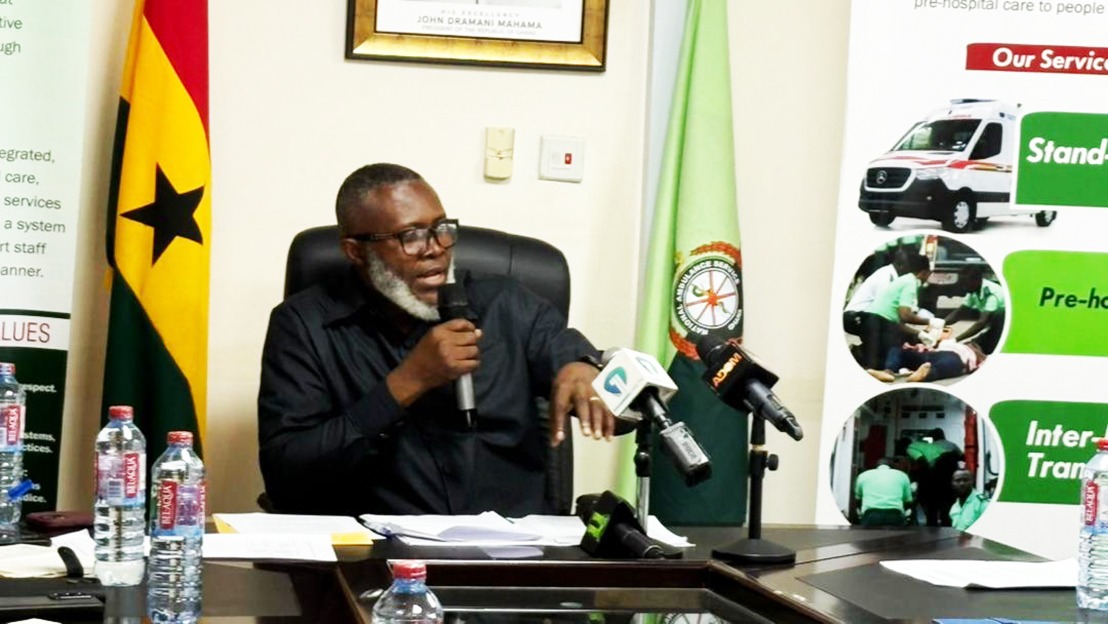
The Executive Director of the National Ambulance Service (NAS), Dr. George Kojo Owusu, has firmly dismissed claims that the Service is in crisis, insisting that while operational challenges exist, decisive interventions are underway to strengthen and modernise emergency medical services across the country.
Addressing members of the media at a press briefing, Dr. George Owusu stated that recent public commentary and heightened scrutiny of the Service had necessitated a clarification of facts.
“The National Ambulance Service exists for one single purpose – to save lives,” he stressed, adding that despite challenges, emergency medical technicians (EMTs) continue to respond daily to emergencies across the length and breadth of Ghana, without discrimination.
He cautioned against what he described as politically coloured narratives capable of undermining public confidence in a life-saving national institution.
Fleet Challenges and Restoration Efforts
The Executive Director of the National Ambulance Service disclosed that upon assumption of office by the new administration, management encountered significant operational setbacks within the ambulance fleet.
A considerable number of ambulances were grounded due to the absence of essential spare parts, despite substantial public resources previously spent on components he described as largely non-essential.
With increased financial support from the Ministry of Health and assistance from metropolitan, municipal and district assemblies, as well as some Members of Parliament, several non-operational vehicles have since been restored and returned to active service.
Insurance Cover Restored
Another major issue inherited, he revealed, was the absence of insurance coverage for ambulances nationwide. By the end of 2024, the entire fleet had reportedly remained uninsured for nearly a year.
Dr. George Owusu announced that management has rectified the situation, stating that all 390 operational ambulances were successfully insured after December 31, 2025 following engagements with the State Insurance Company and the Ministry of Health.
The move, he said, restores compliance and protects national assets, personnel and patients in transit.
Sustainable Funding Measures
On funding, the Executive Director acknowledged that irregular financial releases had previously hampered operations and fleet maintenance. However, government interventions have introduced key reforms, including:
- Capturing National Ambulance operations as a distinct budget line within the national health budget.
- Plans to integrate pre-hospital emergency services into the National Health Insurance Scheme.
- Assurances from the Ministry of Finance for timely fund releases.
- Increased health insurance allocations to enhance operational flexibility.
He described these measures as a major shift toward long-term sustainability.
Management has also turned its attention to 30 ambulances abandoned at Burmacamp since 2016. Engagements are ongoing with the Attorney General’s Department to resolve legal issues surrounding the vehicles. Once cleared, the ambulances will be reconditioned and deployed to improve national coverage.
Modernisation Drive
As part of efforts to modernise operations, the Service is developing an in-house fleet management software system scheduled for launch in May 2026. The system will enable real-time monitoring, preventive maintenance planning and improved deployment efficiency.
To further strengthen capacity, government has initiated plans to introduce 400 new ambulances across various categories, including Basic Life Support, Advanced Life Support, Critical Care, Pediatric and ICU ambulances.
Additionally, 500 medical motorbikes will be deployed under a Rapid Motor Unit initiative aimed at reducing response times, particularly in congested urban centres. The motorbikes will lead during emergencies, allowing ambulances to follow swiftly.
Three oxygen plants are also expected to be established in the northern, middle and southern zones to ensure consistent medical oxygen supply.
Fuel Support and Governance Reforms
Addressing operational constraints, Dr. Owusu announced increased fuel support through the security services margin facilitated by the National Petroleum Authority’s Blue Card system. He assured that strict internal controls have been instituted to prevent abuse.
In line with the Health Institutions and Facilities Act, 2011 (Act 829), the Minister for Health has directed the establishment of an Ambulance Council to regulate standards, training, licensing and operations of EMTs, paramedics and ambulance service providers, including private operators.
Dr. Owusu concluded that while challenges remain, the National Ambulance Service is operational, committed and focused on its mandate.
“It is important that public discourse remains responsible and grounded in facts,” he noted, assuring Ghanaians that management will continue working tirelessly to expand capacity, improve response times and strengthen emergency medical services nationwide.