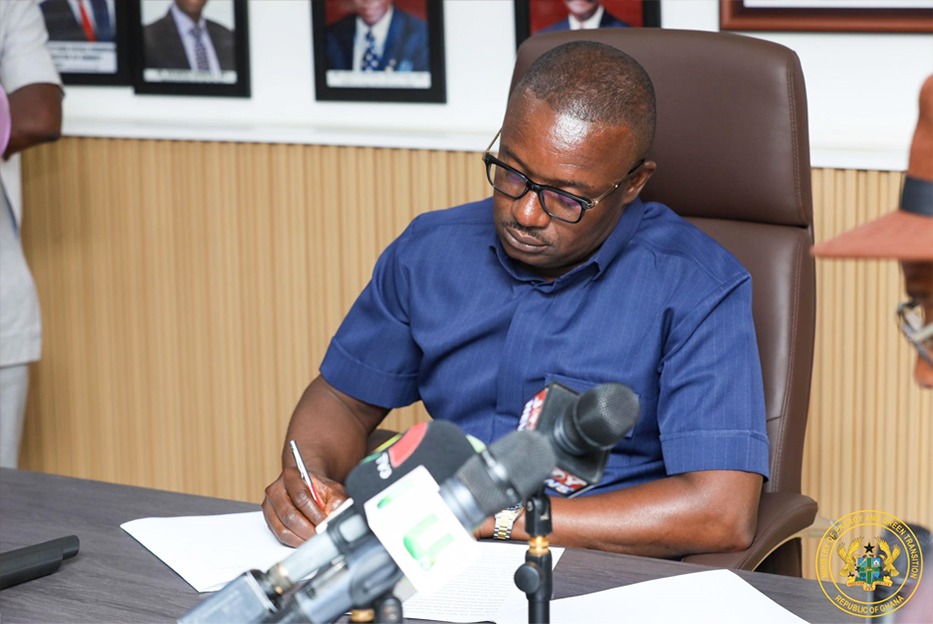
Mr John Jinapor, the Minister for Energy and Green Transition, has told Vice President Naana Jane Opuku Agyemang that the sector was in crisis when the John Mahama-led government assumed office, with load shedding reaching a deficit of about 700 megawatts and sector debt exceeding US$3 billion.
“From January to December 2024, every month there was load shedding,” he said, adding that fuel shortages and mounting debts had brought the sector “to its knees.”
Mr John Jinapor, who was briefing the Vice President during her familiarisation visit to the ministry yesterday, said reforms introduced by his ministry, including the cancellation of more than 200 ECG contracts after value-for-money audits, renegotiation of IPP contracts saving about US$250 million, and strict enforcement of the cash waterfall mechanism, had reduced sector debt by about US$500 million.
He noted that Ghana had enjoyed about 10 months of uninterrupted power supply, attributing the stability to increased gas utilisation and reduced reliance on costly liquid fuels.
“In about 10 months now, we have not had a single day of load shedding,” the Minister said.
The Minister touched on renewed investor confidence in the petroleum and gas sectors, increased gas supply from domestic fields and Nigeria, and plans for a second gas processing plant.
He said fuel prices had dropped significantly from about GH¢23.00 per litre to around GH¢9.00 while outlining green transition initiatives, including solar-powered irrigation, nationwide solar streetlights and solar-backed charging stations for electric vehicles.
Professor Naana Jane Opoku-Agyemang, on her part, called for long-term planning, regular policy reviews and stronger inter-sectoral collaboration to effectively tackle Ghana’s development challenges, particularly in the energy sector.
Prof Opoku-Agyemang commended the ministry and its agencies for stabilising the energy sector, despite what she described as a difficult inheritance characterised by heavy debt and looming power shortages.
“We are in this together,” she said, assuring the ministry of the government’s full support. We are here to congratulate you, encourage you and let you know that we have your back, not only in the successes, but even in the challenges.”
The Vice President emphasised that sustainable development required solid planning rather than rhetoric, urging policymakers to remain open to evaluation, review and re-strategising when circumstances changed.
“There’s nothing like a plan that cannot be looked at again. Things can change and they should change for the better,” she said.
She also underscored the need to diversify the energy mix, particularly through renewable sources such as solar and raised concerns about domestic cooking gas, suggesting alternatives such as piped gas to households.
Linking energy stability to agriculture, the Vice President noted that Ghana should reduce its reliance on food imports as the country was blessed with favourable climate.
The Vice President was accompanied by senior officials from her office, including Mr Alex Segbefia, Chief of Staff; Dr Hamza Zakaria, Economic Advisor and Prof Theresah Ennin, Presidential Staffer and Special Aide.
The others were Ms Mansa Amoa Awuah, Policy Adviser (Finance); Chief Musa, Political Advisor and Ms Amma Pratt, Spokesperson.
GNA