Religion has overtaken ideology as the chief fuel driving contemporary terrorism, transforming conflicts across the Middle East and Africa into battles waged as much through belief systems as through weaponry.

This was the resounding message at the Centre for Policy Scrutiny’s (CPS) high-level programme titled “Fighting Terrorism in the Middle East and Africa,” which convened leading academics, diplomats, security experts and governance specialists.
At the heart of the discussions were the compelling presentations delivered by Dr Vladimir Antwi-Danso and Ambassador Roey Gilad, whose analysis drew a direct line between the escalating religious character of terrorism and the rising instability in both regions.
Antwi-Danso: Terrorism Has Shifted from Ideology to Faith
In an unflinching assessment, Renowned Security Analyst and International Relations Expert, Dr Vladimir Antwi-Danso, declared that terrorism had undergone a radical transformation.
According to him, extremists today operate with a religious fervour that has overtaken the ideological motivations that dominated past decades.

“The canvas for terrorism now is becoming more religious. The ideological nature of terrorism is dying,” he said, stressing that the new wave of terror leans heavily on manipulated interpretations of faith. He noted that religion has become the easiest instrument to weaponise because of its emotional and spiritual pull, recalling Marx’s portrayal of religion as “the opium of the people” and Kierkegaard’s view of it as a form of human submission that extremists can exploit.
To illustrate this, he recounted disturbing intercepted messages from terrorist recruiters who assured young Africans that killing “infidels” particularly French or American citizens guaranteed an immediate ascension to heaven and the reward of “seven virgins.” This, he argued, demonstrates how propaganda rooted in religious manipulation is actively drawing vulnerable youth into extremist networks.
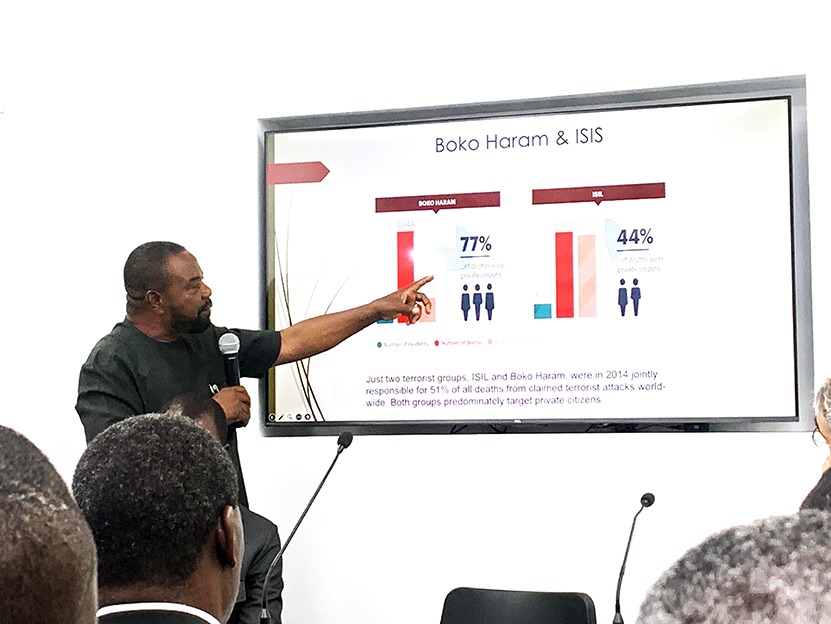
Dr. Antwi-Danso also presented stark United Nations statistics showing that the Sahel region now accounts for 56 percent of all global terrorist activities. He explained that this concentration of violence did not occur overnight, but is the result of a chain of unresolved conflicts and geopolitical shifts.
He traced the crisis to the collapse of Muammar Gaddafi’s regime in 2011, which scattered heavily armed fighters into the Sahel. The subsequent dismantling of ISIS strongholds in the Middle East triggered another wave of militants migrating into West Africa, where they joined or formed alliances with al-Qaeda affiliates and other extremist networks.
According to him, the Sahel has thus morphed into an “arc of instability,” stretching from Western Sahara to Somalia. This vast belt of unsecured land, porous borders and unresolved ethnic tensions has provided extremist groups both shelter and opportunities for expansion.
He emphasised that 70 percent of all terrorist attacks in Africa now take place in the West African Sahel alone, a figure that underscores the gravity of the security crisis.
Dr. Antwi-Danso warned that similar vulnerabilities exist in parts of West Africa where ethnic disputes such as those involving Kussasi, Mamprussi, Fulani and Moshi communities could be exploited in the same manner that internal conflicts in Mali allowed al-Qaeda in the Islamic Maghreb to establish a foothold.
“Terror thrives where there is insecurity,” he cautioned, urging African governments to address unresolved historical grievances that continue to fuel radicalisation.
The Sahel: The New Global Ground Zero for Terror
Dr. Antwi-Danso delivered his most sobering warning when he turned to West Africa. He described the Sahel as the beating heart of Africa’s belt of instability, a vast corridor where terrorist groups now multiply and metastasis.
According to him, jihadist networks have seized upon unresolved historical grievances, weak governance, and extensive ungoverned spaces to push a sophisticated politico-religious agenda.
Citing the Global Terrorism Index 2023, he noted that the Sahel is now the world’s epicentre of terrorism, recording more terrorism-related deaths in 2022 than South Asia and the Middle East and North Africa combined.
Between 2012 and 2019, 70 percent of all terrorist attacks in Africa occurred in the Sahel regions of West Africa— a statistic he described as “catastrophic and telling.”
He explained that the Sahel stretches between the Sahara Desert and the savannah, cutting across ten countries: Burkina Faso, Cameroon, Chad, The Gambia, Guinea, Mali, Mauritania, Niger, Nigeria and Senegal.

Governments in at least Burkina Faso, Chad, Mali, Mauritania and Niger now struggle to control enormous expanses of territory areas historically used as trans-Saharan trade routes, and now exploited by arms traffickers, bandits and extremist groups.
“The Sahel has become synonymous with instability,” he said, warning that the concentration of multiple terrorist organisations in the region has turned it into the most insecure terrain in Africa.
Force Alone Will Never Win
As he moved through his slides, Dr. Antwi-Danso argued firmly that the traditional approach of responding to terrorism purely with military force in what he called the ‘kinetic approach’ has proven ineffective globally.
He noted that although countries like Israel possess strong military capabilities, no nation has succeeded in permanently defeating jihadist movements by force alone because extremist ideologies resurface repeatedly.
“In every case, if you disarm terrorists today, they re-emerge in another form tomorrow,” he warned. He compared this resurgence to a “virus of lethality” embedded in the minds of radicalised individuals, which cannot be eradicated through weapons alone.
He insisted that any meaningful counterterrorism strategy must be paired with sustained efforts to reshape the ideological and psychological motivations that drive extremism.
Ambassador Roey Gilad: “Our Conflict Is Not With Islam
His Excellency Roey Gilad, Ambassador of the State of Israel to Ghana, Liberia and Sierra Leone, offered a diplomatic and historical perspective that sought to correct widespread misconceptions about Israel’s protracted conflict with militant groups.
He stated unequivocally that the Israeli–Palestinian conflict is not, at its core, a religious war, emphasising that Israel maintains excellent relations with many Muslim-majority nations.
“People misunderstand and think our conflict with some Palestinians is a religious one. That’s not true. Our conflict is with one radical translation or understanding of Islam,” he said.
Demonstrating his personal familiarity with Islamic tradition, he read Arabic and the Quran and explained that Islam and Judaism share many of the same prophets, reflecting a common ancestry. However, he argued that radical offshoots such as Hamas, Palestine Islamic Jihad, Hezbollah and the Houthis (Ansar Allah) have distorted religious teachings to justify violence and destabilise the region.

Following the October incursion from Palestine, he said Israel has significantly upgraded its intelligence-gathering capabilities. But the ambassador also highlighted ongoing challenges, such as Israel’s limited geographical depth, the pressure of managing several conflict fronts simultaneously and the constraints he described as “limited oxygen” during prolonged engagements.
He stressed the importance of isolating terrorist groups from internal resources, including cutting off money laundering operations and weapons supply routes. He also noted the critical role of frameworks such as UN Security Council Resolution 1701 and the United Nations Interim Force in Lebanon (UNIFIL) in managing tensions and enforcing post-conflict arrangements in the region.
Ambassador Gilad summarised his position with a strategic warning: “Do not judge your enemy by his intentions but by his abilities.”
Oppong Nkrumah: Terror Is Becoming Normalised
Delivering the keynote as Guest of Honour, Hon. Kojo Oppong Nkrumah, MP and Ranking Member of Parliament’s Committee on Economy and Development, expressed deep concern that terrorism is gradually becoming normalised in West Africa.
He pointed out that the frequency and intensity of attacks reflected in the maps and timelines presented at the event have become so familiar that they no longer shock the region as they once did. According to him, this normalisation poses a significant threat as it dulls the urgency required to respond decisively.
He highlighted three key challenges facing the sub-region: first, the growing acceptance of terrorism as part of daily reality; second, the regression of both national and regional efforts to contain it; and third, the withdrawal of some states from initial collective security arrangements.
Oppong Nkrumah argued that ECOWAS must urgently design a comprehensive medium-term programme that combines kinetic military action where necessary with long-term community engagement strategies aimed at winning hearts and minds.
“We cannot continue to observe the numbers and simply hope it doesn’t get to us,” he warned adding “We must be proactive.”
CPS Reaffirms Its Mission: Security, Development and Peace
Earlier, Dr. Adu Owusu Sarkodie, Executive Director of CPS, welcomed participants by reaffirming the organisation’s role as a new-generation think tank focused on rigorous research and public policy advocacy across areas such as the economy, security, youth and sustainable development.
He stressed that CPS recognises the deep, often overlooked connection between national security and development. “Terrorism threatens the socio-economic development of every nation,” he said, adding that Africa must ground its growth policies in realities that acknowledge the destabilising effects of terror.
Dr. Sarkodie recalled CPS’s October 2025 statement in support of a just and lasting peace in Israel and the Middle East and affirmed that Africa has much to learn from the region’s lessons. He pledged the organisation’s commitment to deepening collaboration with the Israeli Embassy and Israeli think tanks to advance effective research and advocacy.
A Call for a New Battlefront
By the end of the CPS programme, a clear, unified message emerged: the next frontier in counterterrorism is not only on the battlefield, but in the minds of the vulnerable.
Whether in the Sahel or the Middle East, radical religious narratives are reshaping the landscape of global conflict. As Dr. Antwi-Danso emphasised, military action alone cannot break the cycle. And as Ambassador Gilad noted, the challenge is not with entire faiths but with those who manipulate them.
The question now is whether Africa and the Middle East can develop strategies bold enough, united enough and humane enough to confront both the weapons and the worldviews driving this new age of terror.
For more news, join The Chronicle Newspaper channel on WhatsApp: https://whatsapp.com/channel/0029VbBSs55E50UqNPvSOm2z