Home Blog Page 99

Medikal wins Best Hiplife Song with hit single ‘Shoulder’

0
Medikal

In a night defined by high-octane performances and historic wins, the 27th Telecel Ghana Music Awards (TGMA) reached a fever pitch on Saturday, May 9, as Medikal’s hit single ‘Shoulder’ was crowned the Best Hiplife Song of the Year.

The collaboration, which features the lyrical prowess of Medikal, the undeniable star power of Shatta Wale, and the breakout energy of Beeztrap KOTM, proved to be the ultimate fan favourite, cementing its status as the definitive hiplife anthem of the 2026/2027 calendar year.

The Best Hiplife Song category was one of the most competitive of the 27th edition, featuring a “who’s who” of Ghanaian rap and highlife royalty.

To secure the trophy, ‘Shoulder’ rose above ‘Tontonte’ by Ko-jo Cue feat. AratheJay & Ofori Amponsah, ‘Next Door’ by Kojo Blak ft. Sarkodie, ‘Messiah’ by Sarkodie ft. Kweku Flick and ‘Badness’ by Kwesi Amewuga.

The win was met with a thunderous ovation at the Grand Arena, as fans celebrated Medikal and the genre’s enduring relevance.

Credit: myjoyonline.com

Black Sherif’s ‘Where Dem Boys’ reigns supreme as Best Hiphop Song

0
Black Sherif

Black Sherif added another major accolade to his growing list of achievements after winning the Best Hiphop Song award at the 27th Telecel Ghana Music Awards held at the Grand Arena in Accra on Saturday, May 9.

The award-winning rapper and singer secured the honour with his gritty and emotionally charged track, Where Dem Boys, a song that resonated strongly with fans for its raw storytelling, street-inspired themes and commanding delivery.

The category was one of the night’s most competitive, featuring some of Ghana’s biggest rap records released within the year. Other nominees included songs from top acts across the country’s thriving hiphop scene, making Black Sherif’s victory a standout moment during the ceremony.

As his name was announced, cheers erupted across the auditorium, with fans and industry players applauding the artiste’s continued dominance and influence on contemporary Ghanaian music.

Where Dem Boys enjoyed massive commercial success in the year under review, earning strong streaming numbers, extensive radio rotation and widespread social media engagement. The track also sparked conversations among music lovers for blending introspective lyricism with hard-hitting hiphop production.

The win further cements Black Sherif’s position as one of Ghana’s leading music exports and one of the most influential voices of his generation. Over the past few years, the artiste has consistently crossed genre boundaries, combining hiphop, drill, highlife and afrobeats influences into a distinctive sound that has attracted audiences across Africa and beyond.

The 27th Telecel Ghana Music Awards celebrated outstanding achievements in Ghanaian music, bringing together artistes, producers, executives and fans for a night of performances, recognition and celebration of the industry’s growth.

Credit: myjoyonline.com

Australia’s right-wing party scores historic parliamentary win

0
One Nation leader Pauline Hanson and candidate David Farley celebrate the result

Australia’s One Nation party has won its first-ever lower-house seat in what is being seen as an important test for the right-wing populist party.

With most ballots counted, One Nation candidate David Farley has won a two-candidate preferred vote share of 57% in Farrer, a vast regional constituency in New South Wales. Independent candidate Michelle Milthorpe is far behind.

The contest was triggered by the resignation of Sussan Ley, who quit when she was ousted as leader of the opposition conservative Liberal Party.

While the result will not affect the Labor government’s large majority, it is a clear sign that voters are moving away from traditional political parties in Australia.

Saturday’s poll was the first federal test of One Nation’s support after the party recorded the second-highest number of votes out of any political party in the South Australian state election in March.

As news of the party’s victory emerged, One Nation leader Pauline Hanson told supporters this was not just a win for Farrer, but a win for Australia, and said the party was “coming after those other seats”.

Farley – whose background is in agribusiness – told supporters One Nation had “reached the end of its beginning, we’re going through the ceiling”.

“What are we doing tonight? We’re like a mason, with a chisel, and a hammer and we’re re-carving the letters into the Australian democracy.”

Australia has a preferential voting system where voters rank candidates from their most to least preferred. The final tally is calculated as a challenge between two candidates after preferences are distributed to ensure that the winner is supported by a majority.

Credit: bbc.com


Putin says he thinks Ukraine conflict ‘coming to an end’

0
Russian President Vladimir Putin

Russian President Vladimir Putin has said he thinks Russia’s conflict with Ukraine is coming to an end, addressing reporters after a scaled-back military parade in Moscow marking the Soviet victory in World War Two.

“I think that the matter is coming to an end,” he said, referring to the “special military operation” in Ukraine, while condemning Western support for the Kyiv government.

Russia’s annual parade lacked the usual display of tanks and missiles, due to security concerns as authorities feared Ukraine might target Red Square with drones.

A last-minute ceasefire between Moscow and Kyiv, brokered by US President Donald Trump, reduced the danger of any attack and the parade passed off without incident.

Putin’s comments came just hours after he used his Victory Day speech to justify the war.

In that speech he said Russia was fighting a “just” war and called Ukraine an “aggressive force” that was being “armed and supported by the whole bloc of Nato”.

Later, when asked at a news conference about the West helping Ukraine, Putin said: “They (West) promised assistance and then began fuelling a confrontation with Russia that continues to this day. I think that the matter is coming to an end, but it is a serious matter.” Russian forces seized Crimea and parts of eastern Ukraine in 2014, then launched a full-scale invasion of Ukraine in February 2022.

Putin said he would only meet Ukraine’s President Volodymyr Zelensky once a lasting peace deal was agreed to.

Credit: bbc.com

UK army parachutes onto remote island to help Briton with suspected hantavirus

0
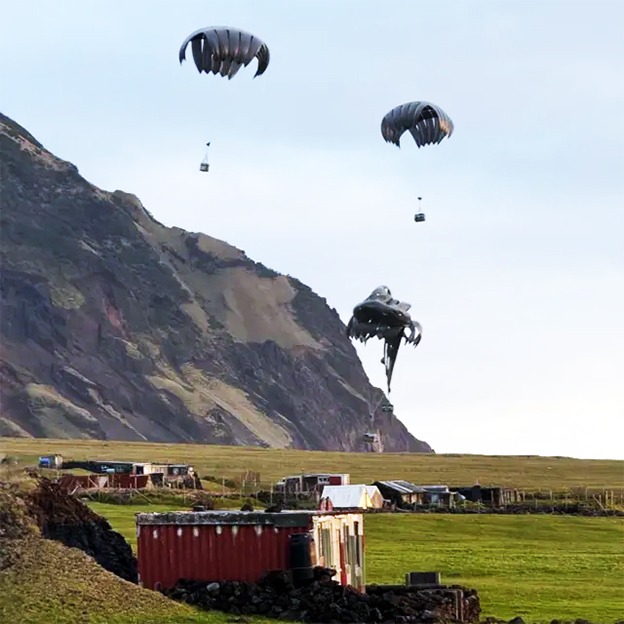
Medical supplies were dropped onto the remote island, which has no airstrip

British Army medics have parachuted onto the remote Atlantic island of Tristan da Cunha to help a British national with suspected hantavirus.

The man left MV Hondius, the cruise ship hit by a deadly outbreak of the virus, in mid-April at Britain’s most remote inhabited overseas territory, where he lives.

He first reported symptoms two weeks after leaving the vessel and is said be in a stable condition while isolating. Six cases of the virus have now been confirmed, including of two other Britons currently being treated off the ship.

Oxygen was also dropped from an RAF A400M on Saturday, with supplies at a “critical level” on the island, the Ministry of Defence (MoD) said.

Almost a month after the first death onboard the MV Hondius, the vessel has now arrived in Tenerife, where authorities are helping more than 100 people disembark to be repatriated.

Three people have died in the outbreak, including two who were confirmed to have had hantavirus.

Hantavirus is a group of viruses carried by rodents. Most hantaviruses do not pass from person to person, but the Andes strain, identified in a number of people who had been on the Dutch cruise ship, does.

The British man who lives on Tristan da Cunha disembarked on 14 April, the World Health Organization (WHO) said.

He reported having diarrhoea on 28 April and fever two days later. He is currently in a stable condition and is in isolation.

A team of six paratroopers and two medical clinicians from 16 Air Assault Brigade parachuted on to Tristan da Cunha – an archipelago in the South Atlantic Ocean considered to be among the world’s most remote islands – having flown from RAF Brize Norton.

Credit: bbc.com

Israel deports two activists detained on board Gaza flotilla

0
Saif Abu Keshek is one of two activists detained by Israel

Two pro-Palestinian activists who were detained in Israel after sailing on a flotilla carrying aid for Gaza have been deported.

Saif Abu Keshek and Thiago Ávila were taken to Israel after the Global Sumud Flotilla (GSF), made up of 22 boats and about 175 activists, was intercepted last week in international waters near Crete, hundreds of nautical miles from Gaza. All the other activists were taken to Crete and freed.

The rights group representing the two activists, Adalah, said their detention was unlawful and that Israel’s accusations against them were baseless.

Israel had said it suspected Abu Keshek of links with a terrorist group and Ávila of illegal activity – allegations they denied.

In a statement posted on X early on Sunday, Israel’s foreign ministry said authorities had completed their investigation and confirmed the two activists had been deported.

“Israel will not allow any breach of the lawful naval blockade on Gaza,” it said.

Hadeel Abu Salih, a lawyer for Adalah who co-represented the activists, said their detention “was a sham proceeding with no legal basis, intended to punish them for attempting to challenge Israel’s illegal blockade on Gaza”.

She said the pair’s transfer to Israeli custody was “a clear violation of international law” and that they had been subjected to ill-treatment while in custody. Israel’s foreign ministry denied that was the case.

During their week-long detention in the southern Israeli city of Ashkelon, Adalah claimed the two men had been subjected to “psychological abuse”, including prolonged interrogations, constant bright lighting in their cells, complete isolation, and transfers while blindfolded, even during medical examinations.

Credit: bbc.com

M-CODe National Leaders Engage World Vision WASH Expert to Revamp Advocacy Push

0
The leadership of M-CODe at World Vision Ghana office

In a renewed push to eliminate open defecation by 2030, the Media Coalition Against Open Defecation (M-CODe) has engaged World Vision Ghana’s Technical Specialist for Water, Sanitation and Hygiene (WASH), to help restructure the coalition and develop strategies to re-energise journalists as frontline advocates.

The high-level consultative meeting, held in Accra, was attended by M-CODe National Convenor, Mr. Francis Ameyibor; Patron Mr. Emmanuel Addai; Administrator Mr. Frank Ofosu Appiah; and National Secretary, Mrs. Benedicta Folly Gyesi. The delegation was received by World Vision Ghana WASH Technical Specialist, Mr. Yaw Atta Arhin.

The meeting focused on reversing the decline in media engagement on sanitation and charting a progressive, professional, and dynamic path forward for the coalition.

M-CODe revealed that Statistical data shows Ghana had made measurable gains, with open defecation rates dropping from 22% in 2010 to 11.7% in 2024.

However, progress has stalled in the Northern, Upper East and parts of the Greater Accra region where infrastructure gaps and behavioural norms persist.

M-CODe’s leadership presented a proposal titled – “Revitalising the Media Coalition Against Open Defecation (M-CODe) for Sustainable Change in Ghana. A Strategic Initiative to Amplify Advocacy, Influence Policy, and Accelerate Ghana’s Journey to an Open Defecation-Free Status by 2030” to World Vision.

Mr. Yaw Atta Arhin, speaking on behalf of World Vision Ghana, commended the leadership for the proactive initiative to revamp M-CODe and said the proposal would be favourably considered.

Mr. Ameyibor expressed concern that advocacy fatigue had set in and stressed the need for a purposeful reset that treats journalists as sustained partners in behaviour change, not just event reporters.

He recalled that M-CODe was established in September 2018 with support from World Vision Ghana and Kings Hall Media to harness the power of the media in advocating for improved sanitation.

Since then, the coalition has played a key role through its regional branches and national team in raising public awareness, holding duty-bearers accountable, and amplifying community voices.

Mr. Ameyibor said momentum had waned because of the inconsistent funding, limited advanced training for members, and shifting media priorities.

He noted that the advocacy relapse has created a vacuum, allowing open defecation to remain a low-priority issue for policymakers and the public alike, calling for enhanced World Vision Ghana support to change the narrative.

He reiterated that the revitalisation plan focuses on media advocacy, capacity strengthening, and high-level stakeholder engagement and aims to transform M-CODe from a passive network into a proactive advocacy force by building journalists’ skills in investigative reporting, advocacy, and digital storytelling across all 16 regions.

He said World Vision Ghana would be expected to play a key supporting role by providing technical, financial, and institutional support.

Mr. Emmanuel Addai, a patron of M-CODe on is part  added that the strategy also involved engaging traditional and political leaders to secure at least 35 concrete commitments and re-launching a targeted multi-platform campaign to reach 1.5 million Ghanaians directly.

The approach, he said, would trigger increased government investment, foster policy action, and create sustainable advocacy structures for long-term impact.

He said the plan also includes establishing a formal secretariat, clear membership criteria, and a performance charter for media houses.

He reaffirmed that Ghana stands at a critical juncture in its quest to achieve Open Defecation Free status by 2030 and said with strategic support, M-CODe could be revitalised into a powerful, sustainable advocacy force.

He disclosed that M-CODe invited World Vision Ghana to partner with them in the urgent and impactful initiative so that together, they could reignite the media’s power as a catalyst for change, ensuring that every Ghanaian could live with dignity, health, and safety.

Parliamentary Select-Committee urges MoF to grant permission for recruitment of more Forest Guards

0
Alhaji Collins Dauda, speaking with the media after the monitoring

The Parliamentary Select Committee on Lands and Natural Resources has urged the government, through the Ministry of Finance, to urgently grant financial clearance for the recruitment of additional forest guards to strengthen the protection of forest reserves and natural resources.

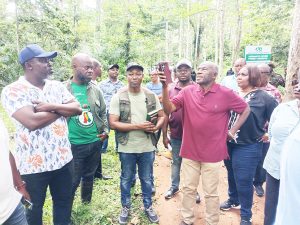
During a working visit to the Senanyayo Forest Reserve and Offin Shelter Belt Reserve, the Committee Chairman, Alhaji Collins Dauda, expressed concern over the persistent shortage of staff and logistics hampering the Forestry Commission’s effectiveness.

Mr. Dauda, who is also the Member of Parliament for Asutifi South, said the challenges facing the Commission are well known and require immediate action.

He noted that through the efforts of the Chief Executive Officer and management, 10 pilot forest protection camps have been established, with seven located in the Ashanti Region.

These camps, he said, are intended to house guards who would protect reserves from illegal chainsaw operators and illegal miners.

Alhaji Collins Dauda speaking with members of the committee and forestry officials at Asenanyo forest Reserves

He stated that one thing is clear – forests are renewable, but they require deliberate policies to be replenished the reason he commended  President John Dramani Mahama’s government for introducing the Tree for Life initiative, aimed at restoring forests across the country.

He stressed that current methods of protecting forests are not yielding the desired results and called for a change in approach.

According to him, the taskforce concept was currently not working because forest reserves of over 6,000 acres are being guarded by only six forest guards.

Mr. Dauda revealed that a request by the Forestry Commission to the Ministry of Finance for financial clearance to recruit more guards has remained unattended for a long time.

He appealed to the Ministry of Finance to act quickly and grant the clearance. He added that without enough personnel, “we cannot effectively fight illegal activities”.

The Acting Ashanti Regional Manager of the Forestry Commission, Mr Kwabena Adu Bonnah, said plantation establishment in degraded areas had been difficult because of illegal logging, chainsaw operations and mining.

He explained that the reintroduction of forest protection camps had improved security in some areas previously considered high-risk.

He revealed that the region needed an additional 205 staff to effectively manage its reserves and called for strategic deployment of personnel to curb illegal activities.

Mr. Kwasi Konadu, Member of Parliament for Manhyia North and Deputy Ranking Member on the Committee, said the government must prioritise the recruitment of forest guards.

According to him, when the numbers are adequate, patrols would improve and guards will be better able to ward off miscreants in the forest reserves.

The Committee reiterated the need for a national effort to protect existing forest reserves and restore degraded ones through initiatives such as Tree for Life and public-private partnerships.


Eye Exams in Your Baby’s First Year

0
Eye Exams in a Baby

Does your baby really need an eye exam in their first year? Absolutely.

The doctor should check their eyes at each visit that first year. If your baby is premature and born in less that 34 weeks, has a family history of cataracts, eye tumors, and other inherited diseases, a specialist should check them while they’re still in the hospital nursery.

At every routine doctor visit during the first year, your baby should be checked by their regular pediatrician to make sure:

If you catch and treat eye conditions early, you’ll spare your child lifelong vision issues and boost their overall health.

Why All the Follow-Ups?

The eye exam your baby had at birth is a great start — but it’s only a start. If they have problems, you’ll want to find them during the first year so treatment can start while their eyes are still developing.

Their vision will change as they grow. First, they’ll notice things that move. In their first full week of life, if they’re a full-term baby, they’ll be able to see facial expressions (like their parents’ happy smiles). It takes a little longer, but soon they’ll be able to spot colors and gain some depth perception. Their eye muscles will begin to work together.

As a parent, you know your child best. If you notice or suspect that their eyes turn in or out, or if the pupils appear white in photographs, call your doctor right away.

If they were premature, make sure your baby gets an eye exam before they come home. If you’re home now and not sure they had one, ask. If no exam took place, make an appointment with an eye doctor as soon as possible.

When Does Your Baby Need an Eye Exam ASAP?

During this first year, be on the lookout for signs of eye or vision problems:

  • Strabismus: Their eyes aren’t aligned and don’t move together.
  • Nystagmus: Their eyes seem to jump or wiggle around longer than after the first 3 months
  • Any eye injury or physical change that concerns you
  • Any sign that their sight isn’t developing properly

Who Does the Exams?

Your baby’s doctor (a pediatrician or family doctor) should include a basic eye exam and look for vision problems during each checkup in the first year. They can treat minor eye health problems like infections.

If there’s a problem, your baby should see an eye specialist. To find one:

  • Get a referral from their doctor.
  • Ask family members or friends to suggest one.
  • Check your health plan for a list of eye doctors in your area.

First-Year Eye Exams: What to Expect

Before you go, make a list of any questions you have. In case you’ll need to wait, bring a favorite toy or something else your baby can play with quietly. Bring a snack, too.

Every well-baby visit should include:

  • A family history of eye health or vision problems.
  • A penlight exam of eyelids and eyeballs: Are their pupils the same size? Are their eyelids firm, not droopy? Is there any sign of infection, disease, tearing problems, or allergy? Do their eyes, lids, and lashes appear normal?
  • Eye movement check (each eye and both together): How well does your baby follow an object (often a toy) as the doctor moves it about? Both eyes should respond the same. If not, there could be a problem.
  • Light reaction test: You’ll take your baby into a darkened room so their pupils can open up. That gives the doctor a better view inside their eyes. The doctor will use a tool to look for a red reflex in your baby’s eyes. They’ll check them one at a time and then together. An abnormal response could signal problems like cataracts or tumors.

Although most doctors know how to check babies’ and children’s eyes, yours may suggest your child get another exam, even if they don’t find vision problems. Experts have different opinions on vision screening for children. Ask your doctor what’s right for you.

Credit: webmd

Feature: Ghana’s fishers hold the knowledge, why are they not shaping policy?

0
Feature

Artisanal fishers in Ghana have since time immemorial relied on the ocean for their livelihoods, and to gain significant knowledge by observation and long-standing experience engaging with it.

Through their trade, artisanal fishers are able to read slight changes in ocean currents, watercolour, track bird movements and moon phases to predict fish availability and productive fishing grounds.

In some cases, too, they are simply able to forecast weather conditions just by observing the shoreline. However, this knowledge is mostly ignored in formal fisheries management policies.

As a result, Ghana’s fisheries continue to be bedevilled with mounting ecological and economic pressure which has been widely document academia and government documents.

Ghana’s fisheries, an industry drowning in crisis

Fish is a significant source of protein for many Ghanaian households and is vital in Ghana’s food security.

Sadly, Ghana’s small pelagic fishes are in deep crisis.

Key fish stock such as sardinella, often referred to as “the people’s fish”, because they are crucial for artisanal fisheries and food security have seen sharp decline in the past two decades.

Between 2007 and 2016, Ghana’s Ministry of Fisheries and Aquaculture Development (MoFAD recorded an up to 80 percent decline of sardinella landings with catches falling from over 120, 000 metric tons in the late 1990s to less than 20,000 metric tons in recent years. In 2018, Ghana’s small pelagic fishery was labelled as near collapse.

Causes

Several factors have been ascribed to this decline including overfishing, Illegal, Unreported, Unregulated fishing (IUU) practices, increased number of canoes coupled with low regulation enforcement and more recently climate change.

The challenges in Ghana’s fisheries sector have become a major concern for industry players including resource managers who continue to depend on limited empirical scientific data obtained through stock assessments.

The fishers themselves are equally concerned about the declining fish stocks.

This has prompted the Government of Ghana to introduce several measures including the closed fishing season, restraints on new canoes entrants to the marine artisanal fishery to reduce pressure on fish stocks.

In as much as these policies are important, my research suggests that they are deeply informed by scientific assessment, overlooking the valuable knowledge of fishers who are the resource users. For me, “this is a major mistake in how fisheries are governed in Ghana.”

Artisanal fishers are not just resource users, they hold valuable knowledge

Artisanal fishers have in-depth ecological knowledge that are extremely powerful and adapt to different socio-economic, ecological and technological changes.

This type of knowledge is deeply embedded in their daily relationship with local environmental conditions and their use of local aquatic resources.

My interviews with artisanal fishers across the cost of Ghana established that they boast of rich body of knowledge about seasons and the weather.

They explained how they are able to identify spawning periods. They are also able to track long-term changes in fish migration patterns.

Many of them also rely on natural indicators such as seabird movement, watercolour, fish movement, sea current and moon phases as well as rainstorm to determine fishing grounds.

In the words of one artisanal fisher, “sometimes putting my feet in the sand at the shore and observing the clouds, I could predict how the weather is going to be”.   One interesting thing I noticed in my research with artisanal fishers is that they can quickly adapt to changing environmental conditions and as well as technological advancement.

Historically, fishers’ ecological knowledge played a crucial role in fisheries conservation. Many Ghanaian fishing communities enforced traditional bans before the celebration of certain festivals and on specific days such as Tuesdays and embarked on seasonal closures to allow fish stocks to recover.

Certain water bodies were considered sacred and remained untouched due to cultural beliefs which indirectly served as protected areas that support fish breeding.

When “inclusion” becomes extraction

Globally, there is growing recognition that knowledge of artisanal fishers is crucial for fisheries management. Thus, calls for its integration into formal fisheries management. Key international agencies such as the Food and Agriculture Organization (FAO) and several academic studies point to the fact that their knowledge offers valuable data on fishing efforts and behaviour to enhance fisheries management. Yet, they remain sidelined in fisheries policies.

“Ghana is no exception. A recurring concern in my research was that fishers are asked to share their knowledge through stakeholder meetings and workshops, but they remain frustrated as they feel their involvement is more about ticking the boxes for the government and fulfilling formalities rather than having a genuine interest in their knowledge and by far making them reflect in governance frameworks”.

As one fisher lamented, “we are called to workshops and meetings, but most times, decisions have already been made. If our knowledge is truly valued, it would be used to guide policies rather than just being documented”. This does not connote to true collaboration but highlights a deeper issue where insights of fishers, irrespective of how valuable they are, only count when validated by science. This is what scholars call “epistemic injustice”, a situation where other forms of knowledge are less valued simply due to who produces them.

Not lack of data, but lack of trust

“In fisheries management, people generally assume that having better data set will ultimately lead to better decision-making outcomes. What we can learn from Ghana’s situation is that the issue is not lack of knowledge, but the real problem has to do with governance.”

Artisanal fisher possesses valuable knowledge relating to fish spawn, season shift and other factors affecting fish stock decline.

“My research has established that there exist structural barriers that hinder effective collaboration. These barriers include centralized top-down decision making that limit effective participation, a strong preference for scientific data over the livid experiences of fishers, lack of formal mechanism for incorporating fishers’ knowledge into formal policies and power imbalances, particularly the influence of industrial fishing interests. Majority of the fishers interviewed expressed strong conviction that industrial operators have much influence on policy decisions as against artisanal fishers.

The sad reality is that traditional regulatory mechanisms that once regulated fishing practices have been weakened and rendered ineffective over time, giving way to widespread illegal fishing practices.

The situation has created mistrust among fishers and resource managers. Artisanal fishers now feel policies are imposed on them instead of developed with them.

The feeling of the fishers also affects compliance and policy effectiveness.

When fishers are heard, policies improve

“The findings of my research show that treating fishers’ knowledge as less credible is not just unfair, but it also detrimental to the effectiveness of fisheries management”.

The case of the implementation of closed fishing season in Ghana is a perfect example of where fishers input improves policy outcomes.

When Ghana first introduced the closed fishing season policy in 2018, artisanal fishers raised concern regarding the timing and called for further engagement.

After further consultation with fishers, the government adjusted the timing. The result of this was greater acceptance and improved compliance.

“This also demonstrates that fishers’ knowledge can be useful in policy designs. In simple terms, when fishers feel their knowledge reflected in decisions, they are more likely to support and ensure it succeeds. If this is non-existent, even well-intentioned policies are bound to fail”.

Looking beyond “Integration”

The FAO have called for more participative management systems that provide space for a process of dialogue and collaboration between diverse stakeholders including governmental entities and local fishers.

But is participation alone enough?

“As established in my research, in most situations, participation is reduced to consultation where fishers are asked to provide their input, but those inputs have little or no influence over final decisions.

The solution to the problem cannot just be to add fishers’ knowledge into existing fisheries management frameworks. That in itself, risk creating just another dataset.

Rather, fisheries governance must gesture towards a relational governance approach.

“By this, resource managers must begin to treat fishers as partners and not just resource users, recognize their knowledge as equally important and not supplementary, build long-lasting relationships based on trust and reciprocity and make sure that fishers input genuinely shaped policies.

“ It is therefore important to ask critical questions such as; how can governance systems be reshaped to respect multiple ways of knowing? And not how can we integrate fishers’ knowledge into science?.

Why Ghana’s situation matters

The case of Ghana mirrors a general challenge across Africa and beyond where small-scale fisheries is a source of livelihood for millions of people, but stocks continue to decline.

At the same time, the valuable knowledge of fishers stays underutilized. As fisheries across Africa continue to witness sharp decline amidst climate impacts, it therefore becomes essential and not optional to make use of all available knowledge systems including that of fishers.

Charting a different ways going forward

“The ultimate takeaway from my research is that Ghanaian artisanal fishers are not seeking to replace science with their knowledge. BIG NO. They just want to be recognized as key partners in the management of the resource they depend on. No doubt their knowledge offers valuable perspectives, especially in areas where scientific data may be limited. It is imperative to utilize both the local knowledge of fishers and scientific data for a more adaptive, legitimate and effective management of the fisheries. Ghana’s quest to rebuild it fisheries must go beyond producing better data or stricter regulations”.

Governance must endeavour to recognize fishers as not just resource users but key partners who hold valuable knowledge in their own right.

By Abdullah Afedzi

The writer is a Fisheries & Governance  Environmental Policy Researcher and a PhD Student, University of Ottawa

GNA


The Ghanaian Chronicle