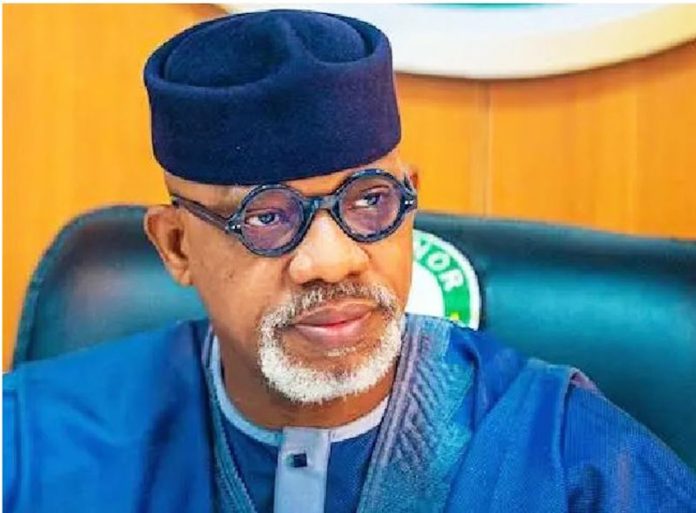
Governor Dapo Abiodun of Ogun State has said that his government will provide electric motorcycles to the Nigeria Police Force to enhance operations in the state.
He disclosed this during the opening of the 5th Conference and Retreat For Senior Police Officers in Abeokuta, the state capital.
The Governor also said he government is partnering a French company to provide drones capable of detecting crime from as far as 8000 feet.
During his speech at the event, the Inspector General of Police, Kayode Egbetokun, mandated all commands of the Nigeria Police Force to implement a comprehensive action plan aimed at reducing crime rates by 50% in 2025.
The theme of the 2025 CARSPO is ‘Improving Nigeria’s Internal Security and Economic Prosperity Through Inclusive Policing’.
IGP Egbetokun noted that the theme is in line with President Bola Tinubu’s security vision and underscores the determination of the NPF to cultivate a police force that is professionally competent, intelligence driven and equipped to confront emerging threats proactively.
IGP Egbetokun noted that the theme is in line with President Bola Tinubu’s security vision and underscores the determination of the NPF to cultivate a police force that is professionally competent, intelligence driven and equipped to confront emerging threats proactively.
The New Nigeria Peoples Party (NNPP) has suspended Senator Kawu Sumaila, who represents Kano South Senatorial district, over alleged anti-party activities and his association with the National Chairman of the All Progressives Congress (APC), Abdullahi Ganduje.
Senator Kawu was suspended alongside three other party members—Ali Madakin Gini, Sani Abdullahi Rogo, and Kabiru Alhassan Rurum. The decision was announced by the NNPP leadership in Kano State on Sunday.
Addressing journalists at a press conference in Kano, the chairman of the NNPP’s Kano State chapter, Hashimu Dungurawa said the suspended members had violated party principles by engaging in actions contrary to the party’s ideology.
“These individuals were elected into the National Assembly under the NNPP platform, yet they have chosen to betray the trust placed in them by the party,” Dungurawa stated. “Their actions contradict the principles and tenets of our party, and as such, we are left with no choice but to take disciplinary action.”
Dungurawa specifically condemned Senator Kawu’s alleged disloyalty, pointing out that the NNPP had granted him and the others complimentary tickets during the last elections. He expressed disappointment that despite this support, they had aligned themselves with figures from the opposition party.
“What is even more shocking is that key members of the APC were invited to Senator Kawu’s daughter’s wedding, as well as the commissioning of some of his projects in Sumaila Local Government Area. This is a clear indication of where his loyalty lies,” Dungurawa added.
However, the NNPP chairman left room for reconciliation, stating that if the suspended members acknowledged their mistakes and sought forgiveness, the party might reconsider its decision.
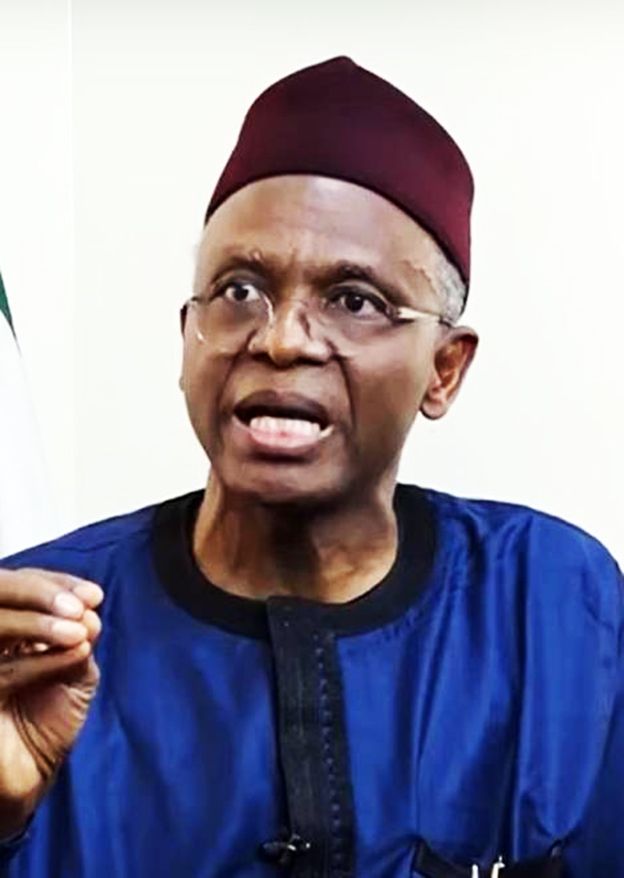
The Presidency on Tuesday said former Kaduna State Governor Nasir El-Rufai feels hurt over his exclusion from President Bola Tinubu’s cabinet.
Tinubu’s Special Adviser on Information and Strategy, Bayo Onanuga, said it is time for El-Rufai to move on and stop behaving like a child crying over spilled milk.
He was reacting to El-Rufai’s remark that Tinubu rejected him, not the National Assembly, despite begging him to become a minister in his cabinet.
The Presidency on Tuesday said former Kaduna State Governor Nasir El-Rufai feels hurt over his exclusion from President Bola Tinubu’s cabinet.
Tinubu’s Special Adviser on Information and Strategy, Bayo Onanuga, said it is time for El-Rufai to move on and stop behaving like a child crying over spilled milk.
He was reacting to El-Rufai’s remark that Tinubu rejected him, not the National Assembly, despite begging him to become a minister in his cabinet.
The former governor made the allegation while featuring on Arise Television on Monday evening.
However, Onanuga said El-Rufai’s reaction is natural after being rejected as a minister.
In an interview with Channels Television’s Sunrise Daily, Onanuga said: “As a person, I think I will pity the former governor of Kaduna State, Nasir El-Rufai. He feels hurt that he was not made a minister. I think it is time for him to move on. He can’t continue to behave like a child, as if somebody stole his bread and he is crying.
“It’s natural for him to feel hurt about being excluded, and the president acknowledged in his birthday message that Nasir helped a lot in installing Tinubu. If he’s not there, it doesn’t mean he should bring down the roof.
“The president has no animosity against Nasir. He naturally feels hurt that he has been excluded, so he goes about campaigning against the president and would not let go.
“He should forget about not being made a minister. He has been in public service since 1999; it’s time for him to move on.”
The United States has published a list of eligible countries for its 2025 Visa Waiver Program, VWP.
The United Kingdom has been removed from the program but remains eligible under specific conditions.
The list, however, does not include African countries such as Nigeria, Ghana, or South Africa.
The VWP list remains mostly unchanged, though Romania has been added in a significant update.
According to the U.S. Bureau of Consular Affairs, the Visa Waiver Program allows most citizens of eligible countries to travel to the U.S. for tourism or business for up to 90 days without requiring a visa.
The agency stated, “Travelers must have a valid Electronic System for Travel Authorization (ESTA) approval prior to travel and meet all requirements explained below.
“If you prefer to have a visa in your passport, you may still apply for a visitor visa.”
The 2025 Visa Waiver Program has also introduced policy updates on permit eligibility, revisions to the list of participating countries, and new travel policies.
The Minerals Commission of Ghana has decentralised its operations to effectively implement its mandate and ensure maximum efficiency. It has also sent over forty mine inspectors including mining engineers, geo-technical engineers, metallurgists, mechanical engineers, mine surveyors and mineral economists abroad to upgrade their technical skills, knowledge and professional competencies.
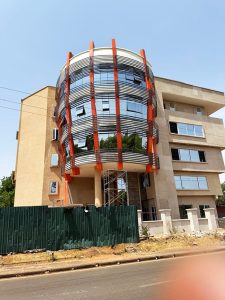
Tamale office under construction
The Commission, in the last three years, under the leadership of Chief Executive Officer Mr. Martin Kwaku Ayisi, has been building office complexes across the regions, using internally generated funds to improve access to information and services and to address inefficiencies in its operations.
The Commission’s decentralisation efforts are expected to have a positive impact on the mining sector, leading to increased investment, job creation and economic growth.
An artist’s impression of one of the proposed offices
Under the Commission’s decentralisation policy, Regional and District offices are to be established and are currently building Regional Mining offices in Kumasi, Tarkwa, Savanna (Bole), Tamale, Wa and Bolgatanga.
The Commission will also establish District offices at Kyebi, Akim Oda, Damang and Bibiani.
Offices in Bibiani and Oda were completed last year, while the Kyebi and Damang Offices are expected to be completed this year, while the Mineral offices in Kumasi, Tarkwa, Savanna and Tamale are under construction.
At Bole in Savanna region, the Office is expected to be completed in April 2025, whereas the New Office for Tarkwa would be ready next year.
The Kumasi Regional Office, which is nearing completion, is an eight-storey ultra-modern and multi-purpose office complex.
Mr. Martin Kwaku Ayisi, the Chief Executive Officer, who disclosed this in an interview with The Chronicle said decentralising the Commission’s operations was crucial for enhancing regulation of the mining sector, emphasising that decentralisation would bring numerous benefits to the minerals industry.
“Decentralization will enable us to provide effective oversight and regulation of mining activities at the regional level,” he stated, adding that “This will lead to improved compliance with mining regulations, reduced environmental degradation, and increased revenue generation for the government.”
Damang mining District office
According to the CEO, the Commission’s decentralization efforts are expected to bring numerous benefits, including improved access to information and services, enhanced regulation of the mining sector and increased efficiency.
He noted that with offices located across the regions, stakeholders will have easy access to the commission’s services and thus help minimize time and resources of stakeholders in traveling to Accra for services and thus improve the efficiency and effectiveness of Ghana’s mining sector.
Mr. Ayisi noted that the commission’s decentralization efforts are in line with the government’s vision to make the mining sector more transparent, accountable, and beneficial to all stakeholders.
Curbing illegal mining activities
Mr.Ayisi described the decentralisation of operations of the Minerals Commission as a timely intervention aimed at addressing the escalating menace of galamsey in Ghana’s mining areas.
He said the lack of effective regulation and oversight responsibilities over the years has allowed illegal mining activities to thrive, resulting in environmental degradation and loss of revenue for the state.
The CEO noted that with the establishment of regional offices, the Mineral Commission will be better positioned to monitor and regulate mining activities, making it more difficult for galamsey operators to evade detection.
He stated that the presence of Mineral Commission officials in the regions will enable them to engage with local communities and stakeholders more effectively and raise awareness about the dangers of galamsey and the importance of responsible mining practices.
Need for quality mine Inspectors
CEO Ayisi emphasised the need for very high level of quality mine inspectors with knowledge and technical skills to be able to identify potential health and safety hazards as Ghana has investors from some of the biggest mining giants or conglomerates in the world, including such companies like Newmont Mining Corporation, which is the biggest gold producing company in the world, AngloGold Ashanti, Goldfields and now the Chinese giant, Zijin Mining Group, which uses high level of sophistication and technology.
In this circumstance, the Chief Executive believes world class training was, therefore, central to ensuring that our mines were safe and a operating responsibly only when mine inspectors and other technical staff of the Commission are well trained.
According to Mr. Ayisi, building the professional and skills capacity of staff members was also crucial to the success of the Minerals Commission.
“By investing in our staff, we can ensure that they have the skills and expertise needed to effectively regulate the mining sector and support the growth of a responsible and sustainable mining industry,” he stated.
As a result, Mr. Ayisi has disclosed that over 40 mine inspectors including mining engineers, geotechnical engineers, metallurgists, mechanical engineers, mine surveyors, mineral economists have been sent to the USA, Australia and Canada to upgrade their technical skills, knowledge and professional competencies through training in world class mines such as Nevada Gold Mines and Freeport McMoRan in the USA and Northern Star Resources and BHP in Australia among others.
He believes the exposure in working in these mines will expose the mine inspectors to new mining softwares, emerging trends and technology, especially in an industry where robotics, Artificial Intelligence and machine learning are gaining extensive use in the mining sector.
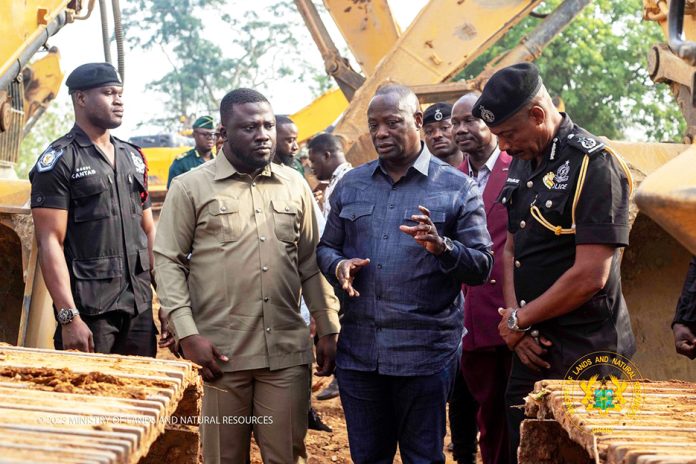
Mr. Armah Kofi Buah (m), Ashanti Regional
Minister and security personnel at Offinso
Shelter Belt Forest Reserves
The Minister for Lands and Natural Resources, Emmanuel Armah-Kofi Buah, has stated that the war declared by President Mahama’s government against illegal mining (galamsey) in the country will be relentless, retributive, fair and firm.
Minister for Lands and Natural Resources, Emmanuel Armah-Kofi Buah
According to the Ellembelle Member of Parliament, the government has made it a priority to salvage all lost forest reserves, restore the colour and quality of water bodies destroyed by illegal mining and also protect biodiversity.
He accentuated that until these goals set by government are achieved and sustainable plans implemented for the long term, his ministry would not relent in the fight against illegal mining.
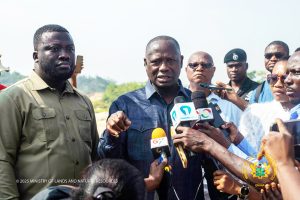
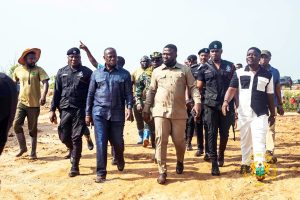
Speaking to journalists after a fact-finding mission and a successful operation in collaboration with the Ministries of Defence and Interior to rescue the Shelter Belt Forest Reserve on Saturday, February 22, 2025 the Lands Minister admonished illegal miners across the country to put down their tools and vacate the forest and river bodies before they are apprehended.
Revealing further details on Monday’s operation, Emmanuel Armah-Kofi Buah announced that thirty (30) hectares of land have been consumed by illegal mining activities in this area alone.
In total, the country has lost about 5000 hectares (7,500 football fields worth of land) to illegal mining operations in Forest Reserves.
While bemoaning the situation, he declared that the situation cannot be allowed to continue as it poses an existential threat to Ghanaians.
He noted that he has received the all-clear from President John Dramani Mahama to chase out illegal miners from the sites.
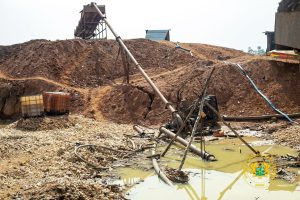
Destruction caused to the forest reserve
“With the unwavering support of my colleagues, the Defence Minister, Dr. Omane Boamah, Interior Minister, Mohammed Muntaka and Dr. Frank Amoakohene, Ashanti regional minister, we deployed the military to the forests to clamp down on these illegal operations’, he said.
During the operation, fifteen excavators were seized and the Lands Minister revealed the plans by the government to channel them into road construction.
He noted that President John Dramani Mahama’s government would not decommission or burn excavators seized at galamsey sites, but instead use them for road construction across the country, which he believes is a more purposeful and innovative approach.
“This, however, is not the end. Investigations are ongoing and we are working closely with the Ghana Armed Forces and the Ghana Police Service to ensure that the perpetrators are brought to justice.
“This is not an exercise in futility. We are resolute in our mission. We will not rest until those responsible for this environmental carnage are held accountable, including their accomplices,” he said.
He also forcefully made the point that the government’s drive to eradicate illegal mining has just kicked off and that despite being in its early stages, successes are being chalked with the operation on the Offin Shelter Belt forest, in addition to the operation on Ankobra River, where 7 Chinese nationals and 8 Ghanaians were apprehended.
He also restated the need for Ghanaians to collaborate with the government in the fight, stressing the importance of a holistic force in confronting and eradicating the menace.
“As I have stated before and I reiterate today, we will not relent in this fight. This is a battle for all of us – every Ghanaian who values our environment, our health and our future. I urge all well-meaning Ghanaians to join us in this critical fight. Together, we can win this war,” he said.
The Lands Minister also condemned the recent attack on the Citi FM Journalists, stressing that such actions should not be condoned.
The Ashanti Regional Minister, Dr. Frank Amoakohene, in his interaction with the press, commended the Lands Minister for not being an armchair Minister and for deciding to visit the field and have firsthand information and experience on the issue.
He insisted that the government was bent on winning the Galamsey War and that no stone would be left unturned in the bid to protect the country’s rivers and forest reserves.
The Chiefs and people of South Dayi District have expressed their heartfelt appreciation for President John Dramani Mahama’s appointment of Dr. Johnson Pandit Asiama, as the Governor of the Bank of Ghana (BoG).
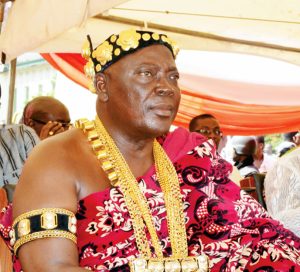
Deiga Kwadzo Dei XII (Paramount chief of the Peki Traditional Area)
In a statement issued over the weekend, the chiefs said this important decision reflects a commitment to excellence and recognises the exceptional qualifications, experience and track record that Dr Asiama brings to this vital role.
Pride in local heritage
South Dayi comprises four traditional areas namely Peki, Kpalime, Kpeve and Tongor.
Dr. Asiama hails from Kpalime Duga, one of the seven towns under the Kpalime Traditional Area, further strengthening the connection between local heritage and national progress.
Dr. Asiama is widely regarded as one of Ghana’s leading Economists, with a wealth of experience in monetary policy formulation, financial stability regulation and economic research.
He holds a PhD in Economics from the University of Southampton, UK and has spent over two decades working at the BoG in various leadership capacities.
Between April 2016 and January 2018 he served as Second Deputy Governor of the BoG, playing a key role in formulating monetary and financial policies to ensure macro-economic stability.
Togbe Akudompey XI (Paramount Chief of Kpeve Traditional Area)
His tenure saw significant improvements in exchange rate policies, liquidity management and overall financial sector regulation.
Dr. Asiama’s deep knowledge of Ghana’s economic landscape positions him well to lead the BoG in steering the country’s financial future.
His nomination signals a continuity of efforts to stabilise the economy, whilst ensuring sustainable financial sector reforms.
His key areas of expertise include monetary and exchange rate policy formulation and implementation, banking sector regulation and supervision, economic research, strategic financial decision-making, risk management, and digital banking regulation.
His leadership is expected to introduce innovative policies that align with global financial trends while addressing Ghana’s specific economic needs.
Mama Tormelo IV (Regent of Tongor Traditional Area)
Dr. Johnson Pandit Asiama’s appointment is a testament to the recognition of merit and competence and it is believed to inspire confidence among stakeholders in the financial sector.
The Chiefs and people of South Dayi stand in full support of Dr. Asiama, as he discharges his responsibilities.
They (chiefs) have urged all Ghanaians to rally behind him, setting aside partisan interests to collectively work towards the prosperity of the nation.
“Once more, the people commend President Mahama for this key appointment and assure Dr. Asiama of their full backing as he leads the BoG into a new era of excellence.”
Signed
Togbega Atikpladza Agbi Yao VIII (Paramount Chief, Kpalime Traditional Area)
Deiga Kwadzo Dei XII (Paramount chief of the Peki Traditional Area)
Mama Tormelo IV (Regent of Tongor Traditional Area)
Togbe Akudompey XI (Paramount Chief of Kpeve Traditional Area)
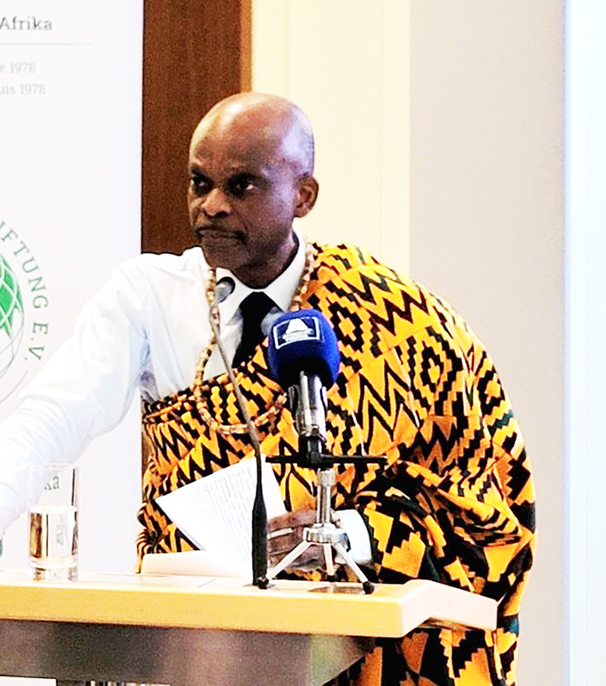
The idea of moving towards a 9th Pan-African Congress in Lomé, Togo, was imposed on Africa for a number of reasons. This includes the need put an end to the paradox between the desire clearly expressed at institutional and national levels by the African Union to involve the diasporas more deeply in the work of continental development and the feeling of abandonment by Africa among several Afro-descendants.
Some Afro-descendants feel resentful towards Africa because of the continent’s lack of commitment to them. They claim to be African and often expect the continent to take an interest in their fate, wherever they are in the world. Africa’s discretion on issues such as the memory of slavery, anti-Afro-descendant racism, discrimination, and reparation is shocking to some people of African descent. It was therefore necessary to overcome this state of cold relations between Africa and these Afro-descendants, And also at the same time to find a framework for reflecting together on the requests from other Afro-descendants to return to Africa.
The Pan-African Congress, as a periodic forum for the African world to come together and reunite, was the ideal setting, hence the decision to organise a 9th Pan-African Congress. One of the main focuses of the 9th Pan-African Congress in Lomé is to provide an opportunity to reaffirm the solidarity between Africa and its Diaspora, which our continental organisation defines as “populations of African origin living outside the continent, irrespective of their citizenship and nationality, and who are willing to contribute to the development of the continent and the building of the African Union”. The value of the AU’s definition of the African Diaspora is that it allows for the inclusion of nationals of African countries living outside the continent and Afro-descendants wherever they may be or reside in the world.
For a long time, the African diaspora in its two-faceted capacity was neglected and marginalised in the continent’s development issues. The reality for some time has been that there has been a shift in awareness of the positive role that the African diasporas and Afro-descendants can play in an Africa in search of a renaissance. There is virtually no African country today that does not have a proven interest in the diasporas. In Togo, for example, there is a policy devoted to the diaspora.
The AU has made the African diaspora the sixth region of Africa. African States have undoubtedly understood the importance of revitalising relations with the diasporas and people of African descent, and this led the AU Assembly of Heads of State and Government to declare, at its 34th ordinary session of 6 and 7 February 2021 in Addis Ababa, Ethiopia, the decade 2021-2031 the “Decade of African Roots and the African Diaspora”.
There is therefore a pressing need to reinvigorate relations between African communities. The 9th Pan-African Congress is intended to respond to this need and reinvigorate relations between the African continent and Africans in the diaspora, as defined in the two-dimensional sense of the term.
This issue of revitalising the relationship with the diaspora and Afro-descendants was at the heart of the regional conference held in Brazil from 29 to 31 August 2024, following the regional pre-conferences of Pretoria (South Africa), Bamako (Mali), Rabat (Morocco), Brazzaville (Congo) and Dar-es-Salaam (Tanzania). Pan-Africanism originated in Afro-descendant American circles, so we cannot carry the movement forward in the 21st century without Afro-descendants.
Fundamentally, the mainspring of pan-Africanism is the solidarity between the different components of the African family throughout the world. In the context of pan-Africanism, “Africa, Africans and the descendants of Africans abroad[1] ” are considered “as a single whole which aims to regenerate and unify Africa as well as to foster a spirit of solidarity between the populations of the African world[2] “.
In other words, the dispersal of people of African descent around the world following the transatlantic slave trade imposed on the African community a duty of global unity, a duty whose roots go back to the end of the 19th century, and which materialised through the holding of the first Pan-African Conference in 1900 in London, on the initiative of the Afro-Trinidadian Henry Sylvester-Williams, and also through the holding of various successive congresses.
Relations between Africa and Afro-descendants have cooled off as a result of distance and the lack of joint memory work. The Lomé Congress will provide an opportunity for Africans and people of African descent to work together to rebuild our relations, and this reconstruction effort will make it easier for Afro-descendants interested in the “Back to Africa” movement to rediscover the countries and families of origin of their parents.
The difficult path of return for Afro-descendants involves a work of reconstitution and reconstruction, and one of the strong resolutions of the Pan-African Congress in Lomé will be the decision at the continental level to facilitate the return to Africa for Afro-descendants who wish to do so as part of the promotion of African citizenship.
The 9th Pan-African Congress will not only be an occasion for intra-African solidarity seen in a historical perspective. It will also be an opportunity to look to the future together, a future that we must build together within the framework of a renewed pan-Africanism, and a future whose leitmotiv is to position Africa as one of the key players in the world in this 21st century. It is by reaffirming their unity and solidarity that Africa and its diaspora will be able to meet the challenges of the future.
As a meeting of fraternity and solidarity, the 9th Pan-African Congress will mobilise several categories of players from the African world, including representatives of African States, the AU Commission, regional economic communities, Latin American and the Caribbean States, African diaspora organisations, organisations of Afro-descendants, target groups from Africa, the diaspora and communities of African descent (intellectuals, scientists, artistic, sporting, cultural and media players, young people, women, opinion leaders, etc.), professional organisations, priests and priestesses of the Voodoo religion, and businesspeople from across the continent.
All these categories of players expected in Lomé will closely examine the key issues on the congress agenda. Some of the key issues that will be at the heart of the Lomé Congress are the work of remembrance, reparation, and the reform of multilateral institutions.
A 31-year-old self-acclaimed businesswoman, Gifty Kyei, has been granted bail by the Dansoman Circuit Court, after pleading not guilty to allegations of defrauding an entrepreneur of GH¢374,434.00 under the pretence of supplying home appliances.
Presiding over the case, Her Honour Halimah El-Alawa Abdul-Baasit set Kyei’s bail at GH¢500,000 with three sureties, one of whom must be justified.
Additionally, she was ordered to deposit her Ghana Card at the court registry and report to the police investigator once every two weeks.
The case, prosecuted by Chief Inspector Kwadwo Aboagye, has been adjourned to March 21, 2025.
Fraudulent Scheme
Court documents indicate that complainant Belinda Boadua Darkwa, an entrepreneur, based in Abokobi, Accra, engaged Kyei in her online business(Everything Some Cheap Enterprise), between May and November 2023 to purchase various electrical appliances and cartons of cooking oil.
Gifty Kyei allegedly demanded upfront payments, assuring delivery within three months.
Darkwa reportedly transferred a total of GH¢374,434.00 for the goods, but Kyei failed to supply them and subsequently cut off communication.
When efforts to reach her proved futile, Belinda Darkwa reported the matter to the police.
Following her arrest on December 17, 2024 Gifty Kyei admitted to receiving the money, but claimed to have refunded only GH¢30,000 leaving an outstanding balance of GH¢344,434.00.
Legal Proceedings
Gifty Kyei faces charges under Section 131(1) of the Criminal Offences Act, 1960 (Act 29) for defrauding by false pretence and if found guilty she could face severe penalties, such as imprisonment.
The prosecution is expected to present further evidence when the case resumes.
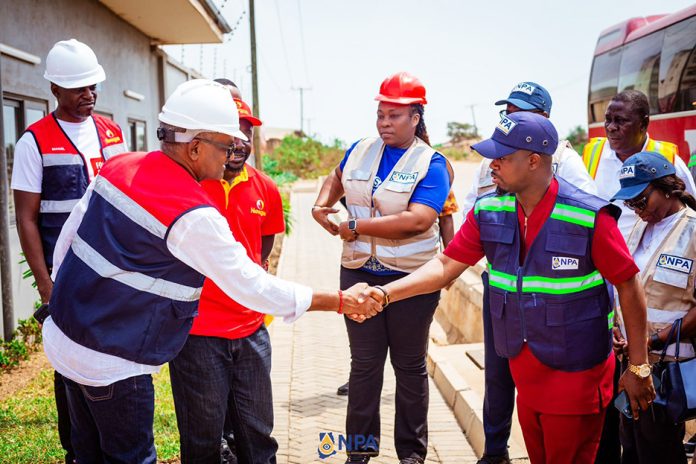
Mr Edudzi Tameklo being welcomed to one of the plants
The Chief Executive of the National Petroleum Authority (NPA), Mr. Godwin Edudzi Tameklo, has affirmed government’s commitment to addressing the challenges with the implementation of the Cylinder Recirculation Model (CRM).
He assured businesses operating in the LPG distribution chain of the petroleum downstream industry of the NPA’s continued collaboration to deal with the lingering issue and promote growth.
Mr Edudzi Tameklo assessing some of the gas cylinders
Mr Godwin Tameklo gave the assurance when he toured LPG Bottling Plants belonging to Goil, New Gas and Blue Ocean in the Tema enclave. This was to acquaint himself with the new LPG distribution chain.
He was accompanied by his two deputies, Dr. Sheila Addo and Dr. Dramani Bukari.
He stated that the NPA was very pro-business in the exercise of its regulatory mandate, as it protects Ghanaian businesses that comply with the standards and play by the rules.
Commenting on the challenges enumerated by the bottling plant owners, the NPA Boss said the Authority would address the issue of unlicensed companies offering LPG door-to-door services, which undermines safety protocols of handling LPG.