Home Blog Page 881

Nigeria’s Inflation Dropped To 23.71 Percent In April –NBS

0

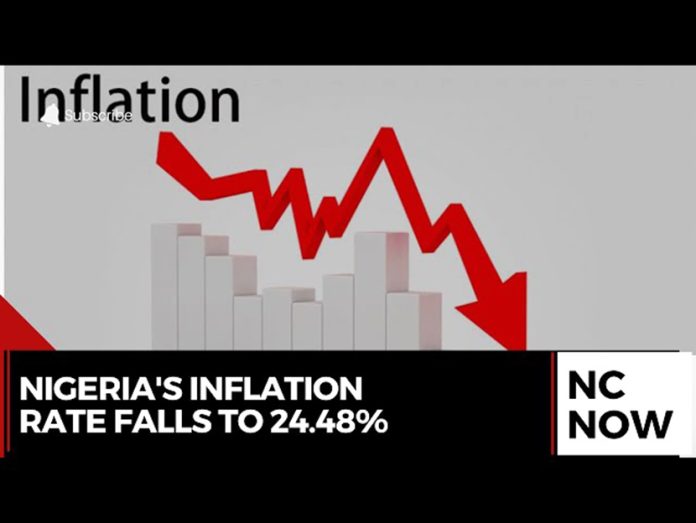
The National Bureau of Statistics (NBS) says Nigeria’s headline inflation rate slightly dropped to 23.71 percent in April 2025 – down from the 24.23 percent in March.

NBS announced the increase in its consumer price index (CPI) on Thursday.

According to the bureau, the movement for April 2025 “headline inflation rate showed a decrease of 0.52% compared to the March 2025 Headline inflation rate”.

“On a month-on-month basis, the Headline inflation rate in April 2025 was 1.86%, which was 2.04% lower than the rate recorded in March 2025 (3.90%),” NBS said.

“This means that in April 2025, the rate of increase in the average price level is lower than the rate of increase in the average price level in March 2025.”

FOOD INFLATION RATE DROPS TO 21%

NBS further said the food inflation rate in April 2025 was 21.36 percent on a year-on-year basis.

This, the bureau said, is 19.27 percent lower compared to the rate recorded in April 2024 (40.53 percent).

“The significant decline in the food annual inflation figure is technically due to the change in the base year,” the statistics firm said.

“However, on a month-on-month basis, the Food inflation rate in April 2025 was 2.06%, down by 0.12% compared to March 2025 (2.18%).

“The decrease can be attributed to the rate of decrease in the average prices of Maize (Corn) Flour, Wheat Grain, Okra Dried, Yam Flour, Soya Beans, Rice, Bambara beans, Brown Beans, etc.”

The report said that in April 2025, food inflation on a year-on-year basis was highest in Benue (51.76 percent), Ekiti (34.05 percent), and Kebbi (33.82 percent), while Ebonyi (7.19 percent), Adamawa (9.52%), and Ogun (9.91 percent) recorded the slowest rise.

On a month-on-month basis, however, NBS said food inflation was highest in Benue (25.59 percent), Ekiti (16.73 percent), and Yobe (13.92 percent).

The bureau added that Ebonyi (-14.43 percent), Kano (-11.37 percent) and Ogun (-7.06 percent), recorded a decline in food inflation.

Credit: thecable.ng

Bill to make voting compulsory for Nigerians passes second reading in House of Reps

0
House of Representatives

A Bill for an Act to Amend the Electoral Act, 2002 to make it mandatory for Nigerians of Maturity Age to Vote in all National and State Elections has scaled second reading in the House of Representatives.

The proposed legislation was sponsored by the Speaker, Tajudeen Abbas, and Daniel Asama Ago

Leading the debate during plenary on Thursday, Ago said the bill aimed to encourage citizens’ participation in the electoral process, noting that voter apathy during elections would be addressed if the bill scales legislative scrutiny.

Ago, who represents Bassa/Jos North under the Labour Party, believes mandatory voting can reduce the influence of vote buying.

The Deputy Speaker, Benjamin Kalu, in his contribution believes this is a good step in the right direction.

He also cited examples of other countries such as Australia where the practice is upheld.

Some lawmakers argued that citizens have lost confidence in the voting system, and also question the authenticity of the voters register.

Similarly, a bill for an Act to amend the Labour Act, to increase the Maternity Leave period of working women to six months has been stepped down in the House of Representatives.

Hon Chike Okafor (Okigwe South/Imo/APC) who sponsored the bill was compelled to step it down after lawmakers including women, debated against it.

The lawmakers argued that increasing the maternity leave period from three to six months would put women in a disadvantaged position as employers would be wary of employing them.

Credit: channelstv.com

Trump says US close to nuclear deal with Iran

0
US in nuclear deal with Iran

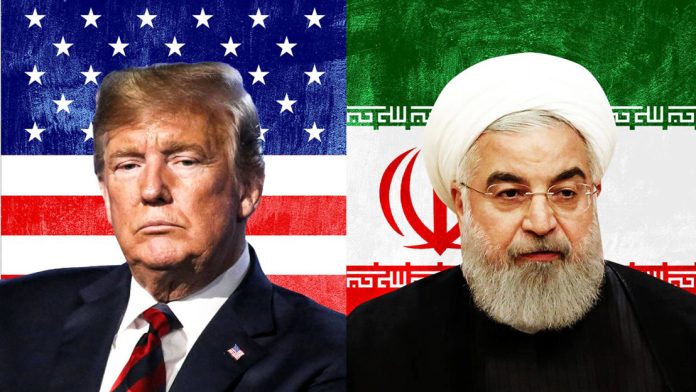
United States President Donald Trump has claimed Washington is nearing an agreement with Iran to resolve a long-running nuclear dispute, despite ongoing diplomatic hurdles.

“We’re in very serious negotiations with Iran for long-term peace,” Trump said in Qatar during the second leg of his Gulf tour on Thursday, before heading to the United Arab Emirates.

“We’re not going to be making any nuclear dust in Iran,” he said. “I think we’re getting close to maybe doing a deal without having to do this.”

Trump said he was basing his optimism on new statements by Iran. “You probably read today the story about Iran. It’s sort of agreed to the terms,” he said.

The president did not specify which remarks he was referring to, but an adviser to Iran’s supreme leader Ayatollah Ali Khamenei, Ali Shamkhani, said in a US media interview this week that Tehran was willing to accept far-reaching curbs on its nuclear programme.

“I want them [Iran] to succeed, I want them to end up being a great country,” Trump added on Thursday, “but they can’t have a nuclear weapon; that’s the only thing, it’s very simple.”

Trump’s remarks come amid intensified negotiations between US and Iranian officials, most recently held in Oman last Sunday. A US official confirmed to Axios that a new proposal had been delivered to Tehran during the fourth round of talks.

Credit: aljazeera.com

Gambia probes sale of ex-leader’s luxury cars, cows and boats

0
Some of Jammeh's luxury cars are not on the list of the sold assets

The Gambian government has announced an investigation into the sale of assets seized from former President Yahya Jammeh, following widespread public concern.

Some of the assets, including livestock and luxury vehicles, were sold off while a panel was still investigating the wealth Jammeh amassed during his 22-year rule.

A newspaper investigation exposed alleged irregularities and an apparent lack of transparency in the sale of the assets, sparking protests organised by young people.

In a televised address on Wednesday night, President Adama Barrow pledged “full transparency” in the probe, saying assets recovered “belong to the people”.

Jammeh, who seized power in a 1994 coup, is accused of orchestrating the huge theft of government funds, as well as extensive human rights abuses, including killing and jailing his critics.

The former leader, who in 2017 fled into exile in Equatorial Guinea after losing elections, has previously denied allegations of wrongdoing.

In 2017, President Barrow set up a commission to investigate alleged corruption and financial misconduct by Jammeh during his two-decade-long rule.

The panel, popularly known as the Janneh commission, concluded its findings in 2019 and recommended the forfeiture of assets linked to Jammeh and his associates.

The investigation found that Jammeh had allegedly stolen at least $360m (£270m) and spent lavishly on expensive vehicles, aircraft and real estate.

He is yet comment on the accusations but his supporters in Gambia have dismissed the findings against him as a political witchhunt.

Jammeh’s livestock – including cows, sheep and goats, – farm tractors, vehicles, and other valuables were among the assets earmarked for seizure by the state.

Credit: bbc.com

India disputes Trump claim it is ready to charge US ‘no tariffs’

0
India has offered to drop all tariffs on goods imported from his country according to Trump

US President Donald Trump’s claim that India has offered to drop all tariffs on goods imported from his country has been swiftly disputed by Delhi.

In a statement to local news agencies India’s foreign minister S Jaishankar countered the claim saying talks are still going on and “nothing is decided till everything is”.

The statement is in stark contrast to comments by Trump to reporters earlier in the day, when he declared Delhi had “offered us a deal where basically they are willing to literally charge us no tariff”.

India and the US are currently in talks to negotiate a trade agreement.

Jaishankar said on Thursday that any trade deal has to be mutually beneficial and work for both countries.

“That would be our expectation from the trade deal. Until that is done, any judgment on it would be premature,” he told news agencies.

Trump made the comments when he was speaking at an event with business leaders in Doha where he announced a series of deals between the US and Qatar, including for Boeing jets.

The US president made the comments while speaking about Apple’s plans to make iPhones in India, saying he had told CEO Tim Cook that he didn’t want him to build in India because it was “one of the highest tariff nations in the world”.

“They [India] have offered us a deal where basically they have agreed to charge us literally no tariffs. I said ‘Tim, we are treating you really good, we put up with all the plants you built in China for years. We are not interested in you building in India. India can take care of themselves’.”

Credit: bbc.com

India, Pakistan trade accusations of nuclear weapons mismanagement

0
A Pakistani Ranger stands guard at the Pakistan-India joint checkpost

India and Pakistan have traded accusations of nuclear weapons mismanagement, days after reaching a truce following four days of cross-border fighting.

India’s Defence Minister Rajnath Singh questioned the safety of nuclear weapons in Pakistan on Thursday at an army base in Srinagar, in Indian-administered Kashmir, calling the neighbouring country an “irresponsible and rogue nation”.

“I believe that Pakistan’s nuclear weapons should be taken under the supervision of IAEA (International Atomic Energy Agency),” Singh said.

In response to the minister’s comments, Pakistan’s Ministry of Foreign Affairs said in a statement that Singh had revealed his “profound insecurity and frustration regarding Pakistan’s effective defence and deterrence”.

“The comments of India’s Defence Minister also show his sheer ignorance of the mandate and responsibilities of a specialised agency of the United Nations like the IAEA,” it read.

“If anything, the IAEA and the international community should be worried about the repeated theft and illicit trafficking incidents involving nuclear and radioactive material in India,” the statement added.

The UN nuclear watchdog monitors countries that have nuclear weapons to ensure that they are peaceful.

Under a 2008 agreement, the IAEA monitors several Indian civilian nuclear facilities.

After conducting tit-for-tat nuclear tests in 1998, India and Pakistan became nuclear powers, making the region one of the world’s dangerous nuclear flashpoints.

Last week, the two countries traded intense missile and drone attacks, leaving nearly 70 people dead.

Credit: aljazeera.com

Long working hours can cause brain damage

0

Long working hours might not just be bad for you, they could also be altering the structure of your brain, a new study suggests.

The research found “significant changes” in the brains of people who were overworking, which is a combination of physical and emotional overexertion, as well as a lack of rest.

Working 52 hours or more each week harms people’s memory and problem solving – and disrupts their emotions, a study suggests.

Experts found that being ‘overworked’ alters the structure of the brain in areas linked to thinking and social skills and mental health.

They looked at the impact of overwork on specific brain regions in health workers who regularly clocked up a 52-hour week or more.

The researchers drew on data from a long-term study looking at worker health and used MRI scans to examine brain structure.

Some 110 workers were included in the final analysis, published in the journal Occupational And Environmental Medicine. Most were clinicians.

Of these, 32 worked excessive weekly hours, while 78 worked standard hours.

Those putting in long working hours every week were significantly younger, had spent less time in work and were more highly educated than those clocking up standard hours.

The researchers, including from Yonsei University in South Korea, said: ‘Overworked individuals exhibited significant changes in brain regions associated with executive function and emotional regulation.’

Analysis showed a 19 per cent increase in left caudal middle frontal gyrus volume in the overworked group compared with the non-overworked group.

This part of the brain has a major role in various cognitive functions, particularly in the frontal lobe.

It is involved in attention, working memory, and language-related processing.

Other areas involved in attention, planning and decision-making were also changed according to the scans, plus regions involved in emotional processing, self-awareness and understanding social context.

The team concluded: ‘This study provides preliminary evidence that overwork is associated with structural brain changes, particularly in regions linked to cognition and emotion.

‘These findings provide novel neurobiological evidence linking prolonged working hours to structural brain changes, emphasising the need for further research to understand the long-term cognitive and emotional implications of overwork.

‘The results underscore the importance of addressing overwork as an occupational health concern and highlight the need for workplace policies that mitigate excessive working hours.’

Ruth Wilkinson, head of policy and public affairs at the charity the Institution of Occupational Safety and Health, said: ‘Global analysis from the World Health Organisation and International Labour Organisation has found that working long hours is on the increase and is responsible for about one-third of the total estimated work-related burden of disease.

‘We believe urgent action is needed to tackle an epidemic of long working hours.

‘A long hours culture can be experienced in what we’ve identified as the “small print” of working life today.

‘This captures those hidden or unspoken expectations placed on top of workers’ contracts.

‘It includes always having to be available/on duty in this digital age, stripped of the right to disconnect from work outside of normal working hours….

‘Our YouGov survey, last year, showed that nearly a quarter of UK workers regularly work more than the legal maximum people should work in the UK (48 hours a week), while 44 per cent said working more than your contracted hours is part of the culture in their organisation.

‘More than half said they regularly check work emails and messages outside of working hours.

‘We want to see employers strip away the “small print”, identify and tackle psycho-social risks as part of risk assessment processes and become more transparent in how they treat their workers.’

Credit: dailymail.co.uk

The God Who Sees You

0
Dr. Joyce Rosalind Aryee, Executive Director, Salt and Light Ministries

“She gave this name to the Lord who spoke to her: ‘You are the God who sees me,’ for she said, ‘I have now seen the One who sees me.’” – Genesis 16:13 (NIV)

INTRODUCTION

In a world increasingly flooded with voices, faces, and distractions, it is easy to feel invisible. For some, this invisibility is born out of suffering, rejection, loneliness, or failure. We go through life wondering: “Does anyone truly see me?” Into that silence comes a name—one whispered in the desert, not by a patriarch or prophet, but by an outcast slave girl: El Roi, the God who sees.

Genesis 16 introduces us to Hagar, an Egyptian servant mistreated by her mistress, Sarah, and overlooked by Abraham. Pregnant, abandoned, and despairing in the wilderness, Hagar has an encounter with the Living God that would echo through eternity. God doesn’t merely hear her cries—He sees her, calls her by name, and speaks promises over her unborn child.

The name El Roi—“The God who sees me”—reminds us that we are never truly alone. Not in our pain. Not in our wilderness. Not in our wandering. The God of all creation has His eyes fixed on us. This truth changes everything.

THE GOD WHO SEES

The revelation of El Roi is rich with theological truth and tender intimacy. It declares something profound: God is not just omniscient in a vast, cosmic sense—He is personally attentive to His people.

1. He Sees Our Pain

Hagar was running from mistreatment, from fear, and perhaps even from herself. But God found her. In the wild, hot desert of Shur, He met her not with rebuke, but with compassion. He asked, “Hagar, servant of Sarai, where have you come from, and where are you going?” (Genesis 16:8).

This is the heart of El Roi. He asks not because He lacks information, but because He cares. The God who sees is the God who engages.

Many of us walk through seasons of hidden pain—misunderstood, dismissed, or entirely unknown by those around us. But God sees every tear. Psalm 56:8 says, “You have collected all my tears in your bottle. You have recorded each one in your book.” Not one cry goes unnoticed. Not one ache escapes His gaze.

2. He Sees Our Potential

God did not merely acknowledge Hagar’s suffering—He gave her hope. He spoke life into her future: “You shall give birth to a son… his name will be Ishmael” (Genesis 16:11), which means “God hears.” Her wilderness encounter was not the end of her story, but the beginning of purpose.

God sees not just where we are, but who we are becoming in Him. Others may define us by our failures, our origins, or our present struggles, but El Roi sees our destiny. In 1 Samuel 16:7, God reminds the prophet Samuel: “People look at the outward appearance, but the Lord looks at the heart.” He sees the masterpiece within the mess.

3. He Sees Us When We Feel Forgotten

Hagar’s second encounter with God came after Sarah sent her away again (Genesis 21). Alone in the desert with her child, she placed Ishmael under a bush and walked away, unable to watch him die. It was then that God called to her from heaven and provided water in the wilderness.

God doesn’t forget us after the first miracle. He is not a one-time rescuer. He is the God who continues to see, provide, and intervene—even when we’ve lost hope. He watches over the widow, the orphan, the foreigner, the prisoner—and the heart that feels abandoned.

4. He Sees Our Worship

It is noteworthy that Hagar gave God a name—a rare and sacred thing. She said, “I have now seen the One who sees me.” Worship flows naturally when we encounter the personal God who sees. Her response was not theological speculation; it was the worshipful cry of a heart that had been noticed, known, and loved.

When we feel unseen by others, the truth that God sees us stirs up a personal song of praise. He doesn’t just see crowds; He sees individuals. He doesn’t just hear choirs; He hears your whisper. And that matters to Him.


WHAT THE GOD WHO SEES ACCOMPLISHES IN US

v  Comfort in Our Wilderness

No matter how far we feel from the comfort of community or the warmth of belonging, El Roi is near. His eyes are on us, and He meets us even in the dry places.

v  Security in Our Identity

If God sees us, we do not need to scramble for human approval or validation. Our identity is not shaped by who ignores us but by the One who sees and knows us fully.

v  Hope in Our Journey

The One who saw Hagar’s future sees ours too. The desert is not our destination. God is still writing our story.

v  Courage to See Others

When we embrace the God who sees, we begin to reflect Him. We notice the overlooked. We extend compassion to the forgotten. Our spiritual sight is sharpened by His example.


CONCLUSION

To believe in El Roi—the God who sees you—is to believe in a God who is deeply personal, endlessly compassionate, and unceasingly attentive. He saw Hagar when no one else did. He sees you—in your doubts, in your dreams, in your breaking points, in your breakthroughs.

Let this name settle into your soul: The God who sees me. Not just your mask, not just your role in society, not just your church face—but the real you. The wounded, weary, wandering, waiting you. And He loves you still.

So today, whether you find yourself in a wilderness or a place of abundance, whisper these words with faith: “El Roi, You see me.” Let it anchor your heart. Let it transform your prayers. Let it shape your worship. And let it assure you that the God who sees is also the God who saves.


  • This article is Inspired by Jordan Wilbanks’ “Who You Really Are”


Remain Blessed!

Please note that the preaching program on Sunny 88.7 FM – Tuesdays at 5:30 am has been temporarily put on hold. However, please continue to join us on Asempa 94.7 FM – Sundays at 5:30 am and YFM 107.9 – Sundays at 6:30 am for our Radio Bible Study, as well as on Sunny 88.7 FM every Sunday at 3:30 pm for Hymns and Their Stories.


Feature: Mahama’s 120 Days

0
Africanus Owusu Ansah (Hot Issues)

Afenyo Markin: “Ghanaians were not given a reset; (you) were sold a recycled failure…”

Nyaho – Nyaho Tamakloe: “(Mahama) so far, so good”

Odike: “Mahama has done well… the strength of the cedi, by whatever means, is a mark of success.

His Excellency John Dramani Mahama has spent his 120 days as President, and he has spoken; “Building the Ghana we want…our social contract… we have fulfilled them… a lean Cabinet (of 60 men appointed 56)… robust Code of Conduct to instill integrity… prohibition of sale of state assets…, promoting fiscal discipline… scrapping draconian taxes (e-levy, betting tax, emission tax, save COVID tax for particular reasons)… no academic fee policy…, Mahama Cares, free sanitary pads for students…, women’s development bank…, Act 2020 (customs) reviewed to remove the law banning the importation of salvaged vehicles (Thumbs up!), …law on banning mining in forest reserves… investigations into major unresolved criminal cases… (Ayawaso West Wuogon, murder of Ahmed Suale… Techiman South political murders …”, probe into VRA spillage disaster… compensate flood victims (thumbs up!) shake-up of loss-making SOEs…”

Fantastic speech, the NDC would say; 20 out of 25 programmes implemented.

Objective analysts (NDC or NPP) see something positive; signs of commitment on the part of the government.

A grading of between 70% and 80% to Mahama and the NDC. The cedi ($1.00 = GH¢12.50) and they cannot guess where the magic comes from.

Recall the 100 days of Nana Akufo-Addo in 2017: one village, one dam; one district, one factory; one district, one million dollars… On April 17, 2017, he addressed the chiefs and people of Kwahu: “…Before the elections, my opponents criticized most of my campaign promises – They said there was no way I could achieve them, but gradually, we are getting there… The free SHS is starting this September.”

Nana Akufo-Addo was criticized for appointing 110 Ministers, the largest Cabinet in the Fourth Republic. But he told Ghanaians he was in a “hurry” to solve the myriad of problems he had inherited. By the time he was leaving government, he had as many as 125 Ministers, including a plethora of Ministers of State at the Presidency!

But vigilante groups (including the Invincible and Delta Forces) were all over the place forcefully taking over public toilets, toll booths, school feeding programmes; seizing government vehicles used by officials of the previous NDC administration. In one instance, the NPP vigilante (Delta) stormed a Circuit Court in Kumasi and brazenly freed 13 suspects who had earlier attacked the Regional Security Coordinator and driven him out of his office. The hard-working, respectful presiding judge, Mary Senkyire, had to be rescued together with the bailiff and prosecutor by the Police in court.

When told to disband vigilante groups, Kan Dapaah, the National Security Minister argued: “There are no legally registered vigilante groups in this country and for that matter, there are no such groups to be disbanded”.

As to be expected, the Minority Party has given a damning verdict over the NDC claims. Insatiable Afenyo-Markin described Mahama’s 120 days as being full of a “cocktail of broken promises.” Mahama’s government is one of “executive lawlessness” that led to the sacking of numerous public servants and replacing them with persons affiliated with the NDC: We now have two Ghana– one for the NDC and one for other Ghanaians. This was not the reset President Mahama promised Ghanaians…” Included in the basket of failed promises were: the resurgence of power outages (dumsor), failure to implement the 24-hour economy, failure to reduce import duties and failure to tackle illegal mining head-on.

What about the repeal of LI 2462, mining in forest reserves and the restoration of the country’s degraded landscape?

He lamented: “Illegal mining has flourished in the full glare of the President, foreigners involved in galamsey are deported instead of being prosecuted… he (Mahama) has failed to declare a state of emergency” it may sound discordant to the ear of Afenyo-Markin to hear “Police update on galamsey fight: 99 excavators seized, 208 arrested (Daily Graphic: Wednesday May 14, 2025).

Afenyo-Markin reiterated the “plethora of promises”: headline-grabbing pledges (no academic fee for all first-year tertiary students, free tertiary education for persons with disability, free sanitary pads) intended to ease burdens on students and parents. … the supposed reduction in ministerial appointments has little to no impact on the ballooning cost of government…”

With the “success – failure” claims, the ordinary Ghanaian is not given the fair opportunity to draw his own conclusions. Articles 34 to 41 of the 1992 Constitution (The Directive Principles of State Policy), particularly Article 35 clause 2 gives the President a comprehensive charge: “We are watching with “eagle eyes”, because “he who comes to equity must come with clean hands.” (Latin: “ex dolo malo non oritur actio…” or “ex turpi causa non oritur actio”).

And, incredibly, less than a week after Mahama had launched the “Code of Conduct” like Hammurabi’s Code for all government and political appointees, Sammy Gyamfi was caught openly in his own trap! Some say the Law of Karma (cause and effect) by Sadhguru in 1904 had caught up with Sam. What at all is the relationship of Sammy Gyamfi with Patricia Oduro Koranteng Asiama (a.k.a. Nana Agradaa) for Sammy to shower dollars on her?

Here is a fetish priestess – turned – evangelist subjecting NDC to fierce spite during the campaign, and swearing to the heavens that if Mahama won, she would go back to her fetish. So, there aren’t any more “poor” people in NDC? It is like the ordure of a lizard-all black with a white tip!

There are so many questions to ask: Who was filming the encounter? What was the intention of Agradaa (a trap, a setup, an agenda-setting)? Was Sammy Gyamfi charmed by Beelzebub to fall “into temptation?.”

How much was the cash? What was the source?

Has Sammy flouted the laws?: Public Services Act, Foreign Exchange Act 2006, Money Laundering Act, et cetera…

The Code of Conduct talks of A …government with no trace of affluence and lavish lifestyle. Any impact of the “apology” from Sammy for his indiscretion? Why comparing Sammy’s act to Cecilia Dapaah (NPP) who had reported the theft of $1 million by her house-help?

And NPP forgets about the open display (on Television) of gold bars by Wontumi, the Ashanti Regional Chairman of NPP? Afenyo-Markin was the Board Chairman of ECG and containers stolen at Tema.

The mouth-watering payments made to CEOs. Sammy Gyamfi earns (1). GH¢1.5 million annual salary (GH¢125,000 per month) (2) Clothing 3. Security: 2 officers or GH¢6.000 for each of them (3) Gardener or GH¢4,000 (4) Full medical Cover-CEO, Spouse, five children under 18 years (5) Two company cars Toyota Landcruiser with full maintenance and insurance (6) 1,500 liters of fuel monthly (Vehicles to be sold to CEO…) (7) Paid vacation 30 days (8) Annual Familiarisation Tour, Airfare up to $10,000 annually (9) Business Travel with business class ticket and $2,000 per diem (10) Personal accident law of Kharma and life insurance cover 5 times the CEO’s annual salary.

Who would love to lose all these lovely goodies? Dismissal – No; Suspension-Yes; CEO of Goldbod – No; Another Board-Yes.

 

Razak Simpson is arguably the best player on the Ghana scene -Kennedy Boakye Ansah

0
Razak Simpson

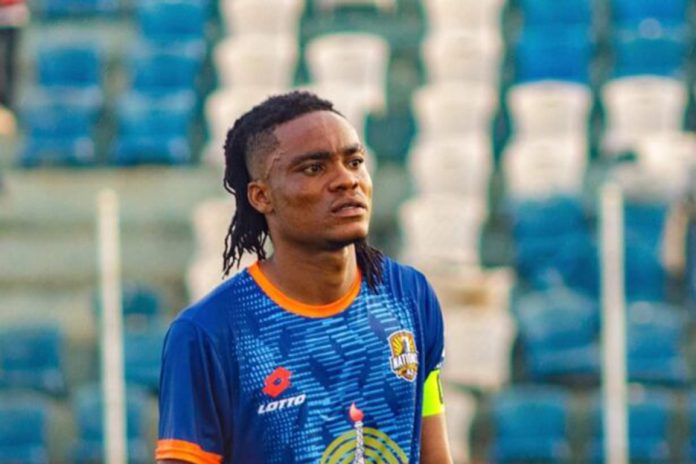
Nations Football Club brands manager Kennedy Boakye Ansah has made a bold claim that Nations FC defender Razak Simpson is arguably the best player on the Ghana scene.

He made the huge claim in an exclusive chat with Citi Sports when talking about the chances of the Kumasi based club winning what would be its maiden Ghana Premier League (GPL) title.

With four games left to be played in the 2024-2025 GPL season, Nations have 54 points and hold a one point lead over second ranked Bibiani Gold Stars.

Simpson, whose string of impressive performances have led to multiple call ups to the Black Stars, has been one of the standout players for Nations FC and Kennedy Boakye Ansah believes that the team’s captain is arguably the best player on the Ghanaian scene.

“He has proven that he is arguably the best player on the local scene and once he was given an opportunity to play for the Black Stars, we all saw the stuff that he is made of.”

We believe that being in the business of football, we should be able to develop talents not just for Nations FC but we should be able to develop talents that will be extremely beneficial to our national team course” Boakye Ansah said.

Credit: citisportsonline.com

The Ghanaian Chronicle