“…for the first time in our nation’s history, the power sector recorded a new and unprecedented peak generation of 5,801.84 megawatts of electricity on March 4, 2025, at 21:15 hours,” he said
Mr Abdulaziz said his state-owned TCN successfully transmitted all the generated electricity.
“The Transmission Company of Nigeria (TCN) efficiently evacuated this bulk power, to distribution load centers nationwide.”
PREMIUM TIMES reports that Nigeria has privatised its electricity generation and distribution companies. But the generated power is transmitted to the distribution companies by the state-owned TCN.
Parties who accept to resolve their disputes through Court-Connected Alternative Dispute Resolution (ADR) have the right to choose who mediates their cases.
Although the selection of mediators could largely be influenced by the background of available mediators, the ultimate decision on who facilitates the process is a prerogative of the parties involved.
Justice Mrs. Angelina Mensah-Homiah, a Court of Appeal Judge with oversight Responsibility for ADR, who gave the explanation, said the concept of mediation was to provide a conducive atmosphere for the two parties to resolve their case themselves.
“The duty of the mediator is to facilitate a dialogue between the two parties for an amicable resolution of their differences,” Justice Mensah-Homiah emphasised during an interaction with the Ghana National Association of Garages in Kumasi.
The exercise formed part of series of engagements with the business community in the Ashanti Region ahead of the annual ADR Week celebration scheduled for March 17-21.
The celebration will be launched at the forecourt of the Court of Appeal in Kumasi on March 17 by the Chief Justice on the theme: “Building the Pillars of Justice through Commercial Justice ADR.”
Also engaged as part of the pre-activities for the celebration were the Association of Ghana Industries (AGI) and the Mt. Olivet Methodist Church at Abrepo Junction.
Justice Mensah-Homiah said there were benefits in resolving disputes through ADR, including saving money and time which were valuable resources for businesses and individuals. It also ensures privacy, especially in marital and other personal matters, because ADR cases are not heard in open court, she noted.
She also explained that apart from the filing fee, parties would not pay any money to the court when they opted for ADR, making it very affordable. Mrs. Christiana Puorideme, Chief ADR Officer at the ADR Directorate of the Judicial Service, said the ADR mechanism was introduced into the Ghana’s justice delivery system in 2005.
She said the goal, among others, was to reduce the case loads in various courts by ensuring expeditious disposal of cases eligible for resolution through ADR.
She implored the participants to explore the use of ADR to settle disputes so they could have ample time for their businesses.
The following is a private member’s motion initiated by the Minority Leader, Osahen Alexander Afenyo-Markin, which was admitted by the speaker, S. K. Bagbin, but he (Afenyo) was prevented from reading it by the first Deputy Speaker, Bernard Ahiafor.
Rt Hon Speaker, I thank you for the opportunity to make a statement in support of my Motion urging this Honourable House to resolve that the directive from the Chief of Staff, Hon. Julius Debrah, in the letter dated 10thFebruary, 2025, with reference SCR/DA85/85/01/A, is inconsistent with good governance practices and has consequences on the Economic Rights of Citizens as provided for under Article 24 of the 1992 Constitution.
Mr Speaker, it is an undeniable fact that the Public Servants whose appointments have been arbitrarily revoked were duly recruited under the administration of President Nana Addo Dankwa Akufo-Addo, in line with established legal and administrative procedures. The power to appoint Public Servants is explicitly vested in the President under Article 195(1) of the 1992 Constitution. This power, as the Constitution provides, may be delegated to Governing Councils or Public Officers under Article 195(2). These appointments were, therefore, made within the legal framework of our nation’s governance.
Mr Speaker, we must also remind ourselves that a President is elected to serve a full four-year term, as clearly stipulated in Article 66(1) of the Constitution. In the specific case of President Nana Addo Dankwa Akufo-Addo, his mandate commenced on 7% January, 2021, and was to remain in effect until midnight on 6 January, 2025. The presidential election held on 7 December, 2024, did not in any way alter or truncate the President’s mandate before the expiration of his term. There was no constitutional vacancy in the Presidency between 7th December, 2024, and 6th January, 2025.
Mr Speaker, it is, therefore, unconstitutional and grossly unfair to revoke appointments that were made within the legitimate tenure of the former President. The directive by the Chief of Staff effectively suggests that the Executive authority of the President was nullified immediately after the elections – a position that finds no basis in law or constitutional practice.
Article 66(3)(b) clearly outlines the conditions under which a President’s term may end prematurely – these include death, resignation, or impeachment under Article 69. None of these conditions applied before the end of President Akufo-Addo’s tenure. Thus, any appointments made before 7′ January, 2025, remain valid and legally binding.
Rt Hon Speaker, this is not the first time that Public Sector appointments have been made after a presidential election, but before the expiration of the incumbent’s term. There are notable precedents:
The appointment letter of Mr. Daniel Domelovo as Auditor-General was written on 19th December, 2016, after the conduct of the presidential and general elections. He was sworn into office just three days before President Mahama left office.
Similarly, the Chairperson of the National Commission for Civic Education (NCCE), Madam Josephine Nkrumah, also received her appointment letter on 19th December, 2016, after the elections. She was also sworn into office three days before President Mahama’s tenure ended.
The CHRAJ Boss, Mr. Joseph Whittal, was also appointed and sworn in by President Mahama after he [President Mahama] had lost the 2016 general elections.
Many other Public Servants were recruited into service in December 2016, after the The December, 2016 elections. When concerns were raised at the time, the then Government, through Felix Kwakye Ofosu, explained that John Dramani Mahama was still the President and would continue to be so until 6th January, 2017. The question then is: WHAT HAS CHANGED?
Mr Speaker, even constitutional amendments have been enacted after elections but before the swearing-in of a new President. The first major amendment to the 1992 Fourth Republican Constitution happened after 20th
December, 1996, following the conduct of the presidential and parliamentary elections that year. The then President assented to the Amendment Bill on 31st December, 1996, and the Act was gazetted the same day.
Mr Speaker, the Public Servants whose appointments have been terminated went through the necessary legal and administrative processes. The individuals affected were duly vetted, approved, and appointed into the Public Service, and as such, are entitled to the full protection of the law. As Public Servants, they are protected by Article 191(b) of the Constitution, which guarantees their security of tenure unless they are lawfully removed for just cause.
Mr Speaker, what is the cause of their dismissal? There was no just cause stated in their dismissal letters. Initially, it was suggested that their recruitment was not in tandem with good governance. But what does that mean? Is “good governance” now a legal basis for nullifying lawful appointments? Clearly, this is a weak rationalisation and an afterthought meant to justify an unconstitutional act.
It was later suggested that there is no money to pay these workers. Mr Speaker, the contradictions in this Government’s actions are both glaring and indefensible. How does an administration that claims it cannot sustain the employment of young Ghanaians due to economic constraints suddenly find the fiscal space to recruit new workers?
The Minister for Foreign Affairs, Hon. Samuel Okudzeto Ablakwa, has already confirmed budgetary allocations for fresh recruitments in the upcoming budget to facilitate the rollout of a 24-hour service delivery system under his Ministry. Meanwhile, existing public sector workers have been dismissed under the guise of economic hardship. Who, then, is being misled? Clearly, these dismissals are not about economic prudence but rather a deliberate political cleansing of the public sector to make room for party loyalists.
Mr Speaker, the very foundation of this Government’s proposed “24-hour Economy” hinges on expanding, not shrinking, the Public Sector workforce. Yet, we witness mass dismissals of legally employed citizens who have undergone due process. How does this Government justify such actions while simultaneously advocating for an economy that requires more workers, extended shifts, and increased productivity? Is it now the case that employment in the Public Sector is reserved only for those who wear the political colours of the ruling party?
13.Mr Speaker, without a just cause – of which there appears to be none thus far
– the President’s directive smacks of vindictiveness and discrimination, in clear violation of:
– Article 12(2), which guarantees equality before the law,
– Article 17(3), which prohibits discriminatory treatment, and
– Article 35(5), which mandates the State to ensure fairness for all Citizens and prohibit discrimination and prejudice.
More importantly, Mr Speaker, this conduct directly violates the Presidential Oath that the President swore on 7th January, 2025 – barely a month and a half ago. The Oath demands that the President preserve, protect, and defend the Constitution of Ghana. Can a President who is actively undermining the Constitution be said to be upholding his Oath?
Article 24 of the Constitution guarantees every Ghanaian the Rights to Employment and Livelihood. These Rights to work cannot be vitiated by an Executive directive, especially when a Citizen has gone through the regular process required for employment. In any event, granted that there was any such procedural irregularity, same can be cured through a process of ratification and rectification, not termination. To the extent that a Citizen has been lawfully issued with an appointment letter and same has been accepted by him and he has entered into the employ of an institution, it will be repugnant to deny such a Citizen his Rights of legitimate expectation that once he is undertaking the prescribed job assigned to the rank in the organisation, the contract of employment is secure and same cannot be terminated.
Mr Speaker, this is an impeachable conduct. The President’s actions constitute gross misconduct under Article 69, warranting his removal from office. But is the President acting with impunity because he knows that the Minority Caucus does not constitute one-third of the membership of the House, and therefore cannot trigger impeachment processes under Article 69(2)(a)?
Mr Speaker, the President campaigned on the promise of resetting the country—a bold commitment to charting a new course and breaking away from past practices that he and his party deemed detrimental to our democracy. But what does this ‘reset’ truly mean if it only serves as a justification to repeat the very actions they once condemned? Those defending these mass dismissals argue that the previous administration did the same upon assuming office. But, Mr Speaker, doesn’t a true reset require doing things differently-strengthening our democracy, upholding the rule of law, and ensuring fairness for all, rather than perpetuating the same cycle of political retribution? If the President’s vision is indeed a reset, then it must be one that fosters progress, not a return to old habits under a new banner.
Moreover, Mr Speaker, this situation poses a serious security risk to the country. Unemployment remains a persistent challenge in Ghana, with the Government serving as the largest employer. The mass revocation of appointments will not only worsen the already high unemployment rate but also inflict severe economic and social hardships on the affected individuals and their families. Beyond personal distress, these layoffs will have broader economic repercussions.
In conclusion, Mr Speaker, there was no just cause for the dismissal of these public sector workers. In taking this action, the President has not only violated the Constitutional Rights of these Citizens but has also undermined the very principles of fairness and justice that should guide our governance.
I therefore urge this House to rise above partisan lines and speak with one voice in the supreme interest of the Ghanaian people. Let us resolve, unequivocally, that the directive from the Chief of Staff was unconstitutional and inconsistent with good governance practices, and same must be reversed.
Gender Working Group in action at Pre-SB62 AGNES meeting
For years, advocates across Africa have fought tirelessly to ensure that African women are not just impacted by climate policies but are actively shaping them. Despite their critical role in food production, water management, and environmental conservation, women have long been sidelined in major climate negotiations. Today, that reality is shifting. The African Group of Negotiators Experts Support (AGNES) has taken a bold step by placing gender at the center of Africa’s climate strategy, ensuring that women’s voices and leadership inform global climate discussions.
Climate Policy Strategy
At the Pre-SB62 strategy meeting in Nairobi, climate experts, negotiators, and stakeholders from over 30 African nations gathered to refine Africa’s position ahead of the 62nd sessions of the Subsidiary Body for Scientific and Technological Advice (SBSTA) and the Subsidiary Body for Implementation (SBI) under the United Nations Framework Convention on Climate Change (UNFCCC). Scheduled for June 16 to 26, 2025, in Bonn, Germany, these negotiations will influence key global climate policies. The meeting also shaped Africa’s priorities for COP30, set for November 10 to 21, 2025, in Belém, Brazil.
This gathering was not just about preparation—it was a strategic effort to ensure Africa’s voice, particularly that of women, is heard at the highest levels. With climate negotiations becoming more technical, the discussions focused on four key areas: Global Goal on Adaptation (GGA), Climate Finance, Agriculture and Food Security, and Gender Negotiations. These working groups tackled pressing issues such as financial access, adaptation strategies, and gender equity, ensuring that Africa’s climate policies reflect the continent’s unique challenges and strengths.
Gender Working Group in action at Pre-SB62 AGNES meeting
Participants at the Pre-SB62 strategy meeting
Gender Equity Advocacy
Women’s participation in climate negotiations is no longer a matter of symbolism—it is a necessity. Across Africa, women bear the brunt of climate change, yet they remain underrepresented in decision-making spaces. The Gender Negotiations stream in Nairobi addressed this imbalance by focusing on the Gender Action Plan (GAP) and identifying ways to integrate women’s leadership into Africa’s climate policies.
At COP29, global leaders extended the Enhanced Lima Work Programme on Gender and its GAP for another decade, a move that reaffirmed gender as a critical component of climate action. However, this commitment means little without real implementation. African women continue to face barriers in accessing climate finance, exclusion from leadership roles, and systemic inequalities that hinder their ability to shape climate solutions. The discussions in Nairobi sought to change this by ensuring that the next phase of the GAP is action-oriented, addressing real challenges faced by African women.
Gender Working Group representatives
Gender Working Group representatives
Policy Implementation Challenges
Dr. George Wamukoya, Team Lead for AGNES Africa, emphasized the importance of strategic preparation in climate negotiations. He noted that Africa’s ability to influence global discussions depends on well-developed submissions on the Global Goal on Adaptation (GGA), agriculture, and gender. Beyond policy formulation, the goal is to create greater awareness around resource mobilization for climate-resilient agriculture and highlight the link between human mobility and climate change.
The Gender Negotiations stream critically examined the existing Gender Action Plan (GAP), identifying gaps and proposing solutions. The outcome of these discussions will be instrumental in strengthening gender-responsive climate policies, ensuring that women are not just participants but key decision-makers in Africa’s climate strategy.
Future Negotiation Roadmap
The insights from the Nairobi meeting will set the stage for discussions at SB62, where a technical workshop will initiate the development of a revised Gender Action Plan. Informed by the 2024 review, this process presents a critical opportunity for African women to assert their perspectives in climate negotiations. Recommendations from stakeholders are expected by March 31, 2025, marking a decisive moment in refining Africa’s climate agenda ahead of COP30.
As preparations continue, African women are no longer waiting to be invited into climate discussions—they are taking their place as architects of the future. From Nairobi to Bonn and ultimately to Belém, their leadership will shape the global climate agenda. Africa is not just responding to climate change; it is leading the way, with women at the forefront of this transformation.
Award-winning American-based Ghanaian movie producer, Leila Jewel Djansi has launched a scathing critique on the Ghana movie industry, citing unprofessionalism by some industry players.
In a post on her Facebook wall on March 2, 2025, the experienced filmmaker described the Ghanaian movie industry as a “mirthless joke”, referencing some unpleasant experiences she witnessed while working in Ghana.
Leila urged industry players to take criticisms in good faith to help grow the industry rather than countering these criticisms with knee-jerk reactions.
“Stop enduring mediocrity, please. Instead of these knee-jerk reactions, instead of acting like people just want to hate, forget the who and the how and actually listen.
“Sit with the criticism. Use it to rise,” she wrote on Facebook.
“Sometimes, when you are given criticism, don’t just get angry and fail to actually see the import or ask the reason behind the accusation. Separate your emotions and be objective,” she added.
The experienced movie producer recounted an instance when actor and politician, John Dumelo was nearly stabbed on set because a production designer was not careful.
“Should I talk about the production designer who passed a real knife to an actor for a stabbing scene? My God. If it wasn’t for divine intervention, Vanessa Williams would have stabbed John Dumelo with a real knife that day. How is this not a joke?” she recalled.
Actor/Film & Stage Play Director, Fiifi Coleman has highlighted some reasons which have contributed to the collapse of the movie industry in Ghana.
Speaking in an interview on Onua Showbiz with Naana Kwame Gyan, Fiifi Coleman explained that the adoption of some foreign cultures and the inability to tell genuine African stories in movies have contributed to the decline of the industry.
He said the influx of producers, screenwriters, cameramen have overshadowed the production of quality content.
“A time came people realized that shooting movies was becoming profitable so everybody became a cameraman, everybody became a soundman and they were doing that until they messed up the industry. So, there were so many round pegs in square holes.
Kieran Culkin won an Oscar on Sunday for playing Eisenberg's on-screen cousin in A Real Pain
US actor Jesse Eisenberg has been awarded Polish citizenship by President Andrzej Duda, after telling the story of the Jewish population during World War Two in his Oscar-winning film A Real Pain.
Eisenberg wrote, directed and starred in the film, about two American cousins who travel to Poland to honour their grandmother, a Holocaust survivor, who was based on Eisenberg’s own great aunt.
He told the citizenship ceremony: “While we were filming this movie in Poland, and I was walking the streets and starting to get a little more comfortable in the country, something so obvious occurred to me, which is that my family had lived in this place for far longer than we lived in New York.
“And of course, the history ended so tragically.”
He continued: “In addition to that tragedy of history is also the tragedy that my family didn’t feel any connection any more to Poland, and that saddened me and confirmed for me that I really wanted to try to reconnect as much as possible.
The Ashanti Regional Minister, Dr. Frank Amoakohene, has constituted a committee to look into factors militating against the growth of the film industry in the region and how to solve them.
In a statement posted on his Facebook page, Dr Amoakohene, he wrote: “Today, I officially commissioned a Ministerial Committee on the Movie Industry & Creatives (Kumawood) to drive the growth and transformation of Ghana’s film and creative arts sector.”
The indicated that the committee has been tasked with “assessing the current state of the industry and identifying key challenges, developing policies to attract investment and ensure sustainable growth, exploring strategies to promote Ghanaian films both locally and internationally, strengthening film infrastructure by improving production facilities and training opportunities, enhancing film festivals and cultural showcases to celebrate Ghanaian storytelling and creativity, and fostering collaboration between stakeholders to create more opportunities for filmmakers, actors, and creatives.”
He therefor urged the committee members to carry out their mandate with dedication, commitment, and a strong sense of unity to ensure that Kumawood and the entire creative industry reach new heights.
He believes that this will help them build a globally competitive film industry that tells the rich stories of Asanteman and Ghana
The show aims to reveal how some banks and finance companies profit from society’s most vulnerable.
Sheen said he did not have £100,000 to “throw around” and therefore wanted the project to be “effective”.
Despite initial doubts, an encounter with a woman in a Port Talbot cafe who shared the story of “steelworkers in tears” losing their jobs, convinced him to keep going.
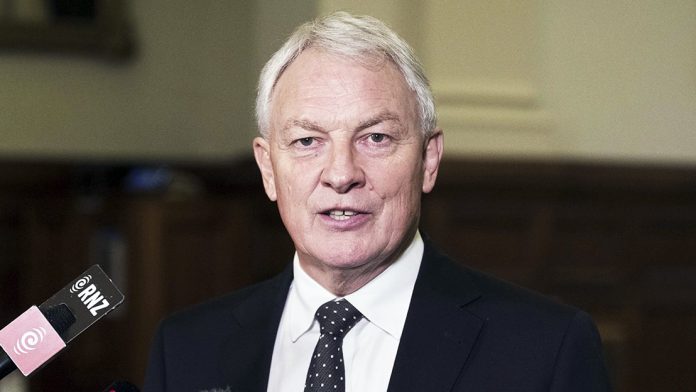
New Zealand’s high commissioner to the UK has been fired after questioning US President Donald Trump’s grasp of history at an event in London.
Speaking at international think tank Chatham House on Tuesday, Phil Goff, the former mayor of the city of Auckland who has also served as foreign minister, said: “I was re-reading Churchill’s speech to the House of Commons in 1938 after the Munich Agreement, and he turned to Chamberlain, he said, ‘You had the choice between war and dishonor. You chose dishonor, yet you will have war.’”
“President Trump has restored the bust of Churchill to the Oval Office,” added Goff. “But do you think he really understands history?”
Goff was making a comparison between Trump’s efforts to end the war between Russia and Ukraine, and the 1938 agreement signed by British Prime Minister Neville Chamberlain and the leaders of France and Germany which gave Adolf Hitler permission to annex part of Czechoslovakia. The Nazi leader invaded Poland a year later, triggering World War II.
New Zealand’s Foreign Minister Winston Peters later fired Goff over his comments and said he would have done the same if he had said something similar about other countries.
“If he (Goff) had made that comment about Germany, France, Tonga, or Samoa, I’d have been forced to act,” Peters told journalists.
“It’s seriously regrettable and one of the most difficult things one has had to do in his whole career,” he added.
“I’ve worked with Phil Goff, I’ve known him for a long time,” said Peters, adding that Goff’s comments were “seriously disappointing.”
“When you are in that position, you represent the government and the policies of the day; you’re not able to free think; you are the face of New Zealand,” he added.
However the move was not without its critics, including former New Zealand Prime Minister Helen Clark.
“This looks like a very thin excuse for sacking a highly respected former #NZ Foreign Minister from his post as High Commissioner to the UK,” wrote Clark in a post on X.
“I have been at Munich Security Conference recently where many draw parallels between Munich 1938 & US actions now.”