Home Blog Page 843

PDA, FRA And NADA Re-Incarnate in Parliament Is It Now Forbidden to Call a Murderer, a Murderer?

0
Opinion

During the First Republic, draconian laws made it very impossible for Ghanaians to express opinions, that may put the president and his government in the negative. The Preventive Detention Act (PDA)1959,gave the president the power to throw anyone to jail without trial and the False Report Act (FRA) 1959, would throw anyone to jail without trial, when he is perceived to have made statements that dishonoured the president and government. Under these laws anyone who is truly or falsely accused will not have the opportunity to defend himself in court. He will go straight to jail.

Then we had the National Assembly (Disqualification) Act (NADA) of 1959which disqualified from sitting, Members of Parliament who failed to carry out their parliamentary duties.

Today it seems these obnoxious laws have re-incarnate in no other place than our honourable House of Parliament.

On February 4, 2025, when the NPP minority leader, Hon Afenyo Markins was eulogising Dr. J.B. Danquah on the 60th anniversary of his death, Hon Murtala Muhammed of the NDC proclaimed that the doyen of Ghana politics and democracy, was a traitor and CIA agent. Hon Zanetor Rawlings of the NDC was seen urging Hon. Muhammed on. Then a strong voice swept the Chamber, “Daughter of a Murderer,” referring to Zanetor.

Since then, all hell has broken loose and that truth is now being described as an unsavory remark which could have thrown one straight to jail under the PDA or FRA in the First Republic. As for the uncouth lie about J.B. Danquah being a traitor and CIA agent, it is acceptable. As in those days, you dare not say harsh truths about Nkrumah, today Parliament is also saying we should not criticise Rawlings.

Someone from the Nkrumaist side of the House had falsely accused J.B. Danquah as a traitor and CIA agent and that is okay, but another from the UP-Tradition side who rightly called Rawlings a murderer, is being criminalised.

Very typical of NDC and Nkrumaists, who have propaganda genes in their blood and can lie till it is accepted as the truth and can easily make the truth look like a lie, they keep insisting that J.B. Danquah was what they described him, but Rawlings was not a murderer.

In fact, we are now being told that, that the word, murderer, is not allowed in Parliament and the MP who utter those words, when found, can be expelled by invoking the re-incarnated National Assembly (Disqualification) Act, because according to Speaker Bagbin, that MPhad failed to carry out parliamentary duties.

Hear the Speaker,“Such a member, when found guilty of defamation or contempt of parliament, or in breach of parliamentary privilege, would be liable to be reprimanded, or by resolution, suspended from the service of parliament for a period not exceeding nine months, or expelled from parliament altogether.”

This is ridiculous! In 2020, Rawlings himself on YouTube, in so many words, announced to the world that he was a murderer.

Before passing judgment on whoever called Zanetor, a daughter of murderer, I expect Parliament to view and debate the full clip of Rawlings’ interview on Asaase FM without any political lenses on. For if someone said it hurts him that,he had people he knew were innocent to be killed, what makes that person?

Some Ghanaians havecome out to label Rawlings,a murderer, when he was alive. They include Mike Adjei, Kwaku Baako Jnr, ex-Cop. Adabuga and others. But Rawlings never had the nerves to take them on, to provide proof. However, when publications came out in some Ghanaian newspapers, demanding him to clear the air about a publication in a foreign media saying he was involved in gold smuggling or drug trafficking, he immediately dragged the editors to court and had them jailed.

The House of Parliament is one arm of government that can clearly come out to label Rawlings as he was and take the necessary steps to console the families of his victims. This is very important because Rawlings did not make this admission at the National Reconciliation Commission but waited about five months to his death to tell us who he truly was. And the government of that day could not send him to court, how sad.

Rawlings had caused lots of pains in the hearts of many families which affect millions of others, by killing their loved ones. In Anlo, we have the Amedume and Goka families. In Tongu, the Agbofu clan of Tefle who are in-laws of Acheampong and are still in pain and mourning him with his children. All across the country there are families mourning the murder of their loved ones by Rawlings and all Parliament is saying it is wrong to call him a murderer? Is Parliament, a House of truth and justice?

If the House finds out who pronounced those words at Zanetor and punishes him, it would breed discontent all over and throw the country into chaos.

I ask the lawyers in Parliament including the Rt. Hon Speaker, that what verdict would a judge give if Rawlings makes the same confessions, he made on Asaase FM, in court? Would Rawlings be convicted of manslaughter or murder?

If the word murderer is unsavoury and unparliamentary, then Ghana is back to the First Republic.

Hon. Daniel Dugan

Editor’s note: Views expressed in this article do not represent that of The Chronicle

Editorial: Destruction Of Railway Lines And High Tension Pylons Must Be Stopped!

0
Rail tracks

The Ghana Railway Authority (GRA) has uncovered severe vandalism and encroachment along the 97-kilometre Tema-Mpakadan railway line, threatening the soon-to-be-launched shuttle service. Inspection teams found stolen bolts, nuts and buffer stops, endangering railway safety.

A High Tension Pylon

In a related incident, more than 15 communities around Ejisu in the Ashanti Region are facing widespread blackout after eight electricity pylons collapsed due to stolen bolts and nuts. Businesses and residents are suffering and the Electricity Company of Ghana (ECG) is working to restore power, though no timeline has been set. Both incidents highlight the dangers of infrastructure vandalism and the urgent need for stricter security measures.

These two incidents are both shocking and deeply troubling. These criminal acts not only pose a serious risk to public safety but also undermine the nation’s infrastructure development and economic progress.

The railway system, a crucial component of our transportation sector is under attack from unscrupulous individuals who seem determined to render it non-operational. The discovery that several bolts and nuts securing the rails have been stolen, leaving the tracks dangerously loose, is an alarming indication of the recklessness and audacity of these criminals. Even more worrying is the theft of buffer stops, very important metal structures designed to regulate train speeds, which could lead to catastrophic accidents if not urgently addressed.

Similarly, the theft of essential components from electricity pylons, leading to a massive blackout affecting over 15 communities in and around Ejisu, highlights the devastating consequences of such criminal acts. The Electricity Company of Ghana (ECG) is scrambling to rectify the situation, but the damage has already been done.

What makes these acts of vandalism even more frustrating is that, regrettably, many of the perpetrators are believed to be scrap dealers, most of whom are not even Ghanaians. This raises serious concerns about border security and the regulation of the scrap industry. The authorities must investigate this syndicate, tracking down not only those who steal these essential materials but also those who purchase them.

Scrap dealers who knowingly buy stolen railway components and electricity infrastructure must face the full rigors of the law. The police must go beyond arresting petty thieves and dismantle the larger network involved in this illicit trade.

Furthermore, we must critically examine the role of surveillance and preventive measures in curbing such acts. The fact that bolts and nuts from railway tracks and electricity pylons can be stolen in such large quantities without detection speaks volumes about the inadequacy of security measures.

Where are the CCTV cameras that should be monitoring these crucial installations? What is the state of security along our main highways and railway corridors? Authorities must immediately install and ensure the proper functioning of CCTV cameras at strategic locations, including major streets and critical infrastructure points, to monitor and deter these criminals.

Additionally, the need for well-lit streets across the country cannot be overstated. Darkness provides a safe haven for these criminals to operate undetected. The government must prioritise the installation of streetlights in every part of the country. This will not only enhance security but also aid law enforcement in tracking down culprits.

Infrastructure development is a painstaking process that requires a lot of investment. It is deeply disheartening that after billions of cedis have been poured into projects like the Tema-Mpakadan railway, criminal elements seek to sabotage progress for personal gain. This menace must be met with swift and decisive action. The government must impose harsh sentences on those caught vandalizing public infrastructure, setting a strong precedent that deters others from engaging in such acts.

The government, security agencies and the public must come together to put an end to this cycle of destruction. Ghanaians must be encouraged to report suspicious activities and security forces must be proactive in preventing these crimes rather than reacting after the damage has been done.

We cannot afford to have our infrastructure undermined by a few unscrupulous individuals. It is time to treat infrastructure vandalism as a national security issue and tackle it with the seriousness it deserves. The perpetrators must be dealt with decisively and preventive measures must be enhanced to safeguard the country’s progress. If we fail to act now, we risk losing not only our infrastructure but also our vision for a developed Ghana.

Works and Housing Minister presents food items to 20 Muslim Communities 

0
Mr. Kenneth Agyei, the Minister for Works and Housing

Mr. Gilbert Kenneth Agyei,  Minister of Works and Housing, has presented food items to about 20 Muslims communities in the Ashanti Region in support of Muslims involved in the fasting and towards the Ramadan festivities.

Mallam Yahaya presenting the items to Mr George Idrisu on behalf of Mr Kenneth Agyei

The items include 100 bags of Sugar, Lipton, 80 bags of Rice and Bottles of cooking oil for each of the Zongo community.

Presenting the food items on behalf of the Minister in Kumasi, the Ashanti Regional Director of Operations, Mallam Yaya Mohammed, commended Muslims for the peaceful observation of this year’s Ramadan, despite their individual challenges.

According to him, the Minister believes that it is essential for all Ghanaians to show love and compassion to their Muslim neighbours, especially during the celebration of Ramadan.

George Iddrisu, a member of the ruling party, who is also the Ashanti Regional DRIP Coordinator, who received the donation on behalf of all the beneficiary communities, expressed gratitude to the Minister for the donation.

Chairman Iddrisu prayed for peace and unity among the populace to work towards addressing challenges in the country.

AGA holds mini clinic to mark World Kidney Day

0
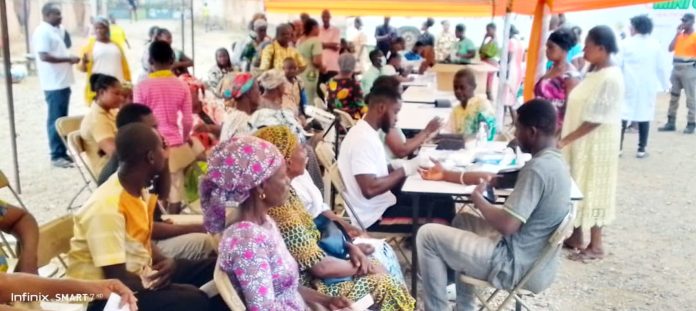
Patients who attended AGA clinic

AngloGold Ashanti (AGA) Obuasi Mine, together with its partners has organised a Mini Clinic at Anyinam, a suburb of Obuasi, to mark World Kidney Day.

World Kidney Day is a day set aside to raise awareness of kidney health and ensure that patients with kidney disease have equitable access to care.

A Physician Specialist at AngloGold Ashanti Health Foundation (AGAHF), Dr. Sulemana Swabil, noted that kidney disease affects about 10% of the world population as a result of which millions of people die every year for lack of access to affordable treatment.

He mentioned that the prevalence of chronic kidney disease in Sub-Sahara Africa is 14% and 13.5% in Ghana.

Some of the people who were rewarded

Dr. Swabil stated further that in Ashanti region, chronic kidney disease is a common cause of hospital admissions and death and that about 17.6 patients require dialysis per million populations.

He pointed out that at AGAHF, two out of ten people admitted to the medical wards have chronic kidney disease, while nine out of ten people with kidney disease are unaware they have it.

He stated that diabetes, high blood pressure and unhealthy lifestyle choices are some of the leading causes of chronic kidney disease in the world.

“This month is not just about raising awareness; it is about taking action. Let’s commit to spreading knowledge about kidney health, encouraging regular check and supporting those with kidney diseases,” Dr. Swabil advised.

In a speech read on his behalf, the Community Relations Manager of AGA, Mr. Edmund Oduro Agyei, said the Mini Clinic was to bring quality healthcare to the doorsteps of the local people by providing free screening for kidney function, eye health, dental care, body mass index (BMI), blood glucose levels and many other screenings.

The Assemblyman for Anyinam Electoral Area, Mr. Solomon Amoako Acheampong on behalf of the community thanked AGA for the gesture.

He stated that but for the benevolence of the company, education on the protection of the kidney in particular and the Mini Clinic would have eluded them.

At the close of day,  ‘The Chronicle’ learnt that over 20 extractions and 63 scaling and polishing cases were executed at the Dental Department by the Otumfuo Osei Tutu II Foundation while over 250 people were screened and treated at the Eye Department.

From Frederick Danso Abeam, Anyinam-Obuasi

Lagos To Shut Independence, Marina-CMS Bridge For Two Months

0
Marina-CMS Bridge

Lagos State Government will shut and divert traffic for the emergency repairs of the Independence/Mekwen Bridge (inbound Marina/CMS route) for two months.

Disclosing this in a statement on Sunday, the State Commissioner for Transportation, Oluwaseun Osiyemi, said the emergency repair of the bridge is scheduled from Wednesday, March 19 19, to Monday, May 26, 2025.

He said during the repairs, the section of the road from the National Open University of Nigeria (NOUN) through Bonny Camp Bridge down to Independence Bridge will be closed to vehicular movement.

“Similarly, the Bonny Camp Underpass Bridge service lane inbound Independence Bridge will not be available for motorists. However, the service lane from Ahmadu Bello Way to Ozumba Mbadiwe will be open to traffic,” the statement read.

“Motorists heading to Victoria Island from Ahmadu Bello Way are advised to use Ozumba Mbadiwe Avenue inbound Akin Adesola Street, and proceed to Falomo Roundabout, then link Obafemi Awolowo Road to access Ring Road to continue their journeys.

Motorists from Ahmadu Bello Way heading to 3rd Mainland Bridge should go through Ozumba Mbadiwe Avenue inbound Akin Adesola Street, then link Alfred Rewane Road to Osborne Road, and connect to Ring Road to reach their destinations.

“Motorists heading to Inner Marina and CMS from Ahmadu Bello Way will be diverted to Ozumba Mbadiwe Avenue inbound Akin Adesola Street to connect Falomo Roundabout, then link Obafemi Awolowo Road to access J.K. Randle Road/King George V Road to reach their desired destinations.”

According to the commissioner, motorists heading to Ahmadu Bello Way from Inner Marina/CMS will have through-traffic access. Osiyemi reassured Lagosians that the Lagos State Traffic Management Authority (LASTMA) will manage traffic flow along the aforementioned routes for the duration of the project.

Credit: channelstv.com

Kogi LGAs shut down cattle markets over security concerns

0
LGAs shut down cattle markets

The Ijumu and Kabba-Bunu Local Government Councils in Kogi State have ordered the immediate closure of two major Zango Cattle Markets following escalating security threats in the area.

The affected markets, located in Iyara (Ijumu LGA) and Odolu (Kabba-Bunu LGA), were reportedly being exploited by criminal elements, including kidnappers and bandits, prompting decisive action by local authorities.

Announcing the closure in Lokoja, the Chairman of Ijumu LGA, Alhaji Haruna Ibrahim, and his Kabba-Bunu counterpart, Dare Zacchaeus, emphasized that the move was in line with Governor Ahmed Ododo’s directive to combat insecurity and protect residents.

Ibrahim explained that intelligence reports had revealed the market was being used as a hub for criminal activities, necessitating its closure until further notice. Security agencies have been mobilized to enforce the order and prevent any breach.

“The safety of Ijumu residents and travelers is our priority. Anyone frustrating the government’s efforts will face the full wrath of the law,” Ibrahim warned.

Similarly, Zacchaeus justified the shutdown of the Odolu Cattle Market due to persistent attacks by bandits and kidnappers. .

He issued a stern warning to displaced herdsmen from Zango in Iyara against relocating to Kabba-Bunu, stating that any such attempt would be met with stiff resistance and legal action. Credit: dailypost.ng


Nigerian troops arrest two notorious bandits, recover dangerous weapons in Plateau

0
Nigerian troops

The Nigerian Army has said its troops of 3 Division/Operation Safe Haven have arrested two notorious kidnappers, Bashir Mohammed and Ismail Mohammad, in Plateau State.

According to a statement on its official Facebook page on Sunday, the Nigerian Army said the operation was carried out on Saturday following intelligence reports.

“The operation, conducted under Operation LAFIYAN JAMA’A, raided a kidnappers’ hideout at Katume High Grounds in Bassa LGA, following credible intelligence that kidnappers often hide their victims in the area while negotiating for ransom,” the Army HQ said.

The statement added that during the operation, troops recovered dangerous weapons, including one AK-47 rifle and one AK-47 magazine, from the criminal elements.

“The arrested kidnappers are currently in custody, making useful confessions that will aid follow-up operations to arrest their cohorts and recover their weapons.

“This success is a testament to the effectiveness of Operation SAFE HAVEN’s efforts to tackle insecurity in the region,” it added.

Credit: dailypost.ng

Stop threatening Nigerians for criticising govt -Amnesty Int’l

0

Amnesty International on Sunday said the Federal Government must stop threatening individuals and groups who criticise the current administration.

“The Nigerian authorities must stop responding with violence and threats to individuals and groups who express dissenting opinions — in utter disregard for Nigerian constitution and international law. Holding and voicing dissenting views is not a crime,” the organisation in a statement on its X handle.

It also condemned the alleged threats and intimidation being faced by Lagos-based National Youth Service Corps member, Ushie Uguamaye.

This followed her viral TikTok video where she criticised President Bola Tinubu’s government over hardship Nigerians face as a result of the economic reforms.

The human rights watchdog denounced the reported threats from NYSC officials, emphasizing that Uguamaye was well within her rights to express her frustration over the country’s worsening economic conditions.

“Amnesty International strongly condemns threats and intimidation directed at a lady who posted TikTok video lamenting the current escalating economic hardship. The lady alleged that NYSC officials @officialnyscng threatened her for refusing to delete the video,” the statement read.

“It is perfectly within her right to express discontent peacefully. Instead of threatening her for her opinions on rampant inflation, the authorities should prioritise addressing the country’s economic woes.

“Millions of people in Nigeria are facing extreme poverty. So far, the authorities have failed to put in place effective mitigation measures, leaving millions of people without the hope of getting out of the economic challenges and enjoying their human rights.”

Uguamaye alleged that shortly after the video went viral, she began receiving threats, purportedly from NYSC officials, pressuring her to delete the content.

She expressed fears for her safety, stating that her personal details had been leaked and that she was being pressured to report to the NYSC office.

Credit: channelstv.com

Potential of youth in agribusiness is limitless-Ansare

0
Economic Youth Agribusiness

Dr Afua Ansare, UN Women Ghana, says the potential of youth in agribusiness is limitless, but they require access to finance, mentorship, market integration, and digital literacy.

She called on the government to commit to policies that dismantled these barriers and unleashed their entrepreneurial spirit.

Dr Ansare was speaking at the maiden edition of AgriBiz Youth & Women Dialogue (AYWD) on the theme: “Sustaining & Scaling Youth and Women-led Agribusiness for Economic Growth.”

The AYWD, an initiative of Africa Skills Hub Foundation (ASH) in partnership with National Youth Authority, is a platform for young people and women in agriculture and agribusiness to share experiences, tackle challenges, and explore opportunities.

This dialogue seeks to increase their voices, promote collaboration, and advocate for policies that enhance their participation in the sector.

The event was to identify key challenges young people and women face in agribusiness, and propose actionable solutions and explore emerging agribusiness opportunities, including innovative financing and technology.

It was also to advocate for policies that enhance inclusivity (youth and women) in agribusiness and facilitate networking to foster partnerships and collaboration among stakeholders.

She said as “we focus on women in agriculture, we must also acknowledge their critical role as caregivers and the impact of agricultural practices on the well-being of young children.”

Dr Ansare said women farmers were often responsible for ensuring household food security and nutrition and supporting them directly translated to healthier families and communities.

She said to achieve sustainable transformation in agribusiness, stakeholders must bridge the gender and youth gap through these key interventions:

She said studies demonstrated that if female farmers had equal access to productive resources, farm yields would increase by 20-30 per cent.

She said Ghana’s agricultural financing gap was estimated at $4 billion annually, according to the African Development Bank (AfDB) and “we must prioritize and scale up targeted credit facilities specifically for women and youth in agribusiness, offering favorable terms and conditions.”

She said in Rwanda, youth-led agribusiness innovations had already achieved a remarkable 15 per cent boost in agricultural productivity over the last five years, as reported by AfDB.

Dr Ansare said Ghana could emulate this success by strategically investing in agritech, mechanization, and climate-smart agriculture.

She said digital agriculture solutions had the potential to increase farm productivity by up to 70 per cent and reduce post-harvest losses by as much as 30 per cent, according to the World Bank.

“Across Africa, young entrepreneurs are pioneering precision farming technologies, including drone-assisted irrigation and AI-driven soil analysis,” she added.

She urged governments, financial institutions, development partners, the private sector, civil society, and everyone to act decisively and collaboratively to support these group of people

She called for investment in women, empowering young people to build a future where agriculture was not simply a means of survival, but a thriving pathway to prosperity, innovation, and sustainable development for all Ghanaians.

“Together, let us cultivate a brighter future for Ghana’s agribusiness sector, transform lives, uplift communities, and leave a legacy of progress for generations to come,” she added.

Mr Daniel Antwi, Executive Director of ASH, said as a dedicated enterprise support organization for youth and women, Africa Skills Hub understood the role of capacity building, capital access and community engagement in supporting and strengthening youth and women enterprises on their entrepreneurial journeys.

He said the conversations provided insights into challenges and opportunities in youth and women-led agribusinesses.

By Morkporkpor Anku

GNA

Minimum Capital Requirement for Establishing Universal Banks and Development Finance Institutions 

0
Dr Gideon Boako, MP for Tano North

I have received numerous inquiries regarding whether the minimum paid-up capital requirementsfor establishing Universal Banks and Development Finance Institutions are the same. These questions have arisen following the government’s announcement of plans to establish a Women Development Bank with a budgetary allocation of GH¢50 million.

I fully support the initiative to establish the Women Development Bank and sincerely hope that the government implements it effectively, in line with the expectations of many Ghanaians.

For the purpose of public education and clarification, I am providing the following insights into the minimum paid-up capital requirements for the establishment of Universal Banks and Development Finance Institutions.

  1. Minimum Capital Requirement for Universal Banks

In accordance with Section 28 (1) of the Banks and Specialised Deposit-Taking Institutions Act, 2016 (Act 930), the Bank of Ghana revised the minimum paid-up capital for both existing banks and new entrants. Effective 11th September 2017, the capital requirement increased from GH¢120 million to GH¢400 million, as specified in NOTICE NO. BG/GOV/SEC/2017/19.

  1. Minimum Capital Requirement for Development Finance Institutions

On 18th March 2021, the Bank of Ghana issued a directive on Licensing and Capital Requirements for Development  Finance Institutions (DFIs), pursuant to the Development Finance Institutions Act, 2020 (Act 1032). This directive, contained in NOTICE NO. BG/GOV/SEC/2021/04, categorises DFIs into four (4) main classes, each with specific capital requirements:

Minimum Paid-Up Capital and Application Processing Fees:

1) Class 1– Wholesale Development Finance Institution: GH¢800 million.

2) Class 2 – Retail Development Finance Institution: GH¢600 million.

3) Class 3 – Guarantee Development Finance Institution: GH¢300 million.

4) Class 4 – Hybrid Development Finance Institutions (depending on the combination of activities undertaken):

– Class 4a (Wholesale, Retail & Guarantee): GH¢1.2 billion.

– Class 4b (Wholesale & Retail): GH¢1 billion.

– Class 4c (Wholesale & Guarantee): GH¢1 billion.

– Class 4d (Retail & Guarantee): GH¢800 million.

It is important to emphasise that, according to the notice, no pre-operating permit will be granted unless the applicant meets the required paid-up capital threshold, and the original sources of capital are deemed acceptable.

  1. The GH¢50 Million Allocation for the Women Development Bank

Given these statutory requirements, it is important to critically assess the government’s proposed GH¢50 million allocation for the establishment of the Women Development Bank.

Is this allocation intended for:

– A Universal Bank?

– A Development Bank?

– A Savings and Loans Company?

– A Microfinance Institution?

Clarity on this matter would be beneficial to ensure the initiative aligns with existing regulatory frameworks.

God bless you all, and have a blissful weekend

By Dr Gideon Boako (MP)

The Ghanaian Chronicle