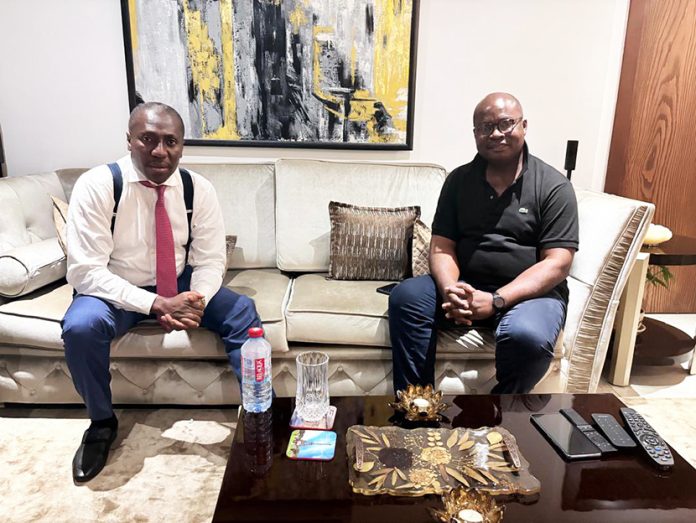
When Samuel Yaw Larbi coordinated the implementation of an electronic ticketing system project after his dissertation on E-ticket from the Kwame Nkrumah University of Science and Technology, which slashed revenue leakage by 60% at Ghana’s Metro Mass Transit, he wasn’t just solving a local problem, he was developing insights that would later reshape global conversations about AI-driven supply chain management.
Now at Northeastern University’s Roux Institute, Mr. Larbi has emerged as an extraordinary voice in sustainable logistics and supply chain, producing six peer-reviewed publications in less than two years that bridge continents and industries. His growing Research Interest Score of 45.4 places him among the top 4% of researchers who began publishing in 2024.
“Real innovation comes from understanding systems at their core,” Mr. Larbi explains. “My 13 years managing one of West Africa’s largest public transit operations taught me that elegant theories mean nothing if they don’t work in practice.”
This philosophy is evident across his research, where sustainability and supply chain resilience intersect through digital innovation. In his study “Quantifying Environmental Impact Reductions through Metaverse Technologies in Transportation,” he moves beyond theory to offer practical frameworks for reducing carbon emissions across transport and logistics networks. Complementing this work, his research on AI-driven supply chain risk management addresses algorithmic bias and transparency, critical challenges he encountered firsthand while modernizing public transportation systems in Ghana, highlighting how ethical AI can strengthen both sustainable operations and supply chain decision making.
What distinguishes Mr. Larbi is his rare combination of operational mastery and academic excellence. As a Chartered Member of The Chartered Institute of Logistics and Transport, he brings unparalleled credibility to complex discussions about global supply chains. His experience reducing fuel consumption by 30% through innovative management systems at Metro Mass Transit directly informs his research on sustainability in traditionally carbon intensive sectors.
“Samuel’s work transcends typical academic research,” notes a prominent Ghanaian logistics and supply chain expert and a member of the Chartered Institute of Logistics and Transport, Mr. Ebenezer Marfo. “He’s lived these challenges, solved them in practice, and now he’s codifying solutions that industries worldwide can implement.”
His influence extends across unexpected domains. From examining agile governance frameworks for smart cities to analyzing the American fashion manufacturing renaissance, his work explores how policy, innovation, and operations converge to drive sustainable change. Mr. Larbi demonstrates how logistics expertise applies universally to solving complex, real world challenges.
Through his work with Germany’s GIZ/Street Girls Aid and the Circular Economy and Innovators Foundation as a trainer, Consultant and Project Monitoring and Evaluation Officer, he trained University of Ghana female engineering students, women and youth who deal in electronic waste (scrap dealers) at various Municipalities in Ghana on sustainable e-waste management, reflecting a strong commitment to cross cultural knowledge transfer.
The numbers reflect his growing impact: over 2,012 reads of his publications, international citations, and collaborations with researchers across continents. Yet statistics only hint at the transformative nature of his contributions. When Mr. Larbi writes about supply chain resilience or transportation efficiency, he draws from managing fleets across Ghana, negotiating with suppliers, and implementing systems that served millions.
Mr. Larbi’s research addresses tomorrow’s challenges today. His exploration of digital twins in logistics and blockchain’s role in supply chain transparency positions him at the forefront of technological disruption. Industries seeking to balance efficiency with sustainability increasingly turn to frameworks he’s developing.
For Mr. Larbi, each publication represents an opportunity to transform industries he knows intimately. His journey from managing Ghana’s buses to shaping global logistics research exemplifies how exceptional talent transcends borders, creating solutions that resonate worldwide.
The Minority Leader in Parliament, Alexander Afenyo-Markin, has strongly criticised the Mahama administration for allegedly using state security to intimidate citizens.
His comments follow reports of missing valuables, including GH¢10,000 and jewellery, from the residence of former Bank of Ghana Governor, Dr. Ernest Addison, during a search conducted by National Security operatives.
How things were scattered in Dr Addision’s house
Addressing a press conference in Parliament yesterday, Afenyo-Markin alleged that the raid on Dr. Addison’s home was led by Richard Jakpa, Director of Special Operations at the National Security Secretariat.
He claimed that during the operation, cash left on Dr. Addison’s bed, as well as earrings and necklaces belonging to his wife went missing.
“Some of these hungry foot soldiers parading as security operatives have perhaps not even been paid, and they use these opportunities to steal,” he stated.
“We cannot allow such lawless acts to continue in our democracy.”
Additionally, Afenyo-Markin revealed that three official vehicles were seized from Dr. Addison’s compound.
The former Governor was allegedly contacted by Richard Jakpa and instructed to send his drivers to retrieve the vehicles from a specific location around 4:30 PM.
“These Acts Undermine Democracy”
The Minority Leader warned that such actions could erode investor confidence and destabilise Ghana’s financial sector.
“If people see appointees being treated this way, it will lead to capital flight. Even Ghanaian citizens will feel unsafe and withdraw from the financial sector, affecting governance and economic growth,” he cautioned.
He called on President John Dramani Mahama to put an end to these acts of intimidation, urging him to uphold the rule of law.
“Mr. President, you have been given another opportunity by the Ghanaian people to lead. Leave a legacy of justice and respect for human rights,” he urged.
Afenyo-Markin also warned against the use of state power to suppress political opponents, reminding the National Democratic Congress (NDC) of past shifts in parliamentary dominance.
“The NDC should not turn Ghana into a lawless state where people believe they can take the law into their own hands,” he said.
“Today, they hold 187 seats, but history shows power can change hands. We once had 169 seats, and before that, NDC had 133 while NPP had 61. Within four years, we increased our seats and took the majority.”
Call for Accountability
The Minority Leader emphasized that the opposition is not against accountability, but opposes human rights abuses and unlawful conduct by state security.
“We are a nation of laws. Even legitimate investigations should follow due process,” he stressed. “The intimidation, hypocrisy, and attacks must stop. We were told Jakpa’s first attack on Ken Ofori-Atta was unauthorised, yet he continues to lead armed police, military personnel and party thugs to terrorise citizens.”
Afenyo-Markin’s remarks add to growing concerns about political tensions and the role of state security in Ghana’s governance.
His call for an end to alleged abuses places pressure on the Mahama administration to address these claims and ensure law enforcement operates within legal and ethical bounds. The government has not officially responded to the allegations.
Hon. Gizella Tetteh-Agbotui speaking at the programme
The Government of Ghana has reiterated its unwavering commitment to ensuring sustainable and equitable access to safe water for all citizens. Speaking at the 15th annual Beyond the Pipe Forum in Accra, the Deputy Minister for Water Resources, Works and Housing, Tetteh-Agbotui emphasised the need for collaborative efforts to tackle Ghana’s water challenges and drive scalable solutions.
She called for the private sector players to collaborate with the government in the provision of Safe Water to Ghanaians. “We recognise that expanding water access requires strong partnerships between government, private sector players and organisations like Safe Water Network. This forum is a vital platform for fostering such collaboration and developing practical and scalable solutions,” she stated.
Gizella Tetteh-Agbotui, also the parliamentary member (MP) for the Awutu Senya West Constituency, commended Safe Water Network, Ghana’s third-largest water utility for its remarkable efforts in extending safe water services to over 500,000 people across 158 communities. She explained that the initiatives being implemented by Safe Water Network align with the government’s broader water strategy and expressed the government’s commitment to supporting innovative models that enhance water accessibility for all Ghanaians.
Mr. Charles Nimako, the Country Director of Safe Water Network, highlighted the significant progress made in expanding access to safe water in Ghana. He revealed that Safe Water Network, in collaboration with other implementers in the Safe Water Enterprise Alliance, has provided safe and affordable water to more than two million Ghanaians.
While acknowledging this remarkable achievement, he emphasised that it is not the finish line, but rather a catalyst for continued innovation, implementation, learning and knowledge sharing to further improve water accessibility.
“At Safe Water Network, we believe that practice should inform policy – and the Beyond the Pipe Forum has always been the bedrock of our implementation work. The insights, dialogues and ideas shared here every year shapes the way we approach service delivery in the field, inform how we adapt our enterprise model and guide our partnerships with government and non-state actors,” he stated.
Themed: “Innovating for Sustainable Safe Water Access,” this year’s forum provided an opportunity to discuss emerging trends, including digital transformation, financial sustainability and cutting-edge technologies in water service delivery.
A highlight of the event was the unveiling of the Safe Water Network Virtual Reality Experience, which provided participants with an immersive perspective on the real-life impact of water scarcity and the transformative effects of sustainable water solutions.
This initiative is part of the Waves of Change campaign aimed at raising awareness, increasing engagement and mobilising resources to scale up water access interventions.
The 2025 forum featured esteemed other distinguished speakers including Chris Williams, CEO of Safe Water Network, Dr. Audrey Smock Amoah, Acting Director-General of the National Development Planning Commission, Ekow Archer, CEO of Cleanearth Scientific and Prof. Lydia Mosi from the University of Ghana.
The newly appointed Inspector General of Police (IGP), Christian Tetteh Yohuno, has organised a three-day workshop aimed at enhancing the communication skills of Public Relations Officers (PROs) within the Ghana Police Service.
The workshop, held at the Detective Training Academy in Accra, brought together Regional and Unit Public Affairs Officers from across the country.
It focused on three key pillars of effective policing communication: transparency, professionalism and consistency.
Delivering his address at the opening ceremony, IGP Yohuno emphasised the critical role of police officers in fostering trust between law enforcement and the communities they serve.
“Effective policing is a partnership that requires officers to work closely with the public to create a safe and crime-free environment,” he stated.
He further underscored the need for a robust communication strategy to ensure police legitimacy and build public confidence.
Strengthening Police-Media Relations
A major highlight of IGP Yohuno’s speech was the need for a structured and professional relationship between the police and the media.
He stressed that media engagement must be intentional and align with police directives, particularly Service Instructions No. 7 (S.I. 7), which governs police-media relations.
He outlined three key principles for PROs to uphold: Balancing Confidentiality and Transparency – Officers must protect sensitive information while ensuring transparency in communication, Maintaining Credibility and Integrity – Media interactions should adhere to the highest standards of professionalism and Consistency in Messaging – All regional and unit public affairs offices must coordinate their communication efforts to present a unified message.
IGP Yohuno reaffirmed his commitment to revitalizing all Regional Police Public Affairs offices, ensuring they are equipped to handle modern communication challenges, including misinformation and disinformation.
Enhancing Police-Public Engagement
The IGP highlighted that policing is not just about enforcing the law, but also about accountability and community engagement. He urged officers to continuously reassess their strategies to adapt to evolving public expectations.
Assistant Commissioner of Police Grace Ansah-Akrofi, a key figure in police public relations, expressed excitement about the initiative, noting that the workshop would provide officers with essential skills to improve police-public engagement.
The workshop, which runs from March 20 to March 22, 2025 includes sessions on crisis communication, digital media management, and strategies to strengthen community relations.
With the new administration’s focus on proactive and transparent communication, the Ghana Police Service is positioning itself to enhance public trust and maintain law and order effectively.
In a heated parliamentary debate on the 2025 budget, former Minister for Defence, Dominic Nitiwul, has described the 2025 budget as a “chop chop” allocation, meant for discretionary spending rather than addressing the real needs of Ghanaians.
However, the Majority Leader vehemently disagreed, insisting that the budget serves the country’s developmental needs.
Taking his turn on the 2025 budget debate, Dominic Nitiwul said “…If you really know what general government services are, that is under the control of the Minister for Finance. It’s really under his discretion. It’s ‘chop chop’. So this is a budget that is padded to chop, nothing more nothing less.”
Contributing to the debate, the Member of Parliament for Bimbila constituency voiced out his discontent with the budgetary allocations. He began his critique by highlighting inconsistencies in the budget, particularly in the allocations for key ministries.
“Mr. Speaker, let me say that this government will be in office for the next four years. And so, it is in our interest as a state, or as people, to make sure that they give the people of Ghana a good life, because if they rule badly we will all suffer. If they succeed, we will all enjoy that success,” he stated.
Nitiwul emphasised that members of the opposition were not merely criticising for the sake of it, but were holding the government accountable for the promises made to Ghanaians.
“If there is anybody chasing you, it is your promises you made to the people of Ghana. So don’t turn your back and be looking at the NPP. When you turn your back, you should be looking at the promises you made to the people of Ghana,” he added.
Turning to page 142 of the budget document, the Member of Parliament for Bimbila expressed concern about the allocation of funds for the Ministry of Labour, Jobs and Employment.
“Mr. Speaker, how will the government explain to the people of Ghana that on page 142, the Ministry of Labour, Jobs and Employment does not have any capital expenditure (CAPEX) allocation? It is zero.”
He further lamented the lack of CAPEX allocation for the Ministry of Youth Development and Empowerment and the Ministry of Sports and Recreation.
“The Minister came here to talk about how he would build and rehabilitate stadiums, including Baba Yara Sports Stadium, Accra Sports Stadium and others. But in the budget there is no CAPEX for these projects,” he stressed.
According to him, this meant that ministries responsible for job creation and sports development were left without the needed resources to execute their mandates.
Nitiwul’s biggest criticism was directed at the allocation of GHS 3.7 billion to general government services, which he described as an avenue for discretionary spending.
“Mr. Speaker, the worst part is on page 144. The Ministry of Finance has allocated GHS 3.7 billion to what they call general government services. None of this is tied to a single project apart from what I will read out. This is under the control of the Minister for Finance and it is really under his discretion. It is ‘chop chop’,” he alleged.
He questioned why ministries such as Youth and Sports were starved of funds, while judgment debts had CAPEX allocations.
“Mr. Speaker, judgment debt has been allocated GHS 661 million CAPEX. What are you going to build under judgment debt? Judgment debt is not a capital project,” he argued.
He further pointed out a GHS 200 million allocation for land compensation under CAPEX, questioning why compensation payments would be categorised as capital expenditure.
“CAPEX for land compensation? To pay for land compensation, you are using CAPEX? What are you going to build? ” he queried.
The former Minister for Defence maintained that certain allocations should be reconsidered and reallocated to projects that directly benefit Ghanaians.
He called on Parliament to insist that the Minister of Finance provides a breakdown of the GHS 3.7 billion allocated to general government services.
“I want you to be able to call the Minister of Finance, if you really care about Ghana, to come and state point by point what this 3.7 billion will be used for.
“Otherwise, please, let us all together put the budget aside until he does that. Otherwise, it’s all ‘chop chop’,” he insisted.
Majority Leader Disagrees
In response, the Majority Leader, Mahama Ayariga, disagreed with Mr. Nitiwul’s characterisation of the budget, offering explanations for the allocations in question.
“Mr. Speaker, nowhere in this budget has the state said that it was going to engage in commercial farming, nowhere.
“Also, the government has a ruling against it, relating to GPGC and we have decided to purchase the plant and pay them off.
“So, we have to make a provision for the judgment debt. It is CAPEX because we are purchasing a plant, which is capital expenditure,” he explained.
On the land compensation issue, the Majority Leader defended the allocation, stating that the government’s agricultural expansion plan required acquiring large tracts of land.
“Mr. Speaker, Ghana imports $2 billion worth of food annually. If we want to develop large-scale commercial agriculture, we need large land holdings and that requires compensation, which is CAPEX,” he argued.
He further called on Parliament to focus on the bigger picture rather than just picking allocations. “Mr. Speaker, the content of speeches is regulated in our standard orders. If we are going to develop, we must prioritise what will drive the economy forward. That is exactly what this budget seeks to do,” he emphasized.
Mahama Ayariga countered, asserting that the government was committed to transparency and that the allocations were necessary to fulfil critical obligations.
Mr. Amankwah handing over the roofing sheets to the beneficiaries, while NADMO officials look on
Mr. Akwasi Amankwaah, a former National Democratic Congress (NDC) Parliamentary Candidate for Kumawu Constituency in the 2024 general elections has donated packets of roofing sheets to some of the victims of the devastating rainstorm that hit Kumawu Township recently.
A household affected by the rainstorm at Kumawu
The rainstorm ripped off the roofs of several houses rendering many families homeless. The timely intervention of Mr. Akwasi Amankwaa, aka Tommy Cee has, however, brought relief to the affected families.
Speaking to the media after the donation, the failed Parliamentary Candidate expressed his sympathy to the victims and emphasised the need for more support from individuals and organisations to help resettle them and recover from the trauma, following the rainstorm.
Roofing of a classroom ripped off by the rainstorm
He also appealed to the government to provide assistance to the affected families to ensure the safety and well-being of the citizens.
The affected and benefitted families expressed their profound gratitude for his kind gesture as the intervention had come at a time when they needed help the most.
Mr. Emmanuel Obeng, the District Director of the National Disaster Management Organisation (NADMO) expressed gratitude to the former Parliamentary Candidate and pleaded with him to continue to respond to the needs of the vulnerable and needy in society.
The children and the family of the late Gertrude Essie Quashigah has condemned the alleged disparaging remarks made against their mother by the former minister for Gender and Social Protection, Sarah Adwoa Safo.
Adwoa Safo, in a radio interview alleged that the late Gertrude Essie Quashigah, who was the head of the Ghana School Feeding Programme (GSFP) mismanaged the programme, a claim that is being denied by her children through a statement they issued yesterday.
The following is the full statement, which was signed by Isaac Aidoo, Esq on behalf of the family;
We, the family and children of the Late Madam Gertrude Essie Quashigah, have noted with great sadness and disappointment the recent allegations made by former Minister for Gender, Hon. Sarah Adwoa Safo, regarding the supposed mismanagement of the Ghana School Feeding Programme (GSFP) during our mother’s tenure as National Coordinator.
Late Madam Gertrude Essie Quashigah (r)
Our mother, who served as National Coordinator of the GSFP from 2019 until her untimely passing in 2023, carried out her responsibilities with the highest levels of integrity, dedication, and selflessness.
Under her stewardship, the Programme witnessed remarkable expansion, touching the lives of thousands of Ghanaian schoolchildren and significantly improving nutrition and welfare standards across the country.
It is deeply painful that such unfounded and unfortunate accusations are being levelled against our mother at a time when she is no longer present to speak for herself. These remarks have caused distress not only to us, her children, but to all who respected her contributions to national development.
We are particularly disheartened given the historical relationship between our late father, Major Courage Quashigah (Rtd) and Hon. Safo’s father, Apostle Kwadwo Safo. Both families have shared bonds rooted in mutual respect and public service, making these claims all the more disappointing.
We respectfully call on Hon. Sarah Adwoa Safo to retract her statement, issue an unqualified apology, and refrain from further casting aspersions on the legacy of our late mother. We urge her to consider the pain such remarks have caused to our grieving family and to all who hold Madam Gertrude Quashigah’s memory dear.
Finally, we call on all well-meaning Ghanaians to continue to honour the life and work of Madam Gertrude Quashigah, a woman who devoted her life to the betterment of Ghanaian children and to the service of her nation.
Signed,
Isaac Aidoo, Esq.
(On behalf of the family and children of the Late Madam Gertrude Essie Quashigah)
The queen mother of Boso in the Boso-Gua Traditional Area in the Asuogyaman District of the Eastern Region, Nana Amponsah Larbea II, has called on the chiefs and people of the area to prioritise peace and unity for development.
According to the Queen mother, history had confirmed that no community or nation had ever developed in an atmosphere of deep-rooted troubles, hence the need for peace and unity.
Boso
She made the call at a press conference, which was attended by her subjects at Boso, to address the unfolding tension, allegations and misunderstanding emanating from the protracted chieftaincy dispute in the area.
At the press conference were Abusuapanin Obiri Yeboah, Mr. John Egyiri Asare, Abusuapanin. Festus Abenny, among other important personalities in the area.
Addressing the media, Nana Larbea II expressed regret over the conduct of some of the youth in the area after they broke into the Stool room of the Kontihene and took away the black Stool of the Queen mother and the Kontihene.
According to the Queen mother, the action of the youth has far-reaching consequences, including possible death, madness among others.
She mentioned that the area had experienced a series of chieftaincy disputes that have significantly impacted on unity and development and that the action of the youth could potentially aggravate the situation.
When the Queen mother of the Boso-Gua Traditional Area calls for peace and unity for development, she is drawing attention to the need for collective action, not just within her region, but potentially beyond it as well.
Nana Larbea II has, therefore, charged the people of the area to demonstrate a sense of responsibility guided by wisdom, foresight, and a deep understanding of their cultural values and needs.
To her, the area lacked behind when it comes to developmental projects due to unresolved conflicts and misunderstandings between different groups within the communities.
“Without peace, the potential for any development becomes limited, as fear and division can affect progress. Peace is not just the absence of conflict, but the presence of mutual respect and trust’, she stressed.
She further disclosed that unity is a foundation of strength and key in bringing people together for a common cause, a situation that drums home the importance of collective effort, where different people, regardless of their background or status, work towards a shared goals.
Meanwhile, the two important Black Stools of the area have been retrieved and returned to the Stool room, through the efforts of the local police.
Minister Joseph Nelson in a meeting with Railay management team
The Western Regional Minister, Joseph Nelson, has unveiled government’s action plan to revive Ghana Railway Company Limited (GRCL), which is currently struggling to operate all its fleet and control of its routes due to financial challenges.
According to the Regional Minister President John Dramani Mahama would fix the problems facing the company and the Railway sector generally.
“What you need now is action. And action is on its way”, Joseph Nelson told the management and staff of the company, when he met them at Takoradi recently.
Railway workers line up to meet Regional Minister Nelson
The Minister explained that the government would implement pragmatic policies and programmes out of the “Big Push” infrastructure development framework being introduced by this administration to reposition the rail sector transport and ultimately operations of the company.
He stressed that bringing back the country’s rail transport sector would improve commercial activities in Sekondi-Takoradi and Western Region generally, hence the determination.
The Minister, however, indicated that the Railway sector as it stands now would require enormous investment and that obviously would be tackled in the “big push” agenda of government.
He said the workers of the GRC have over the years listened to sweet words and lip service being paid to them by authorities instead of commitment to revive the company.
Ghana Railway Company Limited, he underscored, had served the country’s transport sector well, and that under no circumstance should government of Ghana preside over the collapse of company.
The Managing Director of Ghana Railway Company Limited, Ing. Dr. Michael Adjei Anyetei, who has worked for 11 years with the company in Takoradi said since the Minister was abreast with the issues, he would not waste his time trying to convince him.
He nonetheless pointed out the issues currently confronting the operations of the country’s Railway sector. These issues, he said, remained very sensitive and dear to the hearts of the workers.
Established in 1896, the company, he revealed, operated very well and everything was fine until the recent past when it lost all its commodities to road competitors
From Awaso to Takoradi, he said the Railway stopped working due to bad infrastructure along the operational zones.
“We couldn’t continue to be running at a loss. You will bear with me that in the rail sector anything you do is capital intensive”
Aside that, for over 6 months, salaries of the workers havealso not been paid by the government.
“He pleaded with Minister Joseph Nelson to do everything humanly possible to ensure the payment of the salary arrears.
“If the Railway shines, is on you, if the railway fails, which I don’t wish, is on you,” he told the Minister.
Ing. Dr. Michael Adjei Anyetei had briefed the Minister on the current state of the company and explained that the productive capacity of the company had been taken over by vehicular competitors.
In an attempt to revive the operations of the company, he disclosed that his outfit had entered into an agreement with Ghana Manganese Company in anticipation that revenue generation would improve systematically and the welfare of workers equally improved.
He, however, said the new agreement with Ghana Manganese Company must be backed by government to enhance rail operations in the country.
Ing. Dr. Michael Adjei Anyetei noted that he had already had a meeting with the Minister for Transport who gave assurance that payment of the salary arrears of the workers would be carried
“To raise new questions, new possibilities, to regard old problems from a new angle, requires creative imagination and marks real advance in science.”
Albert Einstein
Introduction
Haruna Iddrisu, Minister for Education
On Sunday, February 2, 2025, President Mahama, through his spokesman, Honourable Felix Kwakye Ofosu, issued a press release on “Eight-member team given two weeks to plan National Education Forum”. An eight-member committee was tasked with organizing the National Education Forum. The forum was part of President Mahama’s pledge to the people of Ghana.
This pledge is part of President Mahama’s First 120 Social Contract, a comprehensive plan aimed at addressing key issues in the country. The committee, on the other hand, has issued a statement soliciting input from the public. I would like to take this opportunity to share my thoughts and views on the subject matter and contribute to the discussion on the future of education in Ghana. I would like to write on above topic.
Over the years, the government of Ghana has implemented massive programmes and policies regarding science and technical education. STEM education was part of those programmes and has been in the system for some time now. The importance of STEAM education for the 21st century cannot be overstated. The government of Ghana has made significant efforts to promote science and technical education.
However, it is essential to note that excluding Arts education from STEM is incomplete. We cannot neglect Arts education, which is at the forefront of 21st-century education. Arts education helps 21st-century learners become creative thinkers and innovators. The purpose of this article is to share important views on why STEAM EDUCATION must be part of our 21st-century curriculum.
Comparative and International Education analysis reveals that STEAM education is at the forefront of 21st century education, as it has become a vital component of modern educational system, fostering innovation, creativity, and critical thinking skills in students. This interdisciplinary approach which integrates arts into STEM has been widely adopted by educational institutions and governments worldwide, recognising its potential to learnersforan increasingly complex and interconnected world.
By incorporating STEAM education, schools especially at the pre- tertiary level can provide learners with a comprehensive education that equips them with the skills, knowledge, and competencies necessary to succeed in the 21st century. As an English Language Arts educator, I firmly believe that language also play a vital role in STEAM education, as it enables effective communication, critical thinking and collaboration among learners and professionals.
Many scholars have written extensively on the subject matter, but for the purpose of this discussion or article, I will be relying much onthe book extensively written by David A. Sousa and Tom Pilecki. The book is titled, “FROM STEM TO STEAM: Brain-Compatible Strategies and Lessons That Integrate the Arts”. It was published in 2018.I will be relying on the book because the authors have written extensively on the subject matter, providing valuable insights and perspectives that meets the demands of the 21st century. I will also be relying on other important materials to share or support my input on the subject.
What is STEAM?
STEAM is an acronym for the transdisciplinary integration of the five disciplines: Science, Technology, Engineering, Arts and Mathematics. It is an approach to learning that integrates science, technology, engineering, arts, and mathematics to foster creativity, innovation, and problem-solving skills in learners. It is a holistic approach to learning that combines the technical skills of STEM with creative skills of the arts to prepare learners for the complexities of the 21st century (Sousa, D. & Pilecki, T., 2018). That is, STEAM is an initiative that incorporates the arts (the A in STEAM) into STEM (science, technology, engineering, and mathematics) curriculum, instruction, and assessment.
The concept of STEAM education was first initiated and was launched by the Rhode Island School of Design (RISD) in 2009 to promote the integration of arts and design into STEM education. The initiative aimed to provide learners with a more holistic and interdisciplinary education, one that combined both the technical and creative skills of STEM with the creative skills of the arts. According to RISD, “the goal is to foster the true innovation that comes with combining the mind of a scientist or technologist with that of an artist or designer.” Former RISD President, John Maeda, an early influencer of STEAM posits that the idea of that design thinking and creativity are essential ingredients for innovation.
According to Institute for ARTS INTEGRATION and STEAM, STEAM education is “an approach to learning that uses Science, Technology, Engineering, the Arts and Mathematics as access points for guiding student inquiry, dialogue, and critical thinking.” This definition was given by Susan Riley, Arts Integration Specialist of the Institute. STEAM takes STEM to the next level: it allows students to connect their learning in critical areas together with arts practices, elements, and design principles.
Why Should STEM Become STEAM: the value of ‘A’ in STEAM
The Institute of Arts Integration and STEAMasserts that STEM alone misses several key components that may employers, educators, and parents have voiced as critical for our children to thrive in the present and rapidly approaching future.
STEAM allows students to make connections among schools, community, work, and larger world which they live. Best practices in STEAM allow for the inclusion of the arts and the humanities in order to broaden and deepens the scope of instruction.
The inherent value of the ‘A’ in STEAM has long acknowledged in discussions around skills and competencies. In the context of the Key Competencies for Lifelong Learning (European Union, 2019), representatives of the culture and arts education fields already jointly advocated for the recognition of the full potential of STEAM education: “The importance of adding the A – representing the arts – to the skills required for the 21st century is widely acknowledged. The World Forum identified creativity as the third most value skill of the future and recommended changing curricula radically to focus learning on creative subjects.”
The value of adding the arts to the acronym and thus transforming it to STEAM is based on the insight that it is not sufficient to equip learners with skills in science, technology, engineering, and mathematics in order to make them fit for the job market of the future, unless it goes hand in hand with creativity, design thinking, drive for innovation which artistic disciplines provides. This affirms that STEAM is not just arts integration but it also refers to the process for awakening creativity and innovation in students and teachers. STEAM is a universal language. It knows no limits or boundaries. STEAM has at its core belief that all humans are or can be creative.
In the words of David A. Sousa & Tom Pilecki, in their book, From STEM to STEAM: Brain – Compatible Strategies and Lessons That Integrate the Arts, “many scientists, mathematicians, and engineers know that the arts are vital to their success, and they use these skills borrowed from the arts as scientific tools.” These include the ability to:
Draw on curiosity;
Observe accurately;
Perceive an object in a different form;
Construct meaning and express one’s observations accurately;
Work effectively with others;
Think spatially (How does an object appear when I rotate it in my head?);
Perceive kinaesthetically (How does it move?).
They contend that these skills are often not expressly taught as part of STEM courses, but they are taught at home in writing, drama, dance, painting and music.
In 2020, NaCCA completed the development of a Common Core Programme (CCP) for Basic 7 to Basic 9. The curriculum was implemented in 2021/2022 academic year. In 2022, subsequently, through a consultative forum, the development of SHS 1 to SHS 13 curriculum was also initiated. This curriculum was implemented in 2024/2025 academic year. The new SHS curriculum has seen major changes, especially in the area of vocational education (in the area of the arts), where it has been into four key components namely, 1. Arts and Design Foundation; 2.Arts and Design Studio; 3.Performing Arts; 4. Design and Communication Technology.
The introduction of Creative Arts and Design (CAD) in JHS and Creative Arts in primary schools as a subject into the Common Core Programme has also taken effect.
The rationale behind CAD as stated in Creative Arts and Design Curriculum for Basic 7 -10, is a new subject that been introduced at the Common Core Programme (CCP) level is educating the Ghanaian child. According to the curriculum, the subject is a multifaceted discipline which is both multidisciplinary and interdisciplinary. The subject comprises four major disciplines namely
Design
Visual
Music
Dance and Drama.
For effectively delivery of its content, two main areas are created (namely Design and Creative Arts) that form the main Strand of the subject.
With the above illustration or explanation regarding the ARTS in the Common Core programme or curriculum, from the primary level to the secondary level, one may argue that STEAM education is indeed part of the curriculum. While the inclusion of ARTS in the Common Core Programme is a step in the right direction, research suggests that more needs to be done to fully integrate STEAM education into the curriculum.
Again, to affirm the importance of integrating Arts into STEM, The Education World Forum (EWF) 2025, will discuss one of its agenda themes, ‘Quality’. Under this theme, it is stated that “prioritising STEM education at the expense of arts risks undermining the importance of creativity and critical thinking. While standardised curricula and external regulations can help create a common understanding of education, it is crucial to ensure they do not stifle innovation and adaptability, where necessary for meeting evolving needs.”
The Education World Forum (EWF) is the world’s largest annual gathering of education and skills ministers, providing excellent networking and peer learning opportunities for ministers worldwide to discuss pressing education issues. The 2025 edition of the Education World Forum will take place in London, UK, from May 18-21, 2025, under the theme “From Stability to Growth: Building Stronger, Bolder, Better Education Together.” The event offersopportunities for constructive discussion through the plenary and thematic sessions, organised around five key overarching agenda themes: Stability, Equity, Quality, Innovation and Growth.
It is important to that STEAM education encompasses a broad range of the main areas as stated in the curriculum. Additionally, STEAM education includes other creative fields such as Film and Video production, Creative writing, Architectural, Gardening, and Landscape design and Publishing. These disciplines provide learners with a comprehensive education that fosters innovation and creativity.
What Are the Arts?
Integrating arts related skills activities with STEM concepts can be done by investing a little time up-front to organise curriculum and instruction for the integration. The integration of ARTS and STEM has sparked intense and debate in recent times. A fundamental question arises: what constitutes the Arts? To address this issue, David A. Sousa & Tom Pilecki (2018) have identified seven distinct categories of Arts.These categories provide a framework for understanding the significance of Arts integration in STEM education, particularly at the pre- tertiary level (KG – SHS), where it is essential for fostering creativity and innovation in the next generation of leaders.
1. MUSIC
· Instrumental
1. Solo instrument
2. Orchestra
3. Marching band
4. Composition
5. Ensemble
6. Concert band
7. Jazz ensemble
· Music appreciation
· Computer -generated music
· Choral/vocal
1. Vocal technique
2. Performance
3. Choral technique
4. Composition
2. ARTS
· Drawing
1. Pencil
2. Markers
3. Charcoal
4. Crayon
5. Chalk
6. Cartooning
· Painting
1. Acrylic
2. Oil
3. Watercolour
4. Pottery (including mosaics)
DANCE
· Dance instruction
1. Ballet
2. Jazz
3. Modern
4. Tap
5. International /ethnic
DRAMA/ THEATER
· Drama and acting classes
· Speech and vocal production
· Mime
· Productions of plays and musicals
· Original and adapted scripts
· Drama/theatre appreciation
FILM
· Film production
1. Film editing
2. Video
3. Creating soundtracks and special effects
CREATIVE WRITING
· Writing in different genres
· Readings
1. Poetry slams
2. Coffeehouses
3. Rap
ARCHITECTURE, GARDENING, AND LANDSCAPE DESIGN
· Basic design
1. Traditional
2. Computing generated (CAD)
· Plants Origins and species
· Materials
· Understanding local growing conditions
· design of community and school gardens
· Appreciation
· Preservation issues
· Sculpture
· Fabric art
1. Quilting
2. Found fabric
· Murals
1. Painted
2. Found objects
· Paper
1. Making paper
2. Origami
· Art appreciation
· Computer -generated art
· Choreography
· Production
· Dance appreciation
· Theater technology
1. Theater lighting design and operation
2. Audio/sound and operation
3. Set design and construction
4. Costume design and construction
· Puppetry art
1. Design and creation of puppets
2. Design and creation of puppets stages
· Different genres
· Anime/ animation
· Film appreciation
· Listening/ appreciation
· Technology
1. Translation
How Can We Bring STEAM into Schools?
We can bring STEAM education into our school through guidelines principles. These guidelines may not be conclusive but essential. They are
STEAM mission and planning (having a STEAM programme that is authentic and solid is a great promotional strategy for our schools).
STEAM in the curriculum (If a school wishes to specialise in STEAM education, this be evident in printed material curriculum materials). Just as we have STEM Senior High Schools or STEM Academy, we must also see STEAM schools (STEAM KGs, STEAM Primary Schools & STEAM Junior High Schools& STEAM Senior High/ Technical Schools).
Professional Development for Teachers in STEAM implementation.
STEAM leadership and Management.
STEAM in Classroom Instruction.
STEAM Professional Learning Communities (PLCs).
Expanding STEAM beyond STEM.
Futures in STEAM(no matter the grade level, students can learn and understand the value of STEAM learning for planning a career, learning in trade, or preparing for college; Career Days in STEAM can also be introduced).
STEAM in Action in the Local and Global Community (STEAM learning should connect with community activities and environmental concerns).
A STEAM Exhibition& STEAM Project Centres(an excellent way to have students show off their great works).
The Importance of STEAM Education
The 21st century workplace demands life-long learners and individuals who can easily adapt, think ahead and innovate. STEAM activities stimulate the development of essential skills that meet the needs of a changing world. Education is all about developing skills that are useful across disciplines and stick with the individual through life. Many skills are learned through STEAM.
They include experimentation, observation, creativity, design thinking, reflection, redesigning, innovation, resilience and evaluation. These skills are key to preparing individuals for their future jobs and lives where creativity and innovation are becoming the norm. Our 21st -century learners will need to be able to function in a fast-changing environment. STEAM helps develop innovate and forward- thinking mindsets (Hillyard,2020).
In his article titled, Why STEAM is so Important to the 21st Century Education, Dr Joseph Lathan, a program director of University of San Diego, asserts thatin today’s world, setting students up for future success means exposing to holistic disciplinesin order for them to develop their critical thinking. He further posits that not only does STEAM framework teach students how to think critically, problem solve and use creativity, it prepares students to work in fields that are poised for growth.
An important aspect of educational significance or approach of STEAM education is that students who are taught under STEAM framework are not just taught the subject matter but they are taught how to learn, how to ask questions, how to experiment and how to create.
Conclusion
In conclusion, I strongly urge the committee led by Professor G.T.K. Oduro to give due consideration regarding the integration of STEAM education into our national curriculum. It is imperative that we prioritise the development of a comprehensive and inclusive educational framework that promotes 21st-century skills among our learners. By incorporating STEAM education, we can develop our future generations with the skills and knowledge necessary to thrive in an increasingly complex and technologically driven world. By integrating Arts in traditional STEM, we can create a more nuanced and multidisciplinary approach to education, one that values creativity, imagination, self – expression alongside technical skills and knowledge.It will also help learners to Create, Connect, Explore, Perform, Relate, and Respond to 21st century tasks.
I respectfully implore the committee to take a proactive and forward-thinking approach to education reform, and to recognise the immense potential of STEAM to transform our educational landscape and drive national development.
I am optimistic that with careful consideration and strategic implementation, STEAM education can become a cornerstone of our national education system, empowering our students to become creative problem-solvers, innovative thinkers, and leaders in their chosen areas of interest.
The world needs a shine in every corner. Make a difference anddevelop the habit of reading.
By CALEB PHILIP AMEWORWOR
The writer is a professional teacher at Fumesua M/A Junior High School, located in the Ejisu Municipality of the Ashanti Region of Ghana.
I respectfully request that you inform me via my number when the article is published. I would like to buy (10) copies to keep them in my archives.
Proofreading, grammar checking, and modification are welcomed before the publication of the article. Thank you.
REFERENCES
‘WhySTEAM is so Important to the 21st Century Education’, Dr Joseph Lathan.
(University of San Diego Online Degrees).
European Music Council (2023): Position on the Value of STEAM and ARTS Education.
Dell ’Erb, M. (2019): Preparing Students for Learning, Work and Life Through STEAM Education. (Education Commission of the States), Policy Brief (September 2019).
Sousa, D.A. & Pilecki, T. (2018): From STEM to STEAM: Brain- Compatible Strategies and Lessons That Integrates the Arts. (2nd edition). USA: Corwin, A Sage Publishing Company.
Hillyard, S. (2020): A Pocket Guide to STEAM: A Practical Introduction to STEAM in your classroom. (A Pearson Publication).
Institute for ARTS INTEGRATION and STEAM (2023): The STEM to STEAM Resource Guide.
Education World Forum (2025): Education World Forum. (Retrieved from https. theewf.org).
NaCCA (2019): Creative Arts Curriculum for Primary (B1-B3) and Upper (B4-B6) Schools.
NaCCA (2020): Creative Arts and Design Common Core Programme Curriculum for B7-B10.
NaCCA (2023): Design and Communication Technology Curriculum for Secondary Education (SHS 1-3).
NaCCA (2023): Performing Arts Curriculum for Secondary Education (SHS 1-3).
NaCCA (2023): Arts & Studio Curriculum for Secondary Education (SHS 1-3).
NaCCA (2023): Arts & Design Foundation Curriculum for Secondary Education (SHS 1-3).