Home Blog Page 476

AI In Africa To Top $16.5B By 2030: Mastercard Explores Path For Continued Digital Transformation

0
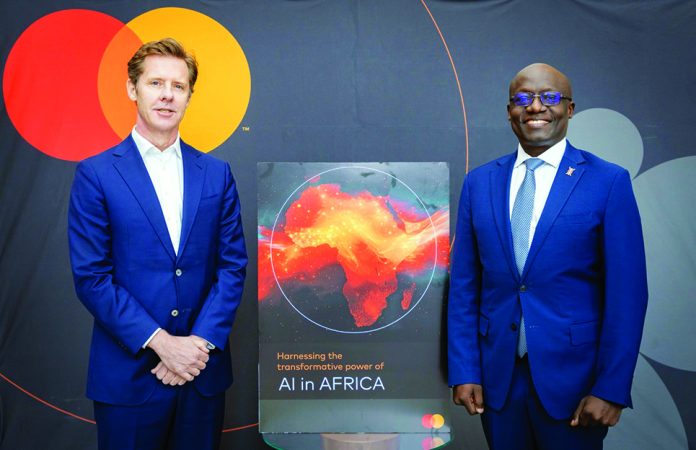
Mark Elliott, Division President, Africa at Mastercard (L) and Ambassador Philip Thigo, Special Envoy on Technology in Kenya (R), at the official launch of the Mastercard whitepaper which provides insights on harnessing the power of AI in driving digital transformation

.Key insightsfrom Kenya, South Africa, Nigeria and Morocco demonstrate AI’s potential to drive financial inclusion, job creation and innovation.

  • Up to 230 million digital jobs projected in Sub-Saharan Africa by 2030 – but infrastructure, regulation and local talent remain critical gaps.

 

Mark Elliott, Division President, Africa at Mastercard (L) and Ambassador Philip Thigo, Special Envoy on Technology in Kenya (R), at the official launch of the Mastercard whitepaper which provides insights on harnessing the power of AI in driving digital transformation

Mastercard has today released its latest whitepaper, Harnessing the transformative power of AI in Africa, a pan-African study of the continent’s readiness, opportunity and roadmap for responsible artificial intelligence (AI) adoption. The whitepaper provides detailed insights into how AI—if deployed responsibly and inclusively—can unlock transformative outcomes across the continent’s major industries, including agriculture, healthcare, education, energy and finance.

With Africa’s AI market projected to grow from USD 4.5 billion in 2025 to USD 16.5 billion by 2030 according to a recent report from Statista, the paper presents a clear case for multi-stakeholder collaboration and investment. It highlights how Africa’s unique demographics, mobile-first infrastructure and entrepreneurial spirit position it as an active architect of the future.

Mark Elliott, division president, Africa at Mastercard, commented: “Africa’s engagement with AI is already reshaping lives — not just in labs, but in farms, clinics and classrooms. To unlock its full potential, we need investment in infrastructure, data, talent, and policy. At Mastercard, we believe responsible, locally rooted AI can drive inclusive growth and connect more people to opportunity.”

The whitepaper outlines the potential positive impact of AI on digital infrastructure, policy and governance, research and development, local language processing and investment into Africa. It also explores how AI can accelerate job creation, with up to 230 million digital jobs projected by 2030, and increase access to formal finance through AI-enabled credit scoring and fraud prevention.

Greg Ulrich, chief AI and data officer, Mastercard, said: “AI is only as powerful as the trust behind it. At Mastercard, we’re committed to building AI that’s responsible, inclusive, and built to bring value to our customers, partners and employees. This isn’t just innovation—it’s innovation with integrity.”

Regional highlights covered in the whitepaper include:

South Africa:South Africa attracted USD 610 million in AI-focused venture capital in 2023, with total AI investment expected to reach USD 3.7 billion by 2030. With the highest data and infrastructure readiness in Africa, the country is solidifying its role as a continental leader in AI research and application. It is home to the Artificial Intelligence Institute of South Africa which serves as a gateway for students and professionals to access world-class education, research and industry news. National plans aim to develop up to 300 AI start-ups and train 5,000 AI professionals by 2030, creating the foundation for a vibrant, homegrown AI ecosystem.

Kenya:An emerging leader in AI innovation, Kenya has leveraged its “Silicon Savannah” status to securely deploy AI across sectors. Platforms like Tala use mobile data for credit scoring, while Jacaranda Health’s UlizaLlama, an AI-powered chatbot, provides maternal health support in five local languages. The newly launched National AI Strategy (2025–2030) outlines the government’s commitment to positioning Kenya as a regional leader in AI research and development, innovation and commercialization for socioeconomic development.

Nigeria:Nigeria ranks second in the number of AI startups in Africa and secured USD 218 million in VC investment in 2023. As one of Africa’s most dynamic AI ecosystems, Nigeria is using AI to personalize learning (Rising Academies), deliver microfinance via Kudi.ai, and strengthen governance with AI tools that monitor public fund allocation. With a $1.4 billion projected AI marketsize by 2025, the government’s proactive approach, combined with growing private-sector innovation, suggests promising growth in AI applications.

Morocco:An emerging AI hub in North Africa, Morocco is advancing AI adoption across healthcare, energy, agriculture, and finance. Institutions such as Mohammed VI Polytechnic University and DeepEcho are driving local innovation, while the MoroccoAI Annual Conference is shaping national dialogue on the future of AI. Under its Digital 2030 strategy, Morocco aims to attract USD 1.1 billion in investment and create 240,000 digital jobs by 2030.Despite this progress, the whitepaper warns that data fragmentation, language exclusion and regulatory inconsistency could deepen the digital divide.

Harnessing the potential of AI in Africa will be instrumental in accelerating financial inclusion and driving the continent’s digital and economic growth. Strategic collaborations between governments, fintechs, and global partners will be key to unlocking AI’s full impact.

Mastercard’s whitepaper draws on insights from leading African technologists, policymakers, academics and entrepreneurs, including interviews with UNESCO, the African Center for Economic Transformation, and fintech leaders across the region.
Convicted Ex SIC Life Worker Faces Civil Suit … After Failing To Refund GH¢738,000 Stolen From The State-Owned Financial Institution

0
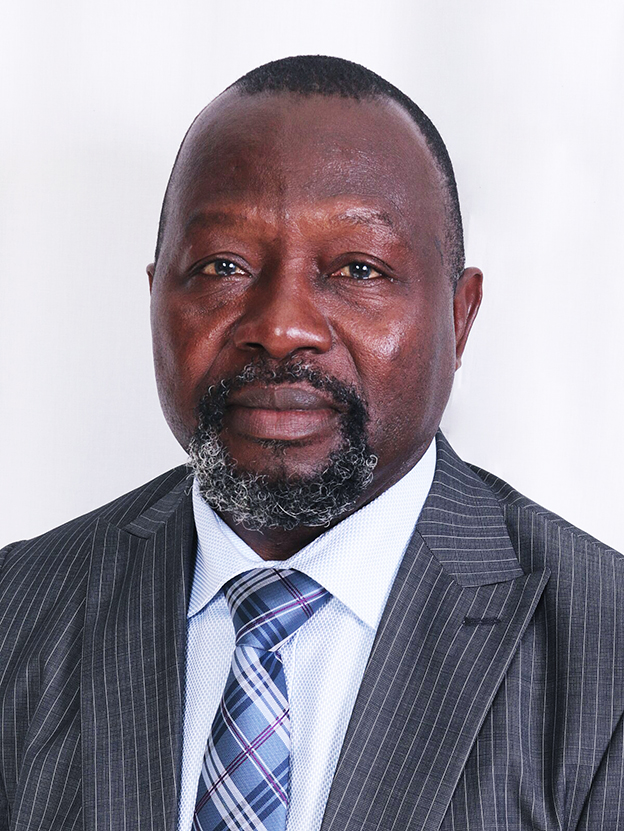
Dominic Akuritinga Ayine, A-G

Ernest Sarfo, a former Accounts Officer at SIC Life Savings and Loans Company Ltd., is likely to face a civil lawsuit by the state after failing to comply with a Circuit Court order to refund GH¢738,000.00 he stole from his former employer.

The court, presided over by Her Honour Susana Eduful, had issued a restitution order for the convict to refund GH¢953,096.05 identified as proceeds of crime directly linked to him.

Sarfo has since refunded only GH¢214,221.00 out of the GH¢953,096.05 leaving a balance of GH¢738,000.00 even though the deadline for the payment had expired on March 31, 2023.

Background of the Case

Ernest Sarfo’s criminal activities, uncovered in 2019, following an internal complaint by the company’s Managing Director, Ama Frimpomaa Dwumah, Esq, revealed a deep-rooted scheme involving forged documents, fake accounts and collusion with accomplices.

Between 2016 and 2018, Sarfo orchestrated the theft of almost GH¢1 million from the company. He worked with three others: OwusuBaffour, his elder brother and a commercial driver; Paul Mustapha Nyaba, former Makola Branch Manager of SIC; James Buabeng, a friend and customer of SIC.

Modus Operandi

Sarfo stole cheque leaflets from the company’s banks – UMB, Zenith Bank and First Atlantic Bank and forged the signatures of authorised signatories to issue payments to fraudulent accounts.

His brother, Baffour, opened multiple bank accounts using forged National Health Insurance Scheme (NHIS) ID cards under fake names, including Isaac Fiifi Bentil, Linus Kumi and Basin Dennis Dery.

The stolen cheques, some with face value as high as GH¢476,200.00 were deposited into these fraudulent accounts. The money was withdrawn and shared among the conspirators.

Sarfo also used the stolen funds to acquire significant assets including a 4-bedroom house at Kuntunse,5 uncompleted shops at Katapor, near Pokuase, and three vehicles – Toyota Corolla (GG-246-19), Toyota RAV4 (GC-65-18) and a Hyundai Van (GG-4430-18).

Conviction and Sentencing

In 2023, Sarfo pleaded guilty to five counts of conspiracy to steal, stealing (x2), money laundering and conspiracy involving fraudulent transactions.

The court convicted him on his own plea and sentenced to 400 penalty units (GH¢4,800) each count, in default, six months imprisonment per count, to run concurrently.

More importantly, the court issued a Restitution Order for Sarfo to repay GH¢953,096.05 by March 31, 2023.

His co-conspirators, Paul Nyaba and James Buabeng, who received GH¢50,000 and GH¢13,329 respectively, have since refunded their shares to the police. Owusu Baffour, who aided Sarfo in laundering funds through fake identities and forged documents was also charged with multiple counts of uttering forged documents.

They were each fined GH¢24,000 in the year 2021 and 2022, after pleading guilty to the offences.

Civil Suit Imminent

According to legal sources, Sarfo’s failure to honour the court’s restitution order would trigger processes for the state to initiate civil proceedings aimed at recovering the outstanding amount.

The civil suit, if filed, would seek to enforce the restitution order and possibly recover assets believed to have been acquired with the stolen funds.

The state is expected to rely on provisions under the Anti-Money Laundering Act (Act 749) and the Criminal Offences Act (Act 29), which empower courts to issue recovery and restitution orders in financial crime cases.

Akua Korang Family Calls For Gov’t Intervention In Asamankese Chieftaincy Dispute

0
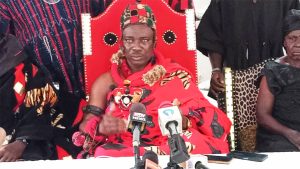
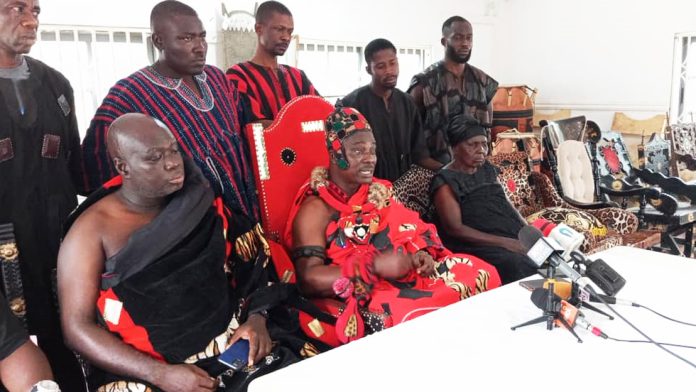
Osaberima Ateabisa Kanrinka Pobi Asumaning I, addressing the press

The Royal Akua Korang Akwamu Lineage, the indigenous ruling clan of Asamankese, led by Osaberima Ateabisa Kanrinka Pobi Asumaning I, has appealed to the Government of Ghana and key state institutions to urgently intervene in the protracted chieftaincy dispute threatening peace and stability in the area.

Addressing a news conference at Asamankese in the Eastern Region yesterday, on Monday, the family expressed concern over what they described as the failure of the state institutions to enforce the numerous rulings by the Akyem Abuakwa Traditional Council, the Koforidua High Court and the Eastern Regional House of Chiefs, which went in their favour.

Osaberima Ateabisa Kanrinka Pobi Asumaning I, addressing the press.

“We are appealing to the Government of Ghana and all relevant institutions of state to uphold the rule of law and ensure that existing decisions made by the courts and traditional judicial committees are implemented,” Osaberima Ateabisa Kanrinka Pobi Asumaning I said.

The family stated that the continued silence and inaction from state and traditional authorities could inflame tensions in the community, despite their repeated efforts to seek resolution through legal and customary channels.

Unimplemented Judgments

According to the royal family, the Eastern Regional House of Chiefs’ Judicial Committee, the Akyem Abuakwa Traditional Council’s Judicial Committee, and the Koforidua High Court have all ruled in their favour.

However, they alleged that these rulings remain unenforced, creating a leadership vacuum. “We have engaged all relevant authorities over the years, including the Ministry of Chieftaincy and Religious Affairs.

“While previous administrations showed some commitment, we have yet to see decisive action from the current government. We are now appealing directly to the State to preserve peace and justice,” the statement added.

Alleged Impostor and Fake Gazette

The family further alleged that an individual currently presenting himself as the Osabarima of Asamankese is not a member of the royal lineage, accusing him of operating under a fraudulent gazette.

They stressed that the only legitimate chief, recognized both by custom and law, is Osabarima Kentinka Pobi Asomaning, who was installed in line with the Chieftaincy Act and the family’s ancestral succession protocols.

Historical and Land Custodianship

The lineage reaffirmed its authority as custodians of Asamankese lands, pointing to a long-standing traditional land-sharing agreement with the Overlord of Akyem Abuakwa, which allocates one-third of land proceeds to the overlord.

“We remind the government that we are the rightful custodians of all Asamankese lands. No external person has the mandate to ascend to the stool or manage our lands,” the family declared.

They also highlighted that the Asamankese Divisional Stool was formally established in the 1930s and 1940s through a colonial executive instrument specifically for their lineage.

Concluding their appeal, the Royal Akua Korang Lineage urged the Government of Ghana, traditional authorities, the judiciary, civil society, and the international community to ensure peace by enforcing existing rulings and safeguarding customary traditions.

“Any attempt to alter the traditional succession or inheritance process will be resisted. We are law-abiding citizens, but we cannot allow our inheritance to be taken through silence or administrative neglect.”

PETITION

Earlier, the Royal Akua Korang Akwamu Lineage of Asamankese had formally petitioned the Minister of Chieftaincy and Religious Affairs and President John Dramani Mahama over what it described as years of neglect in resolving the protracted chieftaincy conflict in the town.

In a letter datedMarch  10, 2025 and signed by  Abusuapannin Kwesi Asare, the family appealed to the Presidency to urgently intervene, warning that the situation, if left unresolved, could spark insecurity in the West Akyem Municipality.

A Ticking Time Bomb

The petition noted that for more than eight years, Asamankese has been engulfed in a chieftaincy crisis that has derailed development and undermined peace.

“Minister, in the past eight years, Asamankese has been engulfed in a protracted chieftaincy conflict that has derailed the development of the West Akyem Municipality and impinged on the peace and tranquillity of the township.

“This conflict has been a time bomb, but for the peaceful posture and careful leadership of our lineage, matters could have escalated,” the letter read.

The family emphasised that despite repeated efforts by stakeholders to bring the matter to finality, judgments delivered by the Koforidua High Court, the Eastern Regional House of Chiefs, and the Akyem Abuakwa Traditional Council’s Judicial Committee have not been enforced.

Endorsement of Osabarima Pobi Asomaning

The petition recounted how, after prevailing in the legal and traditional adjudications, the Akua Korang Akwamu Abrade clan comprising royal representatives from Akwatia, Kwamang and Asamankese endorsed S.K. Boadu, then chief of Aworasa, for his proven developmental leadership.

He was subsequently enstooled as Osabarima Ateabisa Kentinka Pobi Asomaning, the Divisional Chief of Asamankese, after the performance of all required Akan (Akyem Abuakwa and Akwamu) customs and rituals.

The royal family, however, alleged that during the installation rituals at the palace, armed personnel from the national security forcefully ejected them.

“After the enstoolment and installation of Osabarima Ateabisa Kentinka Pobi Asomaning, and after all necessary rituals were performed, officers from national security ransacked us from the palace,” the petition said.

They claimed that this action created an opening for another individual who had lost all legal battles in the courts and traditional councils to parade himself as the Osabarima of Asamankese, in what the family described as an illegal occupation.

The Chronicle has, however, not independently confirmed this allegation.

The family expressed disappointment in the immediate past political administration, which they said ignored their petitions despite acknowledging the disturbances.

They warned that growing frustration among the youth of the lineage could boil over if the issue is not resolved.

“We have come to you through this petition because our youth have given the leadership a three-month ultimatum within your administration to resolve this matter. If not, the worst security crisis will besiege Asamankese,” the petition cautioned.

The Akua Korang Akwamu Lineage urged President Mahama and the Ministry of Chieftaincy and Religious Affairs to act swiftly by enforcing all valid judgments and restoring legitimacy to the Asamankese Divisional Stool to safeguard peace and development in the municipality.

Six Men Arraigned for Causing Harm and Threats at Agbogbloshie

0
The Accra Circuit court complex

Six men have been arraigned before the Circuit Court in Accra, presided over by Her Honour BasiliaAdjei-Tawiah, following a violent altercation at Agbogbloshie on August 1, 2025.

The accused are facing multiple charges, including causing harm and making threats of harm, contrary to the Criminal Offences Act, 1960 (Act 29).

The accused individuals, all businessmen, residing in Agbogbloshie, have been identified as William KwakuMarfo, 45, Richmond Nana Adofo, 30, RaphealKyei, 19, Atsu Amanya, 55, Kofi Isaac, 45 and Samuel Blankson, 51.

Charges

The charges include:Causing harm – William KwakuMarfo is alleged to have struck one of the complainants, Salifu Osman, in the left eye with a pen drive, causing a cut below the eye.

Conspiracy to commit crime, threat of harm, all six are alleged to have acted together with a common purpose to commit harm.

Threat of harm; Each accused allegedly made threatening statements to one OheneKwasi, including threats to stab or burn him, thereby instilling fear.

Court Proceedings

The prosecution, led by Chief Inspector Daniel Appiah-Ofori, presented the brief facts of the case, stating that the incident stemmed from ongoing tension between the accused persons and the two complainants, Salifu Osman and Ohene Kwasi.

According to the prosecution, the altercation began when Ohene Kwasi made provocative remarks to William Marfo about the death of his son.

Marfo reportedly retaliated by physically assaulting Salifu Osman and later confronting Kwasi with the help of the other accused persons.

During the confrontation, the accused allegedly hurled insults and threats, including intentions to stab or burn the second complainant. Following a police report, all six men were arrested and charged.

The plea of the accused persons was not taken, and the case has been adjourned to October 14, 2025.

Bail Conditions

The court granted bail in the sum of GH¢10,000 to each accused person with two sureties, one of whom must be justified. Additionally, the accused are to report to the case investigator once every week until further notice.


Entrepreneur wanted for allegedly indulging in Visa scam

0
Wanted

The Circuit Court 8 in Accra has issued a bench warrant for the arrest of 50-year-old entrepreneur, Prince Nuhu Ahmed, for failing to appear before the court on Monday in connection with a case of defrauding by false pretence.

The bench warrant was issued upon the request of the prosecution, led by Chief Inspector Jonas Lawer, after the accused failed to honour the court’s summons. The court has ordered that Ahmed be brought before it on September 11, 2025.

Ahmed is facing two counts of defrauding by false pretence, contrary to Section 131(1) of the Criminal Offences Act, 1960 (Act 29).

Per the brief facts, on May 9, 2023, in Accra, Prince Nuhu Ahmed allegedly defrauded two businessmen, Alhaji Umar Farouk and Alhaji Yakubu of a total of US$16,000.00 under the pretext of securing Bolivian visas for their children.

In the first count, Ahmed is alleged to have obtained US$10,500.00 from Alhaji Umar Farouk, claiming he could procure Bolivian visas for his two sons. In the second count, he is accused of taking US$5,500.00 from Alhaji Yakubu with a similar promise for Yakubu’s son.

In both cases, Ahmed is said to have knowingly made false representations and issued receipts to the complainants. He reportedly promised that the visas would be ready within a week.

However, months passed without any progress and efforts by the complainants to retrieve their money proved futile.

The matter was reported to the police in February 2024, leading to Ahmed’s arrest. During the course of investigations, the accused refunded an amount of GH¢28,000.00 to the victims, which is significantly less than the full amount taken.

Despite being charged and brought before the court, Ahmed has now failed to attend court proceedings, prompting the issuance of the bench warrant.

Background

Both complainants, residents of Ofankor in Accra, had been introduced to Ahmed as someone capable of facilitating visa acquisition.

According to the brief facts presented by Detective Chief Inspector Stephen Teye Martey, Ahmed had positioned himself as someone with the capacity to secure Bolivian visas and used this deception to collect funds from the complainants.

The case is scheduled to continue on September 11, 2025 where the accused is expected to be produced before the court.

A-G must be fair and firm in seeking Justice against Corrupt Officials – Fifi Kwetey

0
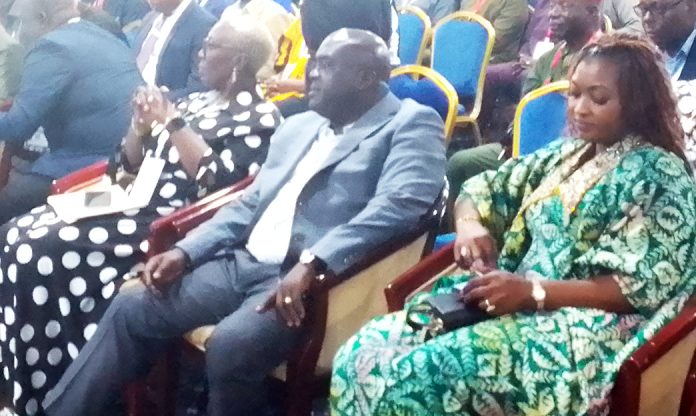
Julius Debrah, Chief of staff ( middle) at the Conference

Mr. Fifi Kwetey, the General Secretary of the ruling National Democratic Congress (NDC), has urged the Attorney-General to be fair and firm in seeking justice, emphasising the importance of pragmatism and the pursuit of justice for the people of Ghana.

Speaking at the 5th Annual Conference of the National Democratic Congress (NDC) in Kumasi, last Friday, he stressed that the nation’s motto, “Freedom and Justice,” should guide actions and decisions.

The NDC chief scribe expressed the view that pragmatism is found in justice and the NDC wants justice to be served properly.

The General Secretary reminded attendees that pressure for immediate punishment is understandable, but emphasised that justice must be done correctly, without taking shortcuts or compromising on principles.

The NDC General Secretary cautioned against letting emotions drive actions, referencing past incidents and the need for a measured approach to ensure justice is served.

He underscored the importance of Ghana’s pursuit of justice being guided by fairness and a commitment to the rule of law.

He stressed that Ghana’s history and the quest for justice were touched upon and noted that the country’s experiences and the need for leaders to balance calls for justice with careful consideration of consequences. He emphasised that the path to justice should reflect the nation’s values and aspirations.

Sleep no more! John Mahama hath murdered sleep

0
The Author, Mr Kwadwo Afari

To their deaf pillows will discharge their secrets

Still it cried “Sleep no more!” to all the house:

“Glamis hath murder’d sleep, and there Cawdor

Shall sleep no more, Macbeth shall sleep no more.”

– William Shakespeare

Give to out tables meat, sleep to our nights


John Dramani Mahama has disrupted the peace and tranquility that Ghanaians rely on for the country’s prosperity by removing the Chief Justice of the Supreme Court of Ghana, Justice Torkernoo. Ghanaian politics will never be the same. The politically motivated removal of Justice Torkernoo has not only weakened the judicial system and the rule of law but also turned the justice system into a kangaroo court in the hands of politicians, leaving most Ghanaians unable to sleep peacefully.

John Mahama shows no remorse. His reasons for the removal lack grounding in reality or consistent principles. He merely shifts from one fabricated reason to another, hoping that Ghanaians will forget that he and his party, the National Democratic Congress (NDC), come from a background where controlling the judiciary by any means necessary, including killing judges, is considered acceptable.

It is crucial to understand the broader context, as this issue extends beyond just legal matters. It touches on fundamental questions about freedom, institutions, and democracy. Early in President Mahama’s second term, his administration quickly increased the number of Supreme Court justices to twenty-one — ensuring that independent judges are outnumbered and effectively marginalized. This strategy allows him to give the appearance of a functioning Supreme Court while keeping it firmly under his control.

Justice Torkornoo was notably removed from office on Monday, September 1, 2025, under Article 146(9) of the 1992 Constitution. A statement from the presidency explained that the decision was based on the recommendation of a committee established under Article 146(6) to investigate a petition filed by citizen Mr. Daniel Ofori. The removal took immediate effect.

As expected, the removal triggered widespread outrage within Ghana’s legal and civil society circles. The Ghana Bar Association (GBA) and the Centre for Democratic Governance (CDM) all condemned the move as unconstitutional and a violation of judicial independence, citing a failure to publish regulations to justify the exercise of presidential discretion, as required by Article 296.

The question of whether the president can fire a Chief Justice has been debated for many years. The removal risks entrenching authoritarian tendencies in Ghana. It is not a criminal trial but a partisan political procedure conducted in secret to determine if a Chief Justice has committed an act that makes them ‘unfit’ for office. The grounds for removal are “Stated Misbehavior, Incompetence, or Infirmity.” Most legal experts agree that these charges are subjective and could be interpreted anyhow to achieve a desired objective.

Meanwhile, Article 127(2) is very clear that the President, Parliament, or any person acting under the authority of any person does not have the right to interfere with Judges when Judges are exercising Judicial Power, for which reasons all organs and agencies of the State are obligated to provide all the assistance needed to protect their independence, dignity, and effectiveness of the Supreme Court.

It is interesting to note that immediately after the sacking of the Chief Justice, Mahama lifted the ban on the sale of public lands to private entities. Now we understand that the removal of the Chief Justice has nothing to do with the integrity of the court or public life but is instead about politics, state capture, and the inordinate desire to take control of state assets and prevent those who might challenge this power in the future.

John Mahama is a narcissistic dictator prone to corruption. He returned to power after a intense propaganda campaign and widespread intimidation and violence by the NDC. Independent judges are a nightmare for would-be corrupt dictators and political parties like the NDC. History shows that corruption often flourishes when the judiciary is compromised. Without a fair judiciary, those involved in corruption can operate with impunity, knowing they will not be held accountable.

We still remember how his brother, Ibrahim, allegedly manipulated government institutions during his first term as president. Through a network of corrupt officials and business executives, Ibrahim:

  • Influenced government contracts worth billions.
  • Took control of state-owned enterprises like the Merchant Bank, and gold and manganese mines.
  • Facilitated ministerial appointments to benefit his business interests.

Sadly, the threat of dictatorship, growing corruption, and ongoing human rights abuses endangers all citizens of this country, especially the poor. It is the duty of citizens to stay alert in defending justice and demanding a fair, independent judiciary. Only through a strong commitment to the rule of law can Ghanaians hope to avoid falling into tyranny and suffering.

Ghanaians may be unsure whether John Mahama feels guilty or can sleep peacefully at night. What we do know is that his desire to control all state institutions, including the judiciary, would cause him extreme anxiety, making it impossible for him to find sleep or peace.

By Kwadwo Afari

BECE Examination Malpractices Must Be Condemned

0
Editorial

Per a secret filming investigation conducted by JoyNews, shocking revelations have emerged about systemic examination malpractice at this year’s Basic Education Certificate Examinations (BECE). The JoyNews Hotline documentary, Dark World of BECE, led by investigative journalist Francisca Enchill uncovered widespread collusion between some officials of the Ghana Education Service (GES) and invigilators.

At the Derby Avenue RC Basic School in Accra, investigation found that Invigilators were bribed with as little as GH¢60 to allow students to cheat by smuggling mobile phones into the examination hall, using artificial intelligence tools like ChatGPT and even receiving solved questions from officials.

At St. George’s Anglican, envelopes containing GH¢400 were distributed to Invigilators, while students made daily payments. Shockingly, an “Aseda Offertory” was later introduced, where candidates contributed GH¢5 each in appreciation of Invigilators who looked the other way.

The West African Examinations Council (WAEC) has since denounced the practice, clarifying that any payment made to invigilators or supervisors during examinations is illegal. Investigations have commenced into the disturbing revelations.

The Chronicle strongly condemns the shameful acts exposed by JoyNews in the documentary. What was uncovered is not just a mere case of malpractice but a calculated subversion of the very foundations of our educational system. We commend JoyNews and its investigative team for this bold and patriotic act of exposing rot in our education sector.

This scandal raises very troubling questions. Why have Invigilators and Supervisors, entrusted with the sacred duty of safeguarding examinations, reduced themselves to accomplices in corruption, for as little as GH¢60?

Why would school officials betray the trust of parents and the nation by enabling students to cheat instead of nurturing their academic integrity? These questions point to deeper systemic failures that go beyond individual misconduct.

One possible reason is the unhealthy obsession with school rankings. Schools are desperate to appear at the top of educational league tables, sometimes pushing their School heads and teachers to pursue results at any cost. The undue pressure from some parents cannot also be ignored.

Too often, parents demand results, not effort. They exert pressure on school heads and even show willingness to fund these illegal practices, believing that a certificate matters more than genuine knowledge. The corrosive influence of money in this context has turned examinations into a commercial venture rather than a test of merit.

But let us be clear: this scandal is a national embarrassment. It undermines public confidence in Ghana’s education system and tarnishes the image of the BECE, an examination that should be a fair assessment of students’ learning. If such malpractices persist our certificates risk losing credibility, both at home and abroad.

We, therefore, call on the GES, WAEC and law enforcement authorities to ensure that investigations into this matter are thorough and that those found culpable, whether Invigilators, Supervisors, school officials or parents are held accountable. Without punishment, these practices will continue.

The Chronicle insists that Ghana cannot build a strong future on fraudulent foundations. Education must remain the bedrock of progress, not an arena for corruption.

‘Beyond the Dreams of the Teenager’ Conference inspires hope and action among Adukrom youth

0
Students and resources people in a group photograph after the influential conference

Over 500 students at the J.G. Knoll Technical Institute were given a fresh dose of inspiration and guidance as the youth-focused NGO, As I Grow, hosted its influential conference themed “Beyond the Dreams of the Teenager”.

The event, designed to empower Ghana’s future workforce with real-life insights on mental health, drug abuse, and career development, brought together educators, health professionals, and university administrators who challenged students to rise beyond distractions and dream with purpose.

The principal of the institute, in his welcome address, praised As I Grow for what he called a timely and life-saving initiative and described the youth-focused engagement as a vital intervention amid growing concerns over drug abuse and moral decline among Ghanaian students.

In his keynote speech, Mr. Debrah Bekoe Isaac, CEO of As I Grow, laid bare the dangers of illicit drug use and the urgent need for public education.

He described the situation as a ticking time bomb, stating, “Our youth are at the mercy of drugs, distractions, and discouragement. We must rise together to fight for their future.”

Mr. Debrah emphasised the organisation’s mission to educate young people on mental health, responsible choices and the importance of staying in school, as he called on educators, parents and government officials to unite in protecting Ghana’s future leaders from self-destruction.

Health professionals took the stage next, with Madam Gertrude Adjo Tay, Head of the Health Department at As I Grow, and Madam Amanda Akonobea, delivering a sobering session on mental health and drug abuse.

“Drug abuse is not just about poor choices, it’s about lost potential, broken homes, and national regression,” Madam Tay said.

She warned students of the irreversible effects of substance abuse, including poor academic performance, mental disorders and even premature death.

Students were then given the chance to ask questions, which were answered with clarity and empathy whilst the health team encouraged all attendees to seek help early and avoid silence on mental health challenges.

Mr. Osei Arko Godfred, Assistant Registrar of UNIMAC, led a compelling discussion on the future of work and education as he urged students to align their skills with the demands of the 21st century, where Artificial Intelligence (AI) and technology are reshaping every sector.

He encouraged students to embrace Technical and Vocational Education and Training (TVET) and explore non-traditional career paths that match their passions and talents, adding that “you cannot rely on yesterday’s knowledge for tomorrow’s opportunities,”.

The Assistant Registrar of UNIMAC also addressed questions around admission requirements for technical students, affirming that their certificates are recognized by universities like UNIMAC. For older students, he recommended exploring the university’s mature entry program for applicants aged 25 and above.

The conference concluded with a stirring presentation from Mr. Samuel Larbi, who spoke passionately about the power of education to transform lives and close the wealth gap.

“Education is not just about passing exams; it is about preparing for leadership, for responsibility and for purpose,” Mr. Larbi said.

He encouraged students to avoid destructive habits such as gambling, substance abuse, and immoral relationships, stressing that social media and betting, though popular among youth, have become addictive traps for many students, robbing them of time, focus, and ambition.

Mr. Larbi urged the students to stay disciplined, form study groups, embrace healthy lifestyles, and take advantage of digital tools like AI to enhance their learning experience.

Akyem Anyinasin Residents Stage Protest against Illegal Mining Operations

0
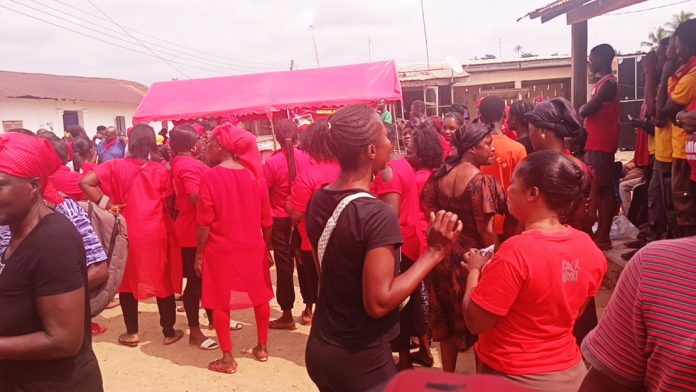
Some protesters at the durbar ground

Tensions flared in the Akyem Anyinasin community in the Abuakwa North Municipality on Friday, as scores of concerned residents took to the streets in protest against proposed mining activities in the area.

Wearing red bands and holding placards, the demonstrators voiced strong opposition to what they described as a covert plan by certain authorities to introduce mining operations allegedly illegal within the Anyinasin enclave.

The protesters carried placards with inscriptions such as: “Our lands are not for sale”, “We will protect our farms and forests for the next generation,” “Mining will not only destroy our livelihoods, but will also pollute our rivers and poison our future.”

During a community durbar held as part of the protest, the residents expressed fears over the potential destruction of their farmlands, water bodies and forest reserves as powerful external interests were working to override local opposition to mining in the area.

The protestors singled out their traditional leader, Osaberema Attah Appiah Krang Adej II, stating that his previously firm stance against mining had been weakened by sustained pressure from external forces.

A native of the community, Mr. Kwadwo Appiah Attah Krang, a founder and president of Save the Nation for Future Leaders and leader of the protesters urged Osaberema Attah Appiah Krang Adej II to stand resolute in defense of the community’s natural heritage and join them in rejecting all mining proposals.

A banner warning prospective individuals who intend to mine in the area.

The demonstrators appealed to key figures, including the Okyenhene, Osagyefuo Amoatia Ofori Panin and President John Dramani Mahama to take interest in their plight and intervene to halt any illegal mining ventures.

They also called on the Environmental Protection Agency (EPA), the Minerals Commission and the Ministry of Lands and Natural Resources to investigate the alleged plans and act swiftly to safeguard the environment and community interests.

The petition, addressed to relevant local and national authorities, outlined the community’s demands and reinforced their collective commitment to resisting any form of illegal mining in Akyem Anyinasin.

As the battle over land and minerals intensifies in Ghana’s Eastern Region, the people of Akyem Anyinasin are sending a clear message: they will not trade their heritage for gold.

The Ghanaian Chronicle