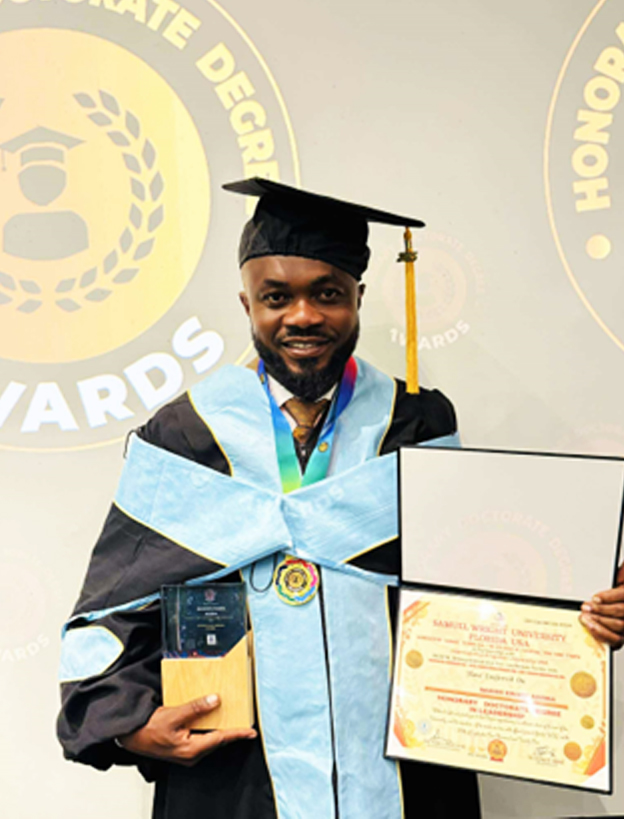
Ghanaian social entrepreneur and recording artist-turned-corporate leader, Saviour Kwaku Adzika, popularly known as Corp Sayvee, has been conferred with an honorary doctorate degree in recognition of his groundbreaking contributions to sustainability, social impact, and youth empowerment.
The award, presented on Thursday, September 25, 2025, by SW University, USA, was received during a colourful ceremony at the Premier Hotel Midrand in Kempton, South Africa. The honour acknowledges Corp Sayvee’s tireless efforts in promoting the United Nations Sustainable Development Goals (SDGs), particularly in the areas of education, climate action, and community development.
This recognition adds to an impressive list of accolades. Earlier this year, Corp Sayvee was inducted into the Corporate Ghana Hall of Fame and named Ghana’s Most Outstanding Personality in Integrated Sustainability and Social Impact. Over the past decade, he has earned a reputation as one of Ghana’s leading voices in the intersection of corporate leadership, philanthropy, and sustainability.
Corp Sayvee, who first rose to prominence as a hip-life artist with popular songs including “Fantefo Na Brofoa”, has since expanded his influence beyond music. As Chairman and CEO of CorpNation Group, he has spearheaded a number of initiatives tackling youth unemployment, promoting financial literacy, and advancing environmental sustainability. His flagship programme, the Corp Tour, has reached thousands of young people across Ghana with practical lessons on savings, entrepreneurship, and work-life balance.
Speaking after receiving the doctorate, Dr. Adzika described the honour as both humbling and inspiring.
“My impact journey is far from over. With this honorary doctorate serving as a new chapter in my life, the world can only anticipate even greater contributions to sustainability, youth empowerment, and social transformation from me,” he said.
He dedicated the recognition to his late parents, his wife, family, and loved ones, as well as his former employers, Tullow Ghana Limited, for their role in shaping his leadership path. Above all, he attributed his achievements to the grace of God.
Dr. Adzika also used the occasion to encourage young Africans to pursue their goals with ambition, perseverance, and a sense of responsibility toward society.
Industry watchers say his recognition in South Africa demonstrates the importance of Pan-African collaboration in addressing challenges such as climate change, inequality, and youth unemployment.
From music stages to corporate boardrooms, Corp Sayvee’s journey continues to serve as a beacon of what passion, purpose, and perseverance can achieve. His latest milestone cements his place among Africa’s most inspiring change-makers.
Acting Executive Secretary of the Creative Arts Agency, Gideon Aryeequaye
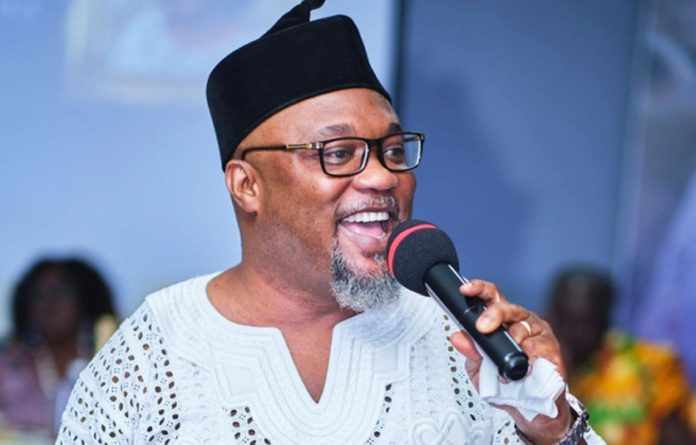
The Acting Executive Secretary of the Creative Arts Agency, Gideon Aryeequaye, has revealed that the body will introduce an annual awards scheme to celebrate industry stakeholders.
He made this announcement on Joy FM’s Showbiz A-Z on Saturday, 27th September 2025, while outlining the agency’s upcoming programmes.
“The second thing we will do which will also be annual is the Creative Arts Awards, to recognise the work that you do, to recognise the work that others do. This is one is not the usual red carpet, turn around 360; proper one. Not a black tie event. If I say black tie then we are losing our identity. But you have to come in something really good. Something that you have created, something that will project you,” he told the host Kwame Dadzie.
He further disclosed that the agency plans to hold an annual festival showcasing all domains of the creative arts.
According to him, the agency will also curate a programme for highlife music, which he described as one of Ghana’s intangible cultural heritage.
The Creative Arts Agency is mandated to coordinate, regulate and promote activities within the creative sector, as well as implement policies and initiatives that drive its growth.
Ghanaian rapper Sarkodie has described music as one of the most rewarding investments, equating its profitability to real estate and other lucrative industries.
In an interview with broadcaster NYDJ, Sarkodie stressed that the music industry holds immense financial potential, often underestimated by those outside the business. According to him, while many people overlook music’s value, insiders understand just how sustainable and profitable it can be.
He drew comparisons between music and traditional industries such as manufacturing and product-based businesses. In manufacturing, he explained, investors are constantly burdened with high operational costs, including machinery maintenance, staff salaries, and daily expenses.
Music, on the other hand, he noted, functions differently. Once the creative process is complete, songs can continue generating income indefinitely, with minimal overheads.
Sarkodie said, “If anybody tells you that music doesn’t make money, they’re lying. One of the best industries you can get into is music. One of the best investments you can make is up there with real estate; it’s up there with any product you can think about. Music is the same, and it’s even better than a lot of products.”
“Because with most products you have to sit down and do servicing, you’re still paying staff; you’re paying people to keep it running. If you’re doing drinks, the machines have to be greased, you have people doing all this labour, and you’re paying. Music doesn’t take that. It’s in the air, and you’re making money. It doesn’t get better than that. So, I would urge investors to come in fully and support the artiste,” he concluded.
The pro-European party of Moldovan President Maia Sanduhas claimed victory and a new majority in parliament in Sunday’s elections seen as critical for her country’s future path to the EU.
Sandu had warned of “massive Russian interference” after voting, saying the future of Moldova, flanked by Ukraine and Romania, was at stake.
Igor Grosu, the leader of Sandu’s Party of Action and Solidarity (PAS) which secured about 50% of the vote, said Russia had thrown “everything it had” at the election.
Opposition leader Igor Dodon had claimed victory even before results came in and called for protests outside parliament in the capital Chisinau on Monday.
However, the win by PAS is emphatic: Monday’s protest was tiny and mostly attended by pensioners. And there is no sense at this point that they have any momentum.
With 99.9% of the 1.6 million votes counted, PAS had 50.17% of the vote – far ahead of the pro-Russian Patriotic Electoral Bloc on 24.18%, Moldova’s central electoral commission said.
Turnout was 52%, higher than in recent years.
European Commission President Ursula von der Leyen welcomed the result. “You made your choice clear: Europe. Democracy. Freedom,” she wrote on X on Monday.
In Russia, Kremlin spokesman Dmitry Peskov said: “From what we see and know, we can conclude that hundreds of thousands of Moldovans were deprived of the opportunity to vote in Russia because there were only two polling stations open to them, which was of course insufficient.”
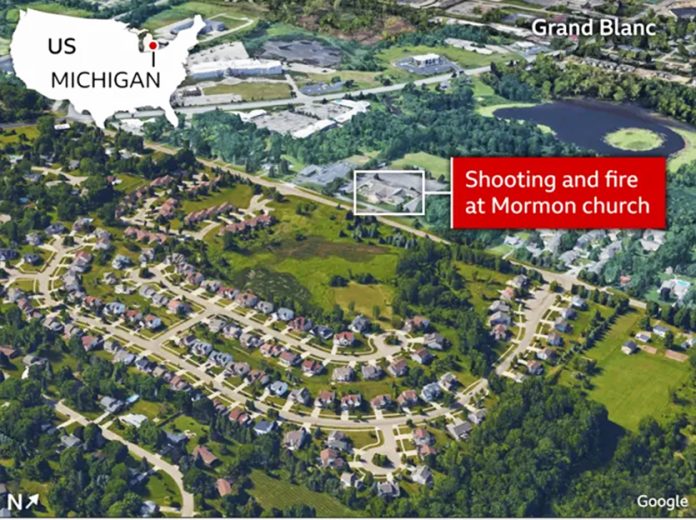
At least four people were killed and eight others injured after a gunman drove a vehicle into a Michigan church, opened fire and set the building ablaze, before being killed himself, police say.
Officials said the attack on the Church of Jesus Christ of Latter-day Saints in Grand Blanc, a town 60 miles (100km) northwest of Detroit, happened during a Sunday service attended by hundreds of people.
The suspect, identified as Thomas Jacob Sanford, 40, from Burton, Michigan, was later shot dead by police in the building’s car park.
Authorities are investigating the incident as an “act of targeted violence”, but say the motive remains unclear.
White House press secretary Karoline Leavitt said the Federal Bureau of Investigation (FBI) was “trying to understand more about this, how premeditated it was, how much planning went into it, whether he left a note”.
Two victims died from gunshot wounds, Grand Blanc Township Police Chief William Renye told a news conference on Sunday.
He later said two more people had been found dead and “some” others remained unaccounted for, though he could not say how many. The church was still being “cleared” on Sunday night after suffering extensive fire damage, he added.
Chief Renye said hundreds of people were attending services at about 10:25 local time (15:25 GMT) when a gunman drove a vehicle into the building.
The attacker then opened fire with an assault-style rifle, “firing several rounds at individuals within the church,” he explained.
The police responded immediately to the scene, Chief Renye said, adding officers “engaged in gunfire with that particular individual, neutralising that suspect”. Sanford was killed at 10:33 local time, eight minutes after the shooting.
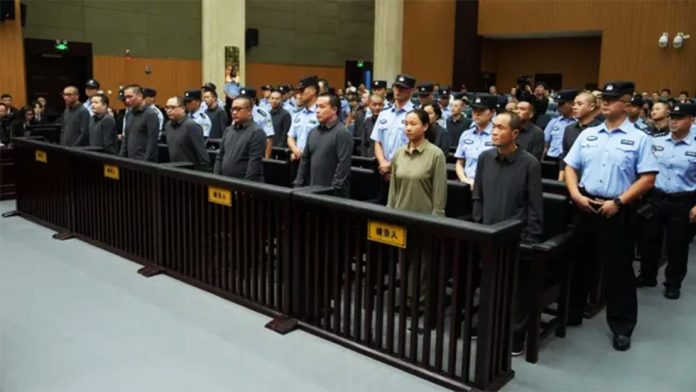
A total of 39 members of the Ming family were sentenced
A Chinese court has sentenced to death 11 members of a notorious family that ran scam centres in Myanmar, according to Chinese state media.
Dozens of members of the Ming family were found guilty of conducting criminal activities, with many receiving lengthy jail sentences.
The Ming family worked for one of the four clans that ran Myanmar’s sleepy backwater town of Laukkai, close to the border with China, and turned it into a hub for gambling, drugs and scam centres.
Myanmar eventually cracked down, arresting many members of these families in 2023 and handing them over to Chinese authorities.
A total of 39 Ming family members were sentenced on Monday in the eastern city of Wenzhou, according to a report by Chinese state broadcaster CCTV.
Besides the 11 members who received death sentences, another five received death sentences with two-year suspensions; 11 were jailed for life; and the rest were given jail sentences ranging from five to 24 years.
The court found that since 2015 the Ming family and other criminal groups had engaged in criminal activities including telecommunications fraud, illegal casinos, drug trafficking, and prostitution.
Their gambling and scam activities had generated more than 10bn yuan ($1.4bn; £1bn), according to the court.
Others had previously estimated that the casinos of each of the four families were processing several billion dollars every year.
The court also found that the Ming family and other criminal groups were responsible for the deaths of several scam centre workers, including shooting workers in one incident to prevent them from returning to China. Credit: bbc.com
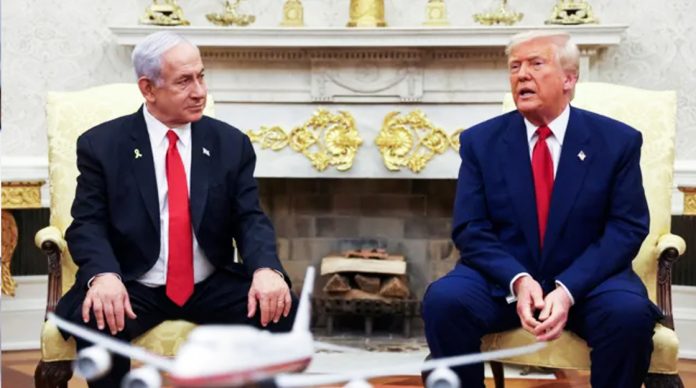
President Donald Trump and Prime Minister Benjamin Netanyahu
US President Donald Trump will push a new peace plan to end the Israel-Gaza war during White House talks with Israeli Prime Minister Benjamin Netanyahu on Monday.
Trump has talked up prospects of reaching an agreement, telling journalists on Friday: “I think we have a deal.”
But Netanyahu said on Sunday “it’s not been finalised yet”, while Hamas said they had not formally been sent the proposal.
According to leaked copies of the plan published by US and Israeli media, it stipulates the release of all hostages within 48 hours of the deal being confirmed. Once they are returned, Israel will free hundreds of Palestinian prisoners serving life sentences.
Hamas members who commit to peace will be offered amnesty and safe passage out of Gaza – and the group will have no future role in the territory. All Hamas military structures will be destroyed.
The Israel Defense Forces (IDF) will gradually withdraw from the Strip and Gaza will be governed by an interim transitional government.
The plan appears to constitute a significant shift of position by the Trump administration, which has previously advocated relocating Gaza’s entire population of 2.1million and redeveloping Gaza into a US-owned “riviera”.
The latest proposal encourages Palestinians to remain in Gaza.
It also acknowledges Palestinian aspirations for a future state, and includes a future role in the territory for the Palestinian Authority (PA) once it has undertaken reforms.
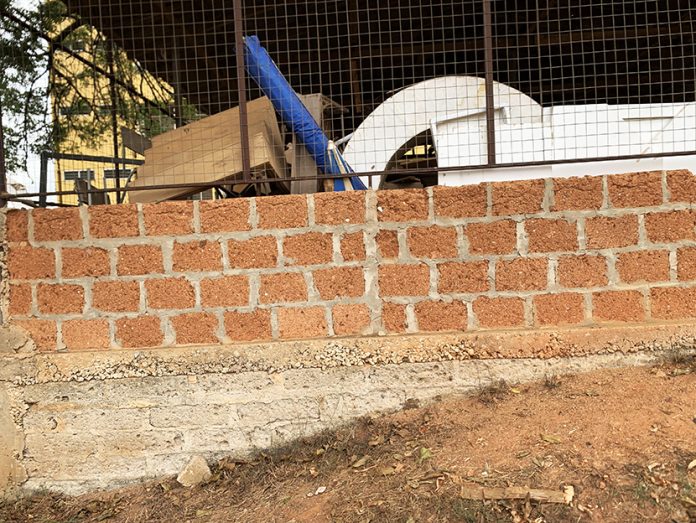
A workshop wall at KNUST constructed with laterite bricks, highlighting the university’s use of indigenous building materials.
Kumasi, Ghana’s bastion of culture and history is steadily losing its architectural soul. Once adorned with buildings that reflected the cultural identity of the Ashanti people, the city is now overwhelmed by rapid urbanisation, dwindling use of indigenous building materials and a complex land ownership system.
The transformation is raising critical questions about the sustainability of local materials and the future of Kumasi’s heritage.
An experimental Atakpame block wall, built in the 1970s at KNUST’s Centre for Settlements Studies, still standing strong
In the heart of the city, particularly the Central Business District at Adum, old structures are being demolished to make way for modern high-rises.
Yet, these new buildings, while ambitious, largely abandon indigenous aesthetics, cultural symbolism and sustainable local resources.
The Chronicle sought insights from academics at the Kwame Nkrumah University of Science and Technology (KNUST), who stressed that Ghana must urgently rethink its approach to housing and indigenous construction.
Housing as a Right, Not a Privilege
Dr. Stephen Appiah Takyi, Senior Lecturer at the Department of Planning, KNUST, framed the issue within the broader scope of housing policy.
“A good planner must look at the social well-being of the people. Food, clothing and shelter are basic necessities of life. If citizens lack a place to sleep, there’s something fundamentally wrong with the country. From a planner’s view, housing is not a privilege, it is a right,” he said.
For him, the solution lies in a national policy that prioritises research, innovation and investment in indigenous building materials.
“If we don’t invest in local materials, the cost of housing will remain high. The less privileged will be pushed into homelessness, worsening social inequality and stifling development,” he warned.
Dr. Takyi reminded Ghanaians that their forebears built homes suited to local climates long before colonial influence.
“Before the colonial masters came, we had houses. They were constructed with indigenous materials adapted to local weather and socioeconomic conditions.
“Even within Ghana, materials varied by region. In the north, for example, builders used different methods because of the climate,” he explained.
He argued that these traditional practices should have been refined over time into modern technologies, preserving both identity and sustainability.
Instead, Ghana has become over-dependent on imported materials.
Policies Without Commitment
Over the years, Ghana has introduced housing and urban development policies that make reference to indigenous materials. Yet, implementation remains weak.
“Since 1992, ask any government how much has been invested in the research and development of indigenous materials, you’ll find very little. The policies are there, but the commitment is missing,” the Senior Lecturer at the Department of Planning noted.
At KNUST’s Centre for Settlement Studies, researchers have already developed technology blocks from local materials. But without policy support and funding, these innovations remain stuck at demonstration level.
Despite centuries-old examples of durable indigenous housing, Dr. Takyi believes modern technology, especially artificial intelligence (AI), can enhance these methods for today’s demands.
“Without technology, we already have indigenous houses lasting 100 to 200 years. With AI and smart labs, we can test, refine and scale these materials,” he said.
For him, adopting technology is not about discarding heritage, but improving upon it.
“We must integrate building codes with our cultural identity. That way, we improve without losing essence.”
Another key challenge, Dr. Takyi stressed, is perception. “People don’t reject indigenous materials because they’re inferior. Humans are rational, they want quality and aesthetics. The reason people prefer imported rice over local rice is branding.
“It is the same with building materials. If we brand indigenous products well, they’ll compete with international ones,” he argued.
The Role of Planners
The Senior Lecturer at the Department of Planning highlighted how indigenous materials support climate adaptation.
“With rising heat levels, northern builders already developed roofing systems that cool houses. Using such materials can reduce reliance on air conditioners, lowering energy costs,” he explained.
Urban and heritage planners, he said, must also preserve old structures as models for future generations.
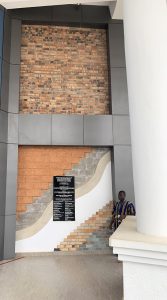
A demonstration wall at KNUST’s College of Art and Built Environment showcasing different construction materials
Dr. Takyi called for a national programme to train artisans, strengthen supply chains, and document indigenous practices.
“We lack industries dedicated to developing these materials. Government should give tax incentives and credit facilities to companies investing in them. District assemblies, universities, and traditional authorities must document building methods for posterity and even tourism,” he urged.
Architecture vs. Local Materials
Dr. Emmanuel Banahene Owusu, a Lecturer at KNUST’s Department of Architecture made an important distinction between indigenous and local materials.
“Indigenous materials are those traditionally used from our environment—mud, bamboo, thatch. Local materials are those produced here, like tiles or fired bricks, which are not traditionally Ghanaian,” he clarified.
For example, sand-dried bricks were indigenous, but fired bricks were introduced by Europeans.
Challenges and Opportunities
Dr. Banahene Owusu noted that Ghana currently lacks engineering standards for indigenous materials like mud walls or bamboo. This absence, coupled with low academic interest, has contributed to their decline.
“We’re not investing in research. Most studies focus on concrete. Yet, at KNUST, we’ve experimented with stabilised mud blocks since the 1970s by adding cement to improve durability. These need further standardisation,” he said.
He also highlighted the use of additives such as grass, rice husk and cow dung in traditional mud construction, which improves binding. Modern methods could incorporate cement, bitumen or other stabilisers.
For Dr. Banahene Owusu, the fastest way to restore trust in indigenous methods is through public buildings.
“If the state builds a theatre in Kumasi with mud or bamboo, confidence will grow. Private citizens won’t risk their limited funds on experiments, but public projects can set the example,” he suggested.
He argued that demand and supply would follow naturally once people see these materials applied successfully in large projects.
Towards a National Policy
Both academics agreed that Ghana urgently needs a national policy on indigenous building materials.
Such a policy would promote research, training, industry development, and standardisation, while encouraging the integration of local materials into modern construction.
“Development doesn’t happen magically. It requires conscious effort, investment, and the right policies. Any country relying solely on imported materials will face rising housing costs and worsening deficits,” Dr. Takyi stressed.
Dr. Banahene Owusu also added that with the right policies, Ghana could pioneer hybrid construction—combining indigenous and modern materials through modular and prefabricated systems. But this requires research-backed standards and government-led projects.
A Wake-Up Call
The academics believe Ghana is standing at a crossroads. On one path lies continued dependence on imported materials, spiralling housing costs, and loss of cultural identity. On the other lies innovation rooted in heritage—cheaper housing, sustainable urban growth, and preservation of Kumasi’s soul.
“It’s possible,” Dr. Takyi said firmly. “The sand beneath our feet can build homes. What we need is leadership, innovation and the belief that we can develop what is ours,” he added.
You exercise. You eat right. You’re in pretty good shape for someone your age.
Still, getting older can bring on health problems as our bodies change. Not everyone will get them. But some medical conditions become more common or more serious after we get a few decades under our belts.
Here are some surprising ways that age itself can pose health challenges.
Flu
When you’re over age 65, your immune system isn’t as strong as it used to be. Seniors make up the bulk of the people who die or are hospitalized for flu-related problems. Age raises the chances of serious flu complications like:
A yearly flu shot is a must. If you’re older than age 65, ask your doctor about the high-dose version, which offers more protection.
Weight Gain
Getting older can be a triple whammy. You lose muscle as you age. That makes it harder to keep the pounds from creeping up. You also become less active. At the same time, your body burns fewer calories for the same physical activities as when you were younger.
You probably know that being overweight or obese raises you chances for many conditions, like heart disease, high blood pressure, diabetes, and stroke. But the extra pounds can pose an even bigger burden for older people. Everyday movements like walking and getting out of chairs get harder. Obesity and arthritis often go together.
So whether you’re 50 or 80, ask your doctor about smart ways to fight the weight gain. Every bit helps.
One way is with exercise. Guidelines that call for working out 30-60 minutes a day are fine for younger adults. But that may not be realistic for many older folks. It’s best to work with your doctor to come up with an exercise plan matched to your health and fitness level. Just remember that it’s never too late to start! Even simple muscle-toning exercises can help you stay limber and mobile.
Sleep Problems
Kids and adolescents need to sleep longer than young adults do. But in our senior years, we need to go back to the 7 to 9 hours of daily shut-eye as in our teens.
Studies show that most sleep problems are not related to aging. Instead, it can stem from medical or emotional conditions that come on as we get older. Aging also affects our sleep-wake pattern. It makes us sleepier earlier in the evening and wakes us up earlier in the morning. That’s true even if you were a night owl before. If you don’t get enough sleep after age 50, it can make you more likely to have memory problems, pain, depression, and nighttime falls.
Nutrition Problems
Our nutritional needs change as we age. Many of us don’t eat as well. Plus, older bodies can more easily lack certain vitamins and nutrients. These include vitamin B12 (we don’t absorb it from foods as well); calcium (we need more as we age); vitamin D (our skin doesn’t soak it up as well from the sun); and vitamin B6 (we need it to keep red blood cells healthy and strong).
Usually, all you need is any multivitamin that offers the minimum daily requirement. You also don’t need huge doses. In fact, they can be harmful. If you’re taking any prescription medications, let your doctor know which supplements you take so you can avoid any bad interactions.
Fragile Bones
Many seniors fear falling. Advancing years can affect your balance and make you less steady and sure on your feet. Falls can be especially dangerous if you have osteoporosis, when your bones become less dense and more prone to breaks and fractures. Almost everyone gets it to some degree if they live long enough, but women ages 50 and older are twice more likely than their male peers to break a bone because of this “brittle bone disease.”
You can keep your bones stronger if you:
Eat lots of fruits, veggies, and foods high in calcium.
Ask your doctor if you need a vitamin D supplement. Older bodies absorb less of it from the sun.
Lift weights or do exercises that use your own body weight (walking, pushups, squats).
Quit smoking and avoid too much alcohol (more than two or three drinks a day).
Cancer
Did you know that age is the single biggest predictor of your chances of getting cancer? It jumps up after you hit age 50. Half of all cancers happen in people over age 65. For lung cancer, the median age is 70.
Scientists don’t know exactly why older people are more susceptible to cancer. It could simply be that you’ve been exposed to cancer-causing agents for longer. Or maybe your body is less able to make repairs when cells go haywire.
Still, getting older doesn’t mean you’re destined to get cancer. You can adopt healthy habits proven to help you lower the odds.
Slim down. Obesity is linked to 13 different types of cancer, including breast, colon, and pancreatic cancers.
Cut down on red and processed meat.
Exercise regularly. It helps to not only prevent some cancers, but keep them from coming back.
You should also ask your doctor about these screening exams
It has come to the notice of Ghanaians that government’s reluctance in tackling the galamsey issue is due to the fact that GoldBod is acquiring a lot more gold from this irresponsible and illegal mining, than it would have, from only dealing with the mainline mining companies.
Yes, Ghana needs lots of gold to improve our standard and cost of living. Yes, Ghana will love to move up to be among the top second-world countries, no longer relying on external loans but rather could give out loans to other countries.
However, if by acquiring gold, higher and larger than Mount Kilimanjaro, and yet all will go into importation of food and water, which we could have produced here; leaving us with bad roads, poor health facilities and poor living conditions among others, what do we benefit? Have we gone or have we come?
If indeed government is behind this surge in irresponsible and illegal mining in recent times to acquire gold for GoldBod, then I will humbly ask Mr. President that he and government should think about the consequences El Salvador went through with irresponsible mining that made that country ban all forms of mining in 2017. Those miserable and dark days of that country are descending on Ghana. If nothing is done about galamsey, this NDC government will become the most irresponsible and evil government ever, no matter what developments it chalks.
Ghana used to produce 1 million metric tonnes of cocoa annually, andis currently the second top producer nation. This is about to change because it will soon be overtaken by Ecuador with its 650,000 metric tonnes at the end of the 2026/2027 season. Ghana is sinking to 600,000 metric tonnes by the next season to place third.
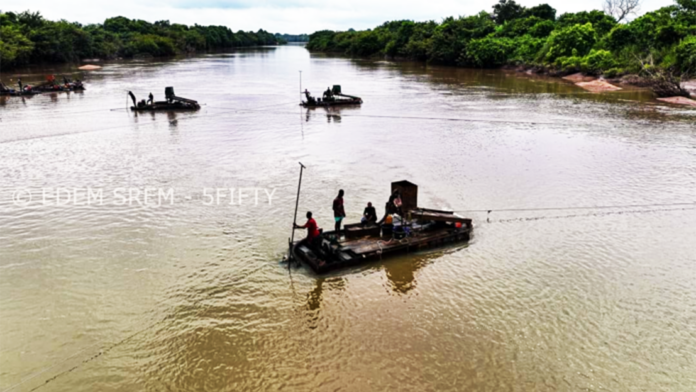
Galamsey is playing a major role in the decline of cocoa production in Ghana, but government seems to have not noticed. Cocoa farmers are giving up their farms for galamsey operations, because of great disappointment in the current producer price announced by government.
When El Salvador finally arrives, the very people who are in those galamsey communities and approve of that form of mining, will rise up against government.
Truly, to me they are the first to blame. How can they allow their youth to transform good soil and fresh natural water to very deadly substances, all in the name of gold? They talk about jobs for the youth, but if galamsey can be called job, then why was it not practised since the days of their ancestors? These ancestors, kept the environment healthy and clean because they believed all belonged to God and passed it down in good state, to this generation.
We hear that four million Ghanaians are involved in galamsey, making up 11.34% of the population, so they must be handled like heroes. Assuming four million rebels are based in the forests, would they not be attacked and destroyed? And of course, people engaged in galamsey are attacking the country. They are worse than coup plotters, who only attack governments. These galamsey operators are attacking and destroying the country. They are waging environmental war on Ghana.
Government must know the differences between someone doing genuine job and the other doing jobs that destroy the soul of the peoples, the environment. The day we will become like El Salvador is not too far away. And when that happens, and the worst calamity takes seat in this country, the galamsey operators will be no where to be found. They will relocate with the gold they have.
In a statement made by the Ghana Catholic Bishops Conference, on September 15, 2025, the bishops of Ghana stated that they cannot be silent before a calamity that imperils both the integrity of God’s creation and the dignity of His people. They reminded Ghanaians that illegal and unregulated mining (galamsey), has become one of the gravest afflictions of our time. It ravages our rivers and forests, poisons our soil, endangers public health, corrupts governance, erodes our moral fibre, and extinguishes livelihoods.
They proclaimed that from the dawn of creation, humanity was entrusted with stewardship of the earth and this vocation is not a licence for reckless exploitation but a sacred trust for the common good.
Unfortunately, our rivers, forests, and farmlands now bear witness to a profound betrayal of this mandate. The Pra, Ankobra, Birim, Offin, Ayensu, and other once-pristine rivers are now laced with mercury and toxic effluents. Some have ceased to flow downstream, while others, like the Ayensu, show turbidity levels so extreme at 35,000 NTU, over twelve times of the maximum threshold of 2,500 NTU that water can be purified.
Once-verdant forests lie stripped to barren scars, while fertile farmlands are rendered sterile, punctured by deadly pits. “The earth is the Lord’s and all that is in it” (Psalm 24:1). To desecrate creation through galamsey is not only an offence against neighbour; it is a grave sin against God, the Creator and Owner of all.
Rather unfortunately, they added the President of the Republic, His Excellency John Dramani Mahama, appears not to grasp the existential scale of the menace. In both January and May 2025, the Conference’s delegation to the president raised these concerns directly with him, only to be met with unsatisfactory responses focused narrowly on economic gain.
The Catholic bishops appealed to President Mahama to show the courage of leadership. Urging his government not only to prosecute the poor and weak but the powerful and well connected as well. They drew attention of Ghanaians that this struggle is not merely about law enforcement. It concerns the very soul of Ghana. It is about whether we choose life or death, blessing or curse (Deuteronomy 30:19).
Also, in its statement on September 15, 2025, the Coalition Against Galamsey (CAG), expressed outraged at government’s failure to see the urgency and crisis Ghana faces from illegal and irresponsible mining.
The Coalition reiterated its disappointment with the recent statements of the President at the Jubilee House on 10th September. Wittingly or unwittingly, these statements seemed to support the environmental terrorism and menace of galamsey. Prolonged tolerance of illegal and irresponsible mining has led to severe environmental damage, including the pollution and destruction of water bodies used by over 20 million people.
In its statement on the galamsey menace issued on September 16, 2025, the National Catholic Laity Council, declaredits full and unwavering support for the statement issued by the Ghana Catholic Bishops’ Conference (GCBC) on the destructive effects of illegal mining, popularly known as galamsey.
The Council thanked God for the courageous and prophetic voice of the Catholic Bishops, who, like true shepherds, have been speaking with clarity and urgency about this national calamity. As the lay arm of the Church, the Council joins the shepherds in calling on the Government of Ghana, traditional leaders, politicians, and indeed every citizen, to take bold steps to end the scourge of galamsey before it consumes the very soul of our nation.
Ghanaians watch fertile farmlands, which for generations fed families and sustained livelihoods, destroyed and abandoned to gaping pits. Children, who should be in school learning for a brighter future, drop out to risk their lives in unstable mining shafts for quick but fleeting gains. Health consequences: strange skin diseases, kidney failures, cancers, and other illnesses have creeped into our communities through polluted water and food.
To the Council, galamsey has truly become a national disaster, not only threatening our environment but also endangering human life, family sustenance, and national security. It went on to remind Ghanaians that galamsey is not simply an economic or political problem but also a moral and spiritual crisis. The Word of God reminds us: “The earth is the Lord’s and all that is in it” (Psalm 24:1).
The National Catholic Laity Council, therefore issued a solemn and pastoral appeal to all Catholic lay faithful to do all in their capacity to help put a stop to galamsey.
It is rather very nauseating to hear ministers in government and NDC members comparing what the government is doing in the fight against galamsey to what the previous administration did. Ghanaians only want results because we are seeing worse things happening now than then.Six breadbasket regions are now producing poisonous foods. No one is safe in Ghana, anymore.
During the previous administration, Sammy Gyamfi held a press conference by a turbid river and accused NPP members on galamsey. In this NDC era he is now telling Ghanaians that galamsey is an aged old problem that can’t be solved by NDC’s eight-month administration, not admitting but hiding the fact that his GoldBod is benefiting from this environmental devasting operations.
H.E. John Dramani Mahama is talking about economic gains, but what will it gain the country to have all the gold in the world but lose the soul of the peoples, the environment?