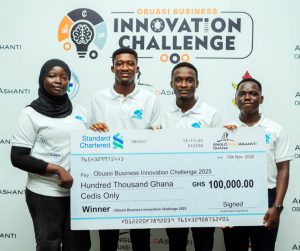
Airotix Technologies at the weekend emerged the proud winner of the maiden Obuasi Business Innovation Challenge organsed by AngloGold Ashanti (AGA) Obuasi Mine and its partners.
The team took home a cool GHC100,000.00 for the ultimate prize while Oli-Emma Enterprise came second and received GHC50,000.00 with Charcoal Masters placing third to receive GHC30,000.00.
Malynx Special Kelewele came fourth and collected GH20,000.00 while IJoy Engineering came fifth and took home GHC10,000.00.
Mr. Edmund Oduro Agyei, Community Relations Manager of AGA noted that the Innovation Challenge Initiative was born out of a vision to empower the entrepreneurs and innovators who are shaping high-growth potential businesses in Obuasi.
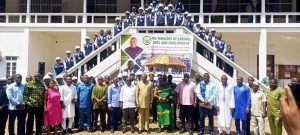
The Winning Team Airotix Technologies pose for the camera
He mentioned that through rigorous coaching, training and vetting, the initial 42 contestants were pruned to 10 outstanding finalists out of which 5 were to be selected and awarded accordingly.
The Community Relations Manager noted that to complement the Innovation Challenge Programme AGA has also implemented the Skills Development and Certification Programme and the Business Acceleration and Sustainability Programme also known as BAST in partnership with Absa Bank Ghana and Master Card Foundation.
“Through these initiatives, we have trained, 1,383 MSMEs with an impressive 53% of the lot being women, showcasing our dedication to inclusivity and empowerment,” he added.
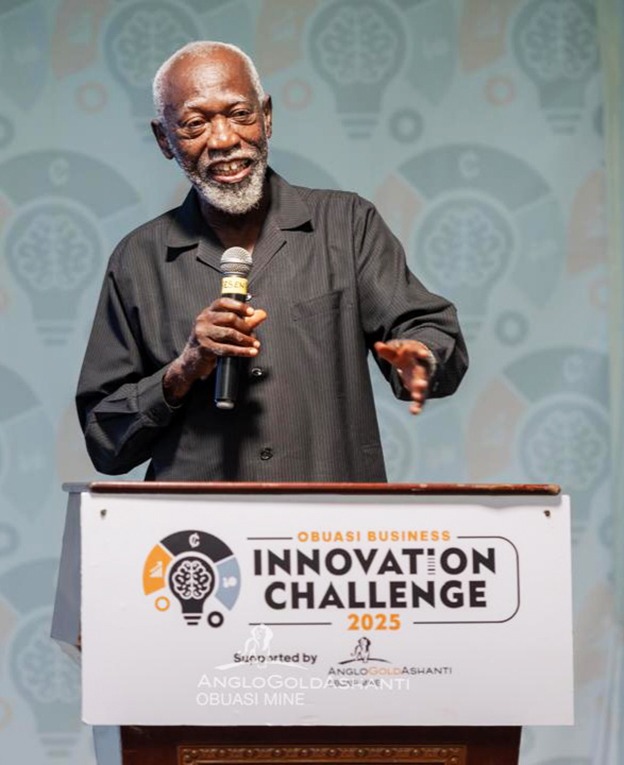
Mr. Kingsley Kwaku Pinkrah, CEO CEDI Ghana commended AngloGold for coming out with the Business Innovation Challenge noting that the Programme is rather a ‘gold mine’ for the youth to exploit and wished the participating teams good luck.
Prof. Stephen Adei, the Lead Judge of the day’s programme, expressed concern over the pollution of River Gyimi as a result of illegal mining activities and said if care is not taken very Obuasi will soon be hit by water sacristy.
To address the unemployment issue among the youth, he suggested the setting up of a big Vocational School in Adansi to train the youth to acquire various skills.
Prof. Adei stated that he had personally acquired a large track of land at his hometown, Hweremoase, near Adansi Asokwa and called for support for the establishment of a Vocational and Technical School for Adansi youth.
The Ministry of Labour, Jobs and Employment has established a Health and Safety Enforcement and Compliance Special Task Force to improve workplace safety standards in the Ashanti region. The launch of the new initiative is to help promote workplace safety and protect the rights of workers.
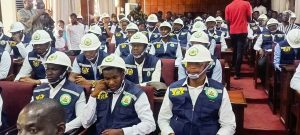
Members of the Taskforce at the inauguration
The Task force, launched by the sector Minister, Dr. Rashid Pelpuo, will support the Factory Inspectorate Agency in ensuring that employers comply with health and safety laws.
Dr.Pelpuo emphasised that workplace safety is a fundamental pillar of sustainable development and productivity, urging employers to take responsibility for their workers’ safety and health.
He noted that compliance with safety regulations has been low due to the limited workforce within the Factory Inspectorate Agency.
The Minister emphasised the importance of workplace safety and training, stating that it is not just a matter of professionalism, but a fundamental right of workers.
Speaking at the launch of a new initiative, which aims to improve workplace safety, increase revenue collection, and promote a culture of compliance, Dr.Pelpuo noted that the Factory Inspectorate Agency was established to ensure that workplaces are safe and healthy for all employees.
According to Dr.Pelpuo, many employers have not taken workplace safety seriously, despite the law requiring them to provide safe working conditions.
He attributed this to the limited workforce within the Factory Inspectorate Agency, which has made it difficult to conduct regular inspections and enforce compliance.
The Minister announced that newly established Taskforce will support the Factory Inspectorate Agency and ensure that employers comply with health and safety laws. He also revealed that a digital compliance app has been introduced to enable inspectors to register, monitor, and verify company certifications in real-time.
The Taskforce and the dignitaries with Labour Minister in a group photo
Dr. Pelpuo emphasized that workplace safety was a shared responsibility, and urged employers to take steps to ensure that their workplaces are safe and healthy and called on workers to report any safety concerns assuring them that their rights will be protected.
The Chairman of the Health and Safety Compliance Committee, Mr. Daniel Ayikwei, urged the task force to execute their duties diligently, ensuring that Ghana’s workplaces become safer and healthier environments for all.
Mr. Augustus Andrews Nana Kwasi, the Ashanti Regional Chairman of the NDC commended the ministry for the initiative to help reduce unemployment among the youth in the Ashanti region.
He said the initiative would ease the unemployment burden, which has being his headache for sometime now as the regional Chairman of the ruling party.
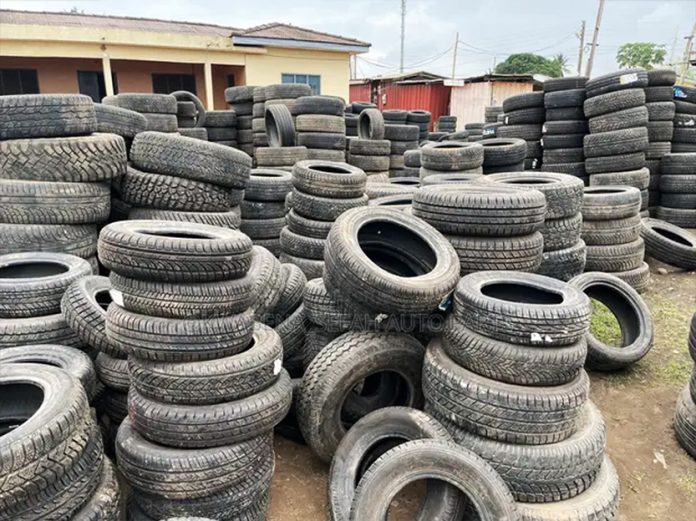
Her Ladyship Halimah El-Alawa Abdul-Bassit, sitting as an additional duty judge of the Circuit Court, has granted bail to Emmanuel Ampah and Benson Tetteh in a case involving the alleged theft and dishonest receipt of 700 pieces of assorted home-used car tyres valued at GH¢350,000.
The two were admitted to bail in the sum of GH¢360,000 each, with three sureties, all of whom must reside within the court’s jurisdiction and must be justified.
Additionally, they are to deposit their Ghana Cards at the court registry and report to the police once every week.
However, the second accused, Ali Mahmud, was remanded into police custody and is expected to reappear on November 26, 2025. The court further ordered the prosecution to file all disclosures and witness statements to enable the Case Management Conference (CMC).The case is being prosecuted by Chief Inspector Christopher Wonder.
The accused persons – Emmanuel Ampah, 46, unemployed, Ali Mahmud, 61, scrap dealer and
Benson Tetteh, 39, Vulcanizer – all pleaded not guilty.
They are facing charges of stealing and dishonestly receiving, contrary to sections 124(1) and 146 of the Criminal Offences Act, 1960 (Act 29).
Brief Facts
According to the prosecution, the complainant, a trader residing at Ablekuma, deals in assorted home-used car tyres stored in his warehouse at Abossey Okai.
Over a period, he detected persistent thefts, but was unable to identify the culprits despite several preventive measures.
On October 18, 2025, the complainant hid in his shop after closing. At 12:38 a.m. on October 19, he allegedly spotted A1, Emmanuel Ampah, sneaking into the warehouse and attempting to leave with a Sprinter tyre valued at GH¢500. Ampah was arrested and handed over to the police.
Ampah later admitted to stealing 25 pieces of tyres and said he supplied them to A3, Benson Tetteh, a Vulcanizer at Zongo Junction. Police arrested Benson, and 19 tyres were retrieved from his warehouse.
Further investigations revealed that Ampah had been stealing tyres over time and handing them to A2, Ali Mahmud, who sold them.
One tyre purchased by Benson was allegedly bought from Mahmud for GH¢100.Benson has since refunded GH¢10,000 in addition to the 19 retrieved tyres.
Investigators are still working to verify the complainant’s claim of 700 stolen tyres valued at GH¢350,000.
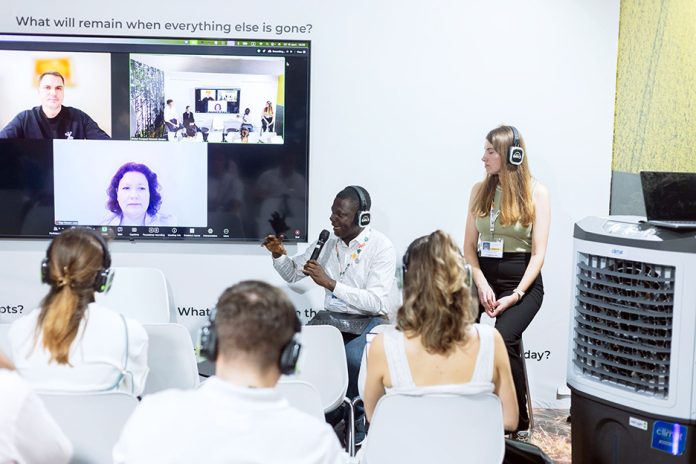
Ing. Dr. Glenn Kwabena Gyimah leading panel discussion at the COP30 in Brazil
The General Manager of the Jospong Green Transition Office, Ing. Dr. Glenn Kwabena Gyimah, says his outfit is demonstrating how Ghana’s private sector can successfully transition from carbon market readiness to tangible climate action.
Speaking during a World Climate Foundation panel discussion on the sidelines of the COP30 currently going on in Brazil, Dr. Gyimah revealed how Jospong has leveraged Ghana’s Article 6 framework to drive both environmental and social impact.
“The clarity brought by Ghana’s Carbon Market Office and National Authorization Framework transformed carbon markets from a policy discussion into a viable business opportunity,” he stated.
He outlined the JGC’s significant progress since 2024, highlighting five key implementation milestones.
“We have successfully integrated our project portfolios with Ghana’s National Carbon Registry, making our composting, landfill gas recovery and clean cooking initiatives among the first to be officially tracked in the national system,” he explained.
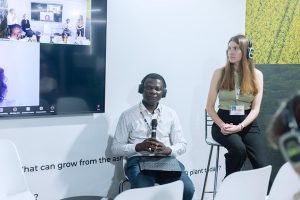
Ing. Dr. Glenn Kwabena Gyimah answering a question
He underscored that Jospong Group’s approach goes beyond mere carbon credit generation.
“For us, participation in carbon markets represents a fundamental redefinition of the private sector’s role in national development.
“Every ton of carbon we mitigate must tell a social story – creating green jobs, improving agriculture yields through organic fertilisers, and enhancing urban air quality.”
Addressing the practical challenges of implementation, Dr. Gyimah acknowledged initial hurdles, but highlighted progressive solutions.
“While we faced complex MRV protocols and high verification costs initially, through public-private dialogue, we have developed workable solutions that maintain both environmental integrity and investment viability,” he said.
Dr. Gyimah outlined four emerging models that are shaping Ghana’s carbon market landscape, stressing particularly the importance of community engagement.
“Our community benefit-sharing model ensures that carbon revenue is reinvested in local development – supporting schools, clean water and reforestation initiatives,” he elaborated.
The Jospong executive concluded with a forward-looking perspective, stating “Our experience demonstrates that when government and business work in synchronisation, carbon markets become more than just transaction platforms – they evolve into powerful instruments for sustainable national development and green growth.”
Ghana is taking deliberate steps toward becoming a vaccine-manufacturing country, a move experts believe will strengthen national health security, accelerate economic development and reduce Africa’s long-standing dependency on external suppliers during pandemics.
This development formed the core of discussions at a two-day training on vaccine communication and advocacy held at the National Vaccine Institute (NVI) in Accra.
The event, organised in partnership with the African Media and Malaria Research Network (AMMREN), Ghana Health Service, Noguchi Memorial Institute for Medical Research and the Food and Drugs Authority (FDA) brought together journalists from across the country to deepen their understanding of vaccine science, counter misinformation and support Ghana’s vaccine self-sufficiency agenda.
Building Local Manufacturing Capacity for National Resilience
The CEO of the National Vaccine Institute, Dr. Sodzi Sodzi-Tettey, said Ghana’s decision to venture into vaccine manufacturing is not only a public health milestone, but also a strategic development investment.
He explained that Africa’s inability to secure vaccines during COVID-19 and Mpox outbreaks exposed structural vulnerabilities on the continent and reinforced the urgent need for domestic production capacity.
Ghana is receiving advanced technical support through a technology-transfer partnership between Atlantic Life Sciences and Indonesia’s BT Biofarma.
This collaboration will allow the country to establish its own production systems while adopting globally recognised standards for quality, safety and regulatory oversight.
The first vaccine to be produced locally will target tetanus bacteria, with rollout expected in late 2026 or early 2027.
Dr. Sodzi-Tettey emphasised that the initiative aligns with President John Mahama’s long-term vision for Ghana to lead West Africa in vaccine development and pandemic preparedness.
“This is a development investment. We are building an ecosystem manufacturing capacity, regulatory systems, scientific research, community engagement, and skilled human resources,” he said.
He described vaccine manufacturing as a catalyst for job creation, biotechnology innovation, and industrial transformation, noting that the sector could spur growth in pharmaceutical engineering, cold-chain logistics, laboratory technology, and advanced research.
Dr. Sodzi-Tettey stressed that misinformation poses one of the greatest risks to Ghana’s vaccine agenda and, by extension, national development.
He recalled how rumours once undermined a vaccine trial in the Volta Region and how COVID-19 conspiracy theories spread even among educated groups.
He said trust is a “development resource” and warned that without it even the best infrastructure and technology could fail.
“If journalists are not well informed, misinformation can collapse the entire effort. Vaccine confidence is foundational to Ghana’s manufacturing ambitions,” he stated.
To address this, the NVI and its partners plan nationwide community engagements to understand public concerns, promote transparency, and prepare communities ahead of the release of Ghana’s first domestically produced vaccines.
Strengthening Human Capital Through Science Communication
Executive Secretary of AMMREN, Dr. Charity Binka, said that strengthening journalists’ capacity was equally a national development strategy.
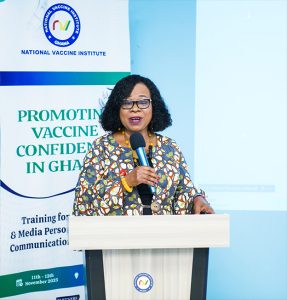
Executive Secretary of AMMREN, Dr. Charity Binka speaking at the media training programme
She explained that a scientifically literate media contributes to a healthier population, better policy uptake, and stronger community cooperation during health interventions.
She described journalists as “critical development actors” who translate complex research into accessible information that informs decision-making at household, community, and national levels. Since 2006, AMMREN has trained hundreds of journalists across Africa to report accurately on malaria, epidemics, and vaccines.
Their partnership with the NVI, she noted, extends this mandate into Ghana’s vaccine-manufacturing era.
Dr. Binka added that vaccines have played a transformative role in reducing disease burden, improving productivity, and enabling children to attend school, which is a direct contribution to Ghana’s social and economic development indicators.
She said the training programme was designed to help journalists understand vaccine science, navigate the ethics of health communication, counter misinformation, and tell development-oriented stories that build national resilience.
“A well-informed journalist supports a well-informed population. And a well-informed population is the backbone of national development,” she said.
Dr. Tanko Schools Media on Vaccine Science
Dr. (Med) Naziru Tanko Mohammed, Deputy Programme Manager for the Expanded Programme on Immunization (EPI) at the Ghana Health Service, reaffirmed the life-saving power of vaccines, describing them as “one of the greatest health breakthroughs in human history.”
Vaccines – Ghana want to produce them locally
He explained that vaccines stimulate the body’s immune system to develop long-lasting protection against specific pathogens.
“Vaccines contain the same antigens found in disease-causing germs, but exposure through vaccination is controlled,” he noted, adding that this controlled exposure teaches the immune system to recognise and respond to real infections without the person falling ill.
Dr.Tanko stated that vaccines used in Ghana’s national immunisation programme generally fall into two categories: Live Attenuated and Inactivated vaccines. Inactivated vaccines include killed, sub-unit, toxoid, viral vector and mRNA types.
While live attenuated vaccines contain weakened germs that cannot ordinarily cause disease. Inactivated vaccines are made from killed germs, specific components, or toxins.
Two or more vaccines can be combined to form multivalent formulations such as Pentavalent, Measles-Rubella (MR), and Tetanus-Diphtheria (Td).
He also highlighted modern vaccine technologies, including mRNA-based vaccines such as Moderna and Pfizer’s COVID-19 vaccines.
Touching on immunity, Dr.Tanko explained that it could be acquired through natural infection or vaccination. Vaccination “primes” the immune system so that when a vaccinated individual is later exposed to live pathogens, their immune system can quickly destroy them before disease develops. He emphasised that vaccines used in Ghana’s national programme are safe and effective.
Although no vaccine is completely free of minor side reactions, the very low risk of adverse events is far outweighed by the dangers posed by natural infections such as measles.
FDA Outlines Ghana’s Vaccine Regulatory Standards
Representing the CEO of the Food and Drugs Authority (FDA), Pharm. Patrick Owusu-Danso, Acting Director at GLSR-FDA, explained the rigorous process that vaccines undergo before approval and distribution in Ghana.
He said the FDA evaluates vaccines across several key areas: safety, identity, efficacy, purity, and quality.
Safety is ensured through detailed animal studies and clinical trials, while identity is confirmed by verifying that labelling accurately reflects active ingredients and excipients.
Efficacy is demonstrated through challenge studies and human clinical trials, purity is maintained by controlling impurities within acceptable limits and quality is guaranteed through adherence to Good Manufacturing Practices (GMP) and robust Quality Management Systems.
Pharm. Owusu-Danso added that the FDA oversees the entire vaccine supply chain, including shipping validation studies, cold-chain monitoring and enforcement of Good Distribution Practices.
He emphasised that Ghana operates under a robust and stringent regulatory environment designed to protect public health.
“FDA Ghana is a strong regulatory authority in Africa with the legal mandate and technical capacity to assure the safety, efficacy, and quality of vaccines,” he said.
Towards a Stronger, Safer and More Self-Reliant Ghana
The Accra training underscored the shared belief among NVI, AMMREN, FDA, GHS, and Noguchi that vaccine manufacturing is not simply a health-sector achievement – it is a national development strategy capable of reshaping Ghana’s scientific, economic and industrial future.
As Ghana moves closer to its first vaccine manufacturing milestone in 2026, stakeholders say public trust, media accuracy and community engagement will be just as crucial as technology and infrastructure.
Through this collaborative approach, Ghana aims to build a future where the country is not the last to receive vaccines during global crises, but becomes a regional leader in biotechnology, innovation, and health sovereignty.
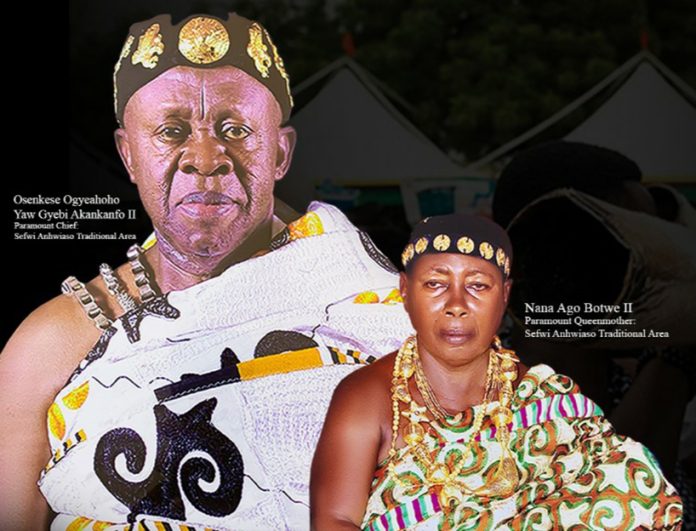
Ogyeahoho Yaw Gyebi II and Nana Ago Botwe II, Paramount Queenmother
This year’s edition of the Eluo festival for the chiefs and people of Sefwi Anhwiaso Traditional Area commenced yesterday with a football Gala competition.
Today, the people will partake in a general health screening in various communities in the area.
There will be Inter SHS Quiz competition on Tuesday followed by a Cultural Day and a Traditional Food Fair on Wednesday and Thursday respectively while Clean up and Spiritual cleansing at Bibiani and Anhwiaso are scheduled for Friday.
As part of the programmes and activities drawn for the week long festivities, the Paramount chief of the Sefwi Anhwiaso Traditional Area, Ogyeahoho Yaw Gyebi II, who also serves as the President of the National House of Chiefs and Nana Ago Botwe II, Paramount Queenmother of the Traditional Area and the Council of Elders will host the President John DramaniMahama (Special Guest), Dr. Daniel McKorley, founder of the McDan Group of Companies (Guest of Honour) and Awulae Agyeifi Kwame II, Paramount chief of Nsein Traditional area (chairman) at a grand durbar at Bibiani on Saturday November 22, 2025 to climax the festival.
The theme for Eluo festival 2025 is: “Our Heritage, our people, our development”.
It coincides with Ogyeahoho Yaw Gyebi II’s 75th birthday and 35th anniversary on the throne.
The festival is a cultural event, which traditionally heralds the harvesting of yams, a staple crop, symbolizing a period of abundance and renewal and used to reinforce community ties and plan for future development.
It brings people from far and near to deepen their understanding of Sefwi culture, foster social cohesion, and promote unity among the various communities.
The durbars held during the festival serve as platforms for traditional authorities and community members to discuss plans for local development, education, and investment opportunities.
During the festival, visitors are welcome to share food, drinks amid drumming and dancing during which people put on their brightest and best traditional clothes to the durbar and showcase splendid cultural performances including poetry, drumming, traditional dance, drama, and arts exhibitions.
The paramount chief has prioritised the promotion of education and peace as key to development over the years.
Ogyeahoho Yaw Gyebi has been influential in the establishment of the Queen’s SHS and encouraged the youth to get involved in TVET programmes to secure their future.
The Omanhene has so far resolved chieftaincy issues hence the prevailing peace in the area.
He has called on Corporate entities operating in the Traditional Area to support students as part of the corporate social responsibility to champion the developmental agenda of the area.
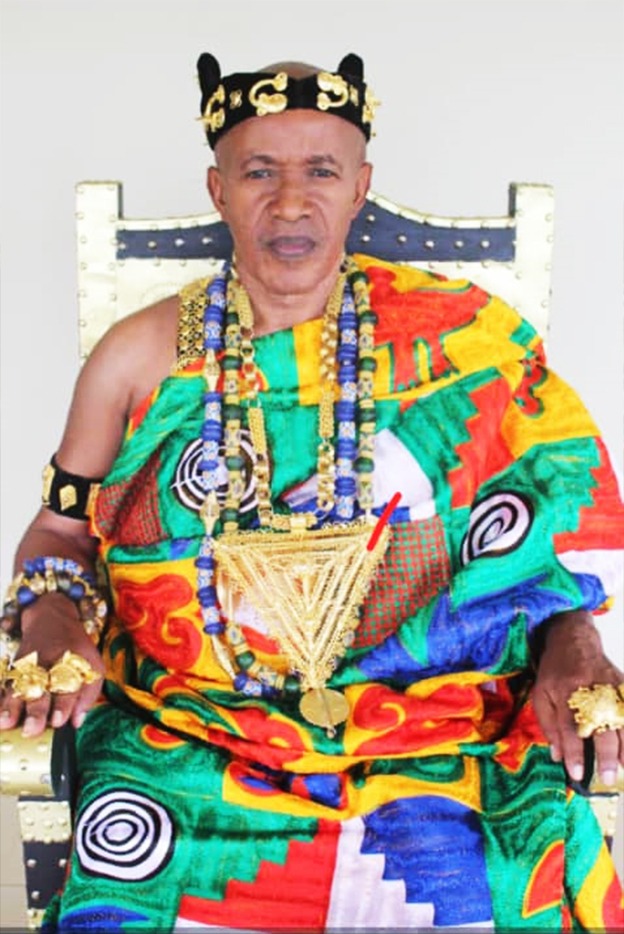
Paramount chief of Battor Traditional Area, Togbega Patamia Dzekley VII
The chiefs and people of Battor Traditional Area in the North Tongu district of the Volta region have, over the weekend, held a colourful mini durbar to herald this year’s Hogbeza.
Slated for 13 December, 2025 the festival will take place at Dugame-Battor and is expected to attract the president, Mr John Dramani Mahama, the regional minister and some other government officials.
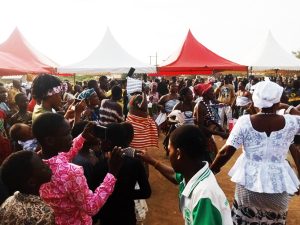
The locals enjoying themselves during the mini festival at Battor
These were disclosed by the paramount chief of Battor Traditional Area, Togbega Patamia Dzekley VII, who is the Vice President of the Volta Regional House of chiefs and a member of the National House of chiefs in a speech he delivered at the mini Hogbeza.
Also president of the Battor traditional council, he praised the chiefs and people of Manya and Kodokorpe for coming together to host the mini durbar.
He appealed to the natives to do away with petty squabbles, forgive one another and live in peace. ‘Let’s forgive one another and live in peace,’ he said.
Togbega Patamia Dzekley expressed worries at the hostile environment that prevailed against the festival celebration over the years.
This, he noted, made it impossible for the traditional council to function to, among other things, seek development projects for the area.
He expressed joy that the wind of the reset agenda is blowing over the Battor traditional area too, which will bring some useful transformations to the people.
He entreated the people to participate in the upcoming Hogbeza in their numbers and contribute their quota to the development plans the traditional council has for it.
The chairman of the mini Hogbeza, Mr Harrison Vortuame, observed that festivals are one of the vessels of developments. Thus any traditional area that doesn’t celebrate a festival will be losing so much by way development and the promotion of its culture.
He bemoaned conditions that obstructed Hogbeza over the years, but was pleased that the festival was resurrected to raise money to continue some projects initiated by the festival planning committee which have stalled.
The acting vice chairman of the planning committee, Togbe Akliku II said despite the short notice due to uncertainties surrounding the festival, the event was heavily attended with many cultural troupes as if it were the main festival.
He commended the people for the demonstration of willingness to support the development of Battor.
‘Dollar Ladies,” a welfare Association of some ladies of Battor, uniquely dressed in white T-shirts with a cap to match, also graced the occasion and made a handsome financial donation and promised to not just promote the upcoming Hogbeza, but also make more donations during the festival in December.
Patrons of the mini Hogbeza expressed joy at the programme and described it as entertaining as and more than successful.
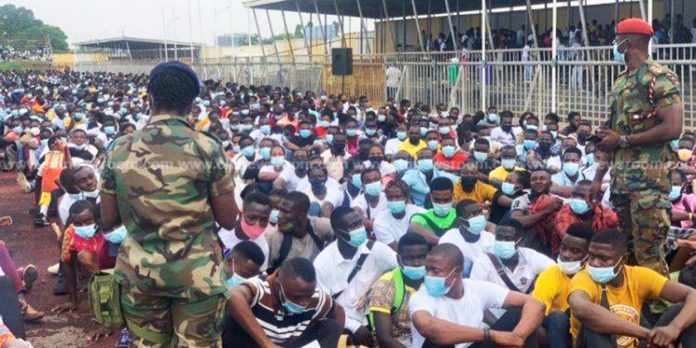
They chose a profession where they would be ready to lay down their lives for the country of their birth. Very determined to join that profession that will make them protect Ghana with their lives, damningany consequences, they charged into the stadium as if confronting an enemy. Ahead of them was a battle for employment.
In what looked like a disorganised and chaotic scene, at the El Wak stadium last week, should the Ghana Armed Forces be blamed? Is it possible that the number of applicants there exceeded the number that should have been there?
The military put out online application and hundreds of thousands of young Ghanaians applied. During this many were disqualified and here, what if some of those disqualified were well-connected and their god-parents told them to go to the El Wak all the same, because they have forwarded their names to the top? What should have been a few thousands, became tens of thousands.
And when the gates of the stadium were opened, instead of getting in gently and orderly, there was a rush to go and get a good place to sit. Then it happened. Just like any battlefield, the bold and the brave fell, and Ghana lost six beautiful young ladies.
Today, most people are blaming the military. But this has never happened before, so why now? Certainly, if the military had anticipated that huge number of applicants, it would have made better arrangements. Perhaps we need the Armed Forces to come out and tell us, how many applicants they were actually expecting.
Sadly, six beautiful young ladies fell on the day they were full of hope to sail through to the next stage and get closer to achieving their dreams of donning the Ghana military uniforms. Their death has revealed lapses in our society and we must make all efforts to prevent such a thing ever happening again.
No matter how we look at things, these young ladies were true heroes, who gave up their lives to help us identify what to fix in this country. They need to be honoured. I will suggest they are buried with full military honours.
In the Catholic Church, catechumens who are preparing to receive the sacrament of baptism, but die before that are buried with full requiem mass. It is so, because there is that intent to be Catholic.
So, I ask again, that with the strong intent to become military personnel, which these young ladies were fighting to be, and be able to defend this country with their lives, should they not be given military burial with full honours? Can they not be posthumously given the ranks they would have be gotten, if they were successful in their applications to join the Armed Forces?
I pray for their souls and all the souls of the faithful departed. May their souls be among the Elect in Heaven and may God console their parents, siblings and relatives.
As Christians we mourn the dead and pray for their souls. When Jesus Christ was killed on the Cross, His followers were traumatised and sorrow-stricken. Jesus’ death was ordained by God and He watched as His Only Begotten Son was tortured and killed by humans. During His passion, all the angels in Heaven were horrified and deeply angry at what was happening to their Lord and Master, and very ready to charge down to earth and discipline mankind.
They waited for the okay from God, but He knew why Christ must suffer and die, even as it was very painful to His love ones.
The NDC MP for Pusiga, Hon. Ayaamba Ayii Laadi, said her tribute to our fallen heroes and she was emphatic in saying that Allah had ordained that day for the young ladies to die and so nothing could be done about it. The way she put it, she was indirectly condemning those who were in mourning due to that loss and making them understand that they cannot change what Allah had ordained.
This is very bad and cruel. How can you mock and insult a family in mourning? Yes, I do agree that God allows things to happen, including death. There are still-births which depress the mothers. Their dreams of cuddling and nursing their babies never materialised and they deeply mourn. Then there are deaths of children, who just completed SHS or their first degree with flying colours. Yes, God allowed it, but the families will be in deep sorrow and they must be consoled and certainly not with these words Hon. Laadi said.
Spouses wave good-bye to each other as they set off for work, only for one not returning. He or she is dead after having said what was the final goodbye. Families mourn and Hon. Laadi is suggesting that they should be condemned for that?
When the eight gentlemen; two ministers of state, three government officials and three air force personnel died in the helicopter crash, why did Hon. Ayaamba Ayii Laadi not make the statement she made last week and condemn even President Mahama for mourning?
Yes, God allowed the death of the six fallen heroes to happen and it is our responsibility to mourn them and console their family. A true and genuine last post should be sounded when they are being buried, to honour their memories.
Hon. Daniel Dugan
The views expressed in this article are the author’s own and do not necessarily reflect The Chronicle’s stance.
Kwasi Kyei Darkwah, a celebrated media personality popularly known as KKD, has been appointed Ghana’s Special Envoy to the Caribbean Region by President John Dramani Mahama.
His appointment comes at a time when Ghana is seeking to consolidate its international relations and deepen bilateral ties with countries across the Caribbean.
As Special Envoy, KKD is expected to play a key role in strengthening diplomatic, cultural, and economic cooperation between Ghana and Caribbean nations—regions linked by deep historical, cultural and ancestral connections.
His mandate covers Caribbean countries such as Cuba, Haiti, the Dominican Republic, Trinidad and Tobago, and Barbados, among others.
The role is central to Ghana’s broader foreign policy drive, which includes expanding trade and investment opportunities, promoting Ghanaian culture globally, and engaging Caribbean partners on shared development challenges.
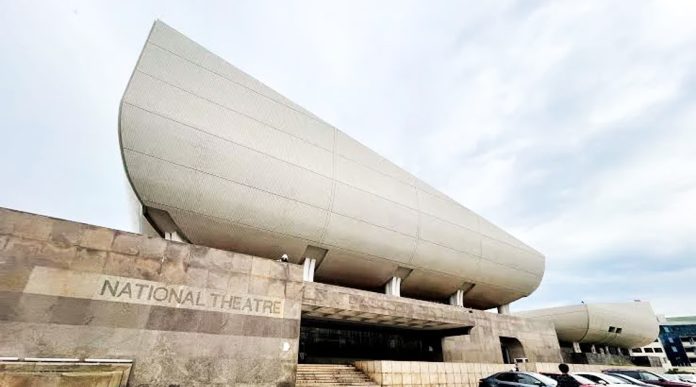
Entertainment analyst, Arnold Asamoah-Baidoo, has described the government’s plan to renovate the National Theatre in Accra as “a very good call,” highlighting the venue’s long-standing infrastructure challenges and its significance to Ghana’s arts and entertainment sector.
Speaking on Starr Showbiz with Feeling Daddy on Starr 103.5 FM, on Saturday, November 15, 2025, Arnold detailed the theatre’s current issues, noting that “most of the chairs are broken, air condition is not working,” and recalling past backstage difficulties that have disrupted performances.
“I remember one time we were calling one of the guys to lower the curtain. It took 30 minutes for the person to lower the curtain, all because it was not functioning,” he said, emphasising the urgent need for comprehensive renovations.
He welcomed the $2 million funding secured from China for the renovation, pointing out that “incidentally, it’s the same Chinese government that built the National Theatre in the 1990s. And since that building, there has been no renovation.”
Arnold also highlighted the theatre’s vital role in hosting national arts groups, saying, “The National Theatre really houses a lot of activities. Apart from the National Dance Group, the National Orchestra… most of our events are held in the National Theatre.” He stressed that improving stage operations and technical management is essential for both performers and audiences.
He further noted the contributions of private entities in supporting the theatre, such as donating air conditioning, underscoring the importance of a full-scale government-led renovation. “We need to fix the National Theatre because it houses a lot of activities,” Arnold stated.