Home Blog Page 2015

Niger coup: Wagner taking advantage of instability – Antony Blinken

0
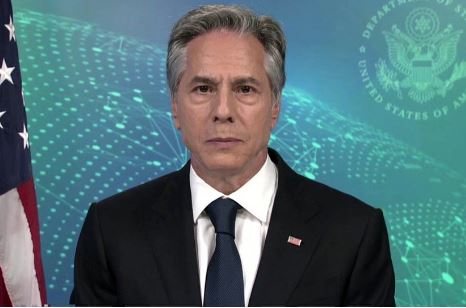
Antony Blinken, US Secretary of State

Russia’s Wagner mercenary group is “taking advantage” of instability in Niger, US Secretary of State Antony Blinken has told the BBC.

The country has been ruled by a junta following the ousting of President Mohamed Bazoum nearly two weeks ago.

There have been suggestions the coup leaders have asked for help from Wagner, which is known to be present in neighbouring Mali..

Mr Blinken said he did not think Russia or Wagner instigated Niger’s coup.

However the US was worried about the group “possibly manifesting itself” in parts of the Sahel region, he told the BBC’s Focus on Africa programme

“I think what happened, and what continues to happen in Niger was not instigated by Russia or by Wagner, but… they tried to take advantage of it.

“Every single place that this Wagner group has gone, death, destruction and exploitation have followed,” said Mr Blinken.

“Insecurity has gone up, not down”.

He added that there was a “repeat of what’s happened in other countries, where they brought nothing but bad things in their wake”.

Both the US and France operate military bases in Niger as part of operations to disrupt jihadist groups operating in the wider region. Niger became the main base for French troops after they were told to leave Mali following a coup there.

Source: bbc.com

Niger coup leaders rebuff diplomatic overtures from AU, ECOWAS

0
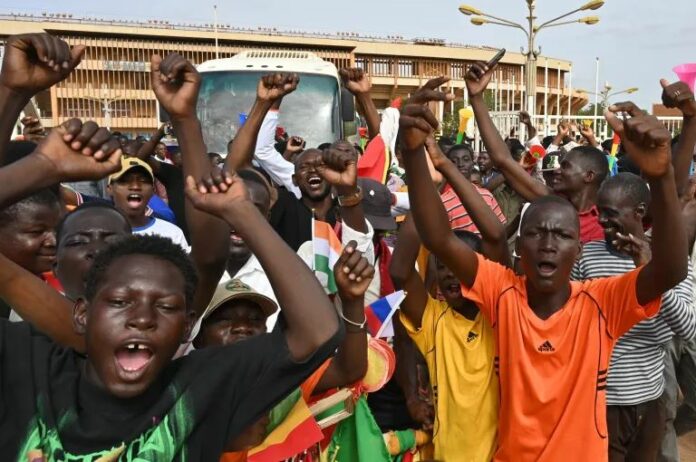
Supporters of Niger's National Council for the Safeguard of the Homeland (CNSP) demonstrate in Niamey on August 6, 2023

Niger’s military government has rejected the latest diplomatic mission from African countries aimed at restoring constitutional order after a July 26 coup, resisting pressure from the United States and United Nations to come to the negotiating table.

The African Union (AU) planned to send a joint mission with representatives of the UN and the West African bloc ECOWAS to Niger on Tuesday, but it was denied permission by the military government, which has closed Niger’s airspace, the French magazine Jeune Afrique reported.

Leaders of ECOWAS, or the Economic Community of West African States, are preparing for a summit on Thursday to discuss their standoff with Niger’s coup generals, who defied a Sunday deadline to reinstate overthrown President Mohamed Bazoum.

The possibility of military intervention will be discussed, but ECOWAS has said it is a last resort.

An AU spokesperson confirmed to the Reuters news agency that a mission had been denied access while ECOWAS declined to comment.

The coup leaders had already snubbed meetings with a senior US envoy and another ECOWAS delegation that tried to negotiate.

Under Bazoum, Niger was relatively successful in containing an armed uprising devastating the Sahel region. It was also an important ally for the West after two of its neighbours rejected former colonial power France as an ally and turned towards Russia instead.

Niger is the world’s seventh largest producer of uranium, the most widely used fuel for nuclear energy, adding to its strategic importance.

Source: Aljazeera.com

New Juaben Educational Directorate Receive Material Boost …as PTY Foundation support BECE candidates

0
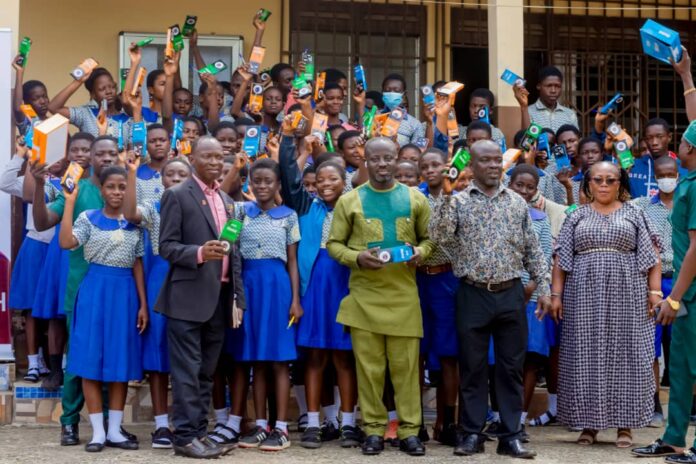
The Chief Executive Officer of PTY Foundation Hon Philip Twum Yeboah (in green dress) with some teachers and students in a group photograph after the donation

In the quest to encourage Junior High students who are sitting for this year’s Basic Education Certificate Examination (BECE) in the New Juaben North Municipality, Philip Twum Yeboah, has donated mathematical sets to the Educational Directorate.

A total of 1,500 mathematical sets were donated for onward distribution to all the final year students who are sitting for the exam.

Speaking to the media during the short ceremony at the forecourt of the New Juaben North Educational Directorate office, the Chief Executive Officer (CEO) of PTY Foundation said that supporting students to have peace of mind during exams time was a prime objective.

The PTY CEO, who is also an aspiring parliamentary candidate for the area, encouraged the candidates to be strong, audacious and read the questions carefully before answering them in order to achieve the best grades.

Mr. Yeboah cautioned them to desist from fasting during the examination period in order to increase their glucose levels to allow their brains to function, and also have enough time for sleeping.

He indicated that some candidates did not have vital stationeries to prepare adequately for the examination, adding that some suffered in answering construction questions without the use of the appropriate materials.

He continued that he had been donating mathematical sets and other learning materials to schools in the municipality for years as part of efforts to support quality teaching and learning.

The aspiring Member of Parliament (MP) on the ticket of the ruling New Patriotic Party (NPP), averred that he was committed to addressing the educational challenges in the area.

Mr. Philip Twum Yeboah said he was supporting final year students because of the Free Senior High School (SHS) introduced by the government to enable every child in the country who qualifies for second-cycle education to be placed freely in a public school.

He added that the PTY Foundation was committed to supporting students in the municipality because not all of them were privileged to have a mathematical set during the examination.

On behalf of the final year students, the New Juaben North Municipal Education Director, Madam Beverly Dansoa Bartels, thanked the PTY Foundation for supporting the candidates with the mathematical sets.

She added that sometimes pupils asked their colleagues for rulers, pens and others materials during examinations, hence the donation was timely and highly appreciated.

Madam Beverly Dansoa pleaded with the Foundation to continue donating learning materials to enable the municipality deliver better education.

She called on the PTY for a partnership in terms of donating learning materials to enlarge the Foundation.

Solving infrastructural challenges is our dream –NCC Executive Director

0
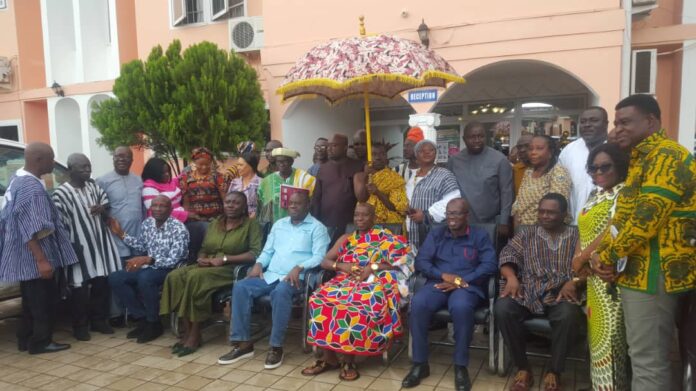
Officials of NCCE, traditional leaders among other personalities in a group picture

The Executive Director of the National Commission on Culture (NCC), Nana Otuo Owoahene Acheampong, has stated that solving infrastructural challenges was their dream.

To him, the Commission aimed to improve on its finances and resources, building capacity for its staff, solving infrastructure challenges, general operations, and its regional centers.

The new Executive Director said that his major vision was to foster unity towards efficient and effective delivery of the mandate of the Commission and the regional centers.

Delivering a speech at the 2023 Mid-Year Performance Review meeting of the Commission in the Eastern Region, Nana Otuo Acheampong disclosed that the Deputy Executive Director would embark on a working tour to ascertain the real situation of the operations of the regions and how to address their peculiar challenges.

Nana Otuo Acheampong also indicated that the Commission would continue working assiduously, obviously with the help of the Ministry to amend NCC Act 238 of 1990 to help improve its operations, adding that before his appointment the Commission was working on it.

“I am very much ready to work with a strong and vibrant conference that will be determined to play their role in support of the Commission. Very soon, we shall be coming out with a comprehensive medium-term development plan, which will give us clear directions for, at least, the next five years,” said Nana Otuo Acheampong.

The Minister for Tourism, Arts, and Culture (MoTAC), Dr. Mohammed Ibrahim Awal, on his part, said that the government, through the Ministry, had revived the Kwame Nkrumah Mausoleum, adding that without a good cultural background, there was no tourism.

He promised that the Ministry would support the NCC to deliver on its mandate, whilst affirming the government’s determination to generate about US$6 billion into the Ghanaian economy through tourism from 2025.

The Head of the Eastern Regional Coordinating Council, Mr. John Donkor, on behalf of the Eastern Regional Minister, stated that it was paramount to recognise the need to preserve cultural heritage to harness the economic potential of the sector for sustainable development.

Mr. Donkor indicated that culture was an important sector that contributed significantly to the socio-economic development of the Ghanaian economy, hence investing in it was essential for the overall growth and development of the region, and country at large.

Mr. Donkor explained that it was important to equip the Centers for National Culture with the needed resources to make them more effective and efficient.

Mr. Donkor added that culture formed the foundation of our identity and heritage, and unites us as a people, while it also helps us to express our unique tradition, values and artistic endeavours since it formed an integral part in the development of our country.

Mr. Donkor indicated that many African countries were said not to have made giant strides in their development agenda, owing to their inability to combine their indigenous values with the colonial legacies as the Asians had done.

The theme for the programme was “Towards Effective Operation of the Centres for National Culture; the role of Partnership and Collaboration.”

Feature: Misconceptions about Coup d’état in Sahara Regions

1
The writer: Sir Alfred Kesse (Pan African Child)

Many people have criticised the current Coup d’État by the military in NIGER.

Having followed these occurrences in the NIGER, BURKINA FASO, GUINEA and MALI, I realised that people don’t really understand the French system of governance and are wishing same to be done in their various countries.

The truth of the matter is that the current Coup d’etat in West Africa is not purposely due to economic hardship.

The question is: Why are coups d’états happening in only the Francophone countries for the past 20 years?

I am not a prophet of doom but findings from my research indicate, and I can unequivocally predict, that there are more military COUP D’ÉTATs in the offing in francophone countries.

Francophone countries

Did you know many African countries (Francophone) continue to pay colonial tax to France since their independence till today? Yes, 14 African countries are forced by France to Pay Colonial Tax for the benefits of Slavery and colonization.

When Sékou Touré of Guinea decided in 1958 to get out of French colonial empire and opted for independence for the country the French colonial elite in Paris got so furious, and in a historic act of fury the French administration in Guinea destroyed everything in the country which represented what they called the benefits from French colonization.

Three thousand French left the country, taking all their property and destroying anything that  could not be moved: schools, nurseries, public administration buildings were crumbled; cars, books, medicine, research institute instruments, tractors were crushed and sabotaged; horses, cows in the farms were killed, and food in warehouses were burned or poisoned.

The purpose of this outrageous act was to send a clear message to all other colonies that the consequences for rejecting France would be very high.

Slowly, fear spread through the African elite, and none after the Guinea events ever found the courage to follow the example of Sékou Touré, whose slogan was “We prefer freedom in poverty to opulence in slavery.”

As I write this article, 14 African countries are obliged by France, through a colonial pact, to put 85% of their foreign reserve into France central bank under the French minister of Finance control.

So Togo and about 13 other African countries still have to pay colonial debt to France. African leaders who refuse are killed or victimised in a  coup. Those who obey are supported and rewarded by France with lavish lifestyle while their people endure extreme poverty, and desperation.

Republic of Togo

Sylvanus Olympio, the first President of the Republic of Togo, a tiny country in West Africa, found a middle ground solution with the French.

He didn’t want his country to continue to be a French dominion, therefore he refused to sign the colonisation continuation pact De Gaule proposed, but agreed to pay an annual debt to France for the so-called benefits Togo got from French colonization.

It was the only condition for the French not to destroy the country before leaving. However, the amount estimated by France was so big that the reimbursement of the so-called “colonial debt” was close to 40% of the country budget in 1963.

The financial situation of the newly independent Togo was very unstable, so in order to get out of the situation, Olympio decided to get out of the French colonial money FCFA (the franc for French African colonies), and issued the country’s own currency.

On January 13, 1963, three days after he started printing Togo’s own currency, a squad of illiterate soldiers backed by France killed the first elected President of newly independent Africa.

Olympio was killed by an ex-French Foreign Legionnaire army sergeant called Etienne Gnassingbe who supposedly received a bounty of $612 from the local French Embassy for the hit man job.

Olympio’s dream was to build an independent and self-sufficient and self-reliant country. But the French didn’t like the idea.

Modiba Keita – first president of the Republic of Mali

On June 30, 1962, Modiba Keita , the first president of the Republic of Mali, decided to withdraw from the  French colonial currency FCFA which was imposed on 12 newly independent African countries. For the Malian president, who was leaning more to a socialist economy, it was clear that colonisation continuation pact with France was a trap, a burden for the country’s development.

On November 19, 1968, like, Olympio, Keita will be the victim of a coup carried out by another ex-French Foreign legionnaire, Lieutenant Moussa Traoré.

In fact, during that turbulent period of African fighting to liberate themselves from European colonization, France would repeatedly use many ex-Foreign legionnaires to carry out coups against elected presidents:

Role of ex-French foreign legionnaire

On January 1st, 1966, Jean-Bédel Bokassa, an ex-French foreign legionnaire, carried a coup against David Dacko, the first President of the Central African Republic.

On January 3, 1966, Maurice Yaméogo, the first President of the Republic of Upper Volta, now called Burkina Faso, was victim of a coup carried by Aboubacar Sangoulé Lamizana, an ex-French legionnaire who fought with French troops in Indonesia and Algeria against these countries independence.

On October 26, 1972, Mathieu Kérékou who was a security guard to President Hubert Maga, the first President of the Republic of Benin, carried a coup against the president, after he attended French military schools from 1968 to 1970.

In fact, during the last 50 years, a total of 67 coups happened in 26 countries in Africa, 16 of those countries are ex-French colonies, which means 61% of the coups happened in Francophone Africa.

Coups in Francophone Africa countries

Togo    1

Egypt  1

Tunisia 1

Cote d’Ivoire 1

Equatorial Guinea 1

Madagascar     1

Guinea Bissau 2

Rwanda           1

Algeria            2

Congo – RDC 2

Mali     2

Congo 3

Tchad  3

Burundi           4

Central Africa 4

Niger   4

Mauritania       4

Burkina Faso   5

Comores          5

As these numbers demonstrate, France is quite desperate but active to keep a strong hold on his colonies no matter the cost involved.

In March 2008, former French President Jacques Chirac said: “Without Africa, France will slide down into the rank of a third [world] power”.

Chirac’s predecessor François Mitterand already prophesied in 1957 that: “Without Africa, France will have no history in the 21st century”.

France’ $500 billion from Africa

France is not ready to move from that colonial system which puts about 500 billions dollars from Africa to its treasury year in year out even though it is such an evil system denounced by the European Union.

We often accuse African leaders of corruption and serving Western nations’ interests, but there is a clear explanation for that behavior. They behave so because they are afraid the be killed or victimised by a coup. They want a powerful nation to back them in case of aggression or trouble. But, contrary to a friendly national protection, the western protection is often offered in exchange of these leaders renouncing to serve their own people or nations’ interests.

African leaders would work in the interest of their people if they were not constantly stalked and bullied by colonial countries.

“Cooperation Accords”

In 1958, scared about the consequence of choosing independence from France, Leopold Sédar Senghor declared: “The choice of the Senegalese people is independence; they want it to take place only in friendship with France, not in dispute.”

From then on France accepted independence only on paper ( “independence on paper”) for his colonies, but signed binding “Cooperation Accords”, detailing the nature of their relations with France, in particular ties to France colonial currency (the Franc), France educational system, military and commercial preferences.

The 11 main components of the Colonisation pact since 1950s

#1.  Colonial Debt for the benefits of France colonization

The newly “independent” countries should pay for the infrastructure built by France in the country during colonization.

I still have to find out the complete details about the amounts, the evaluation of the colonial benefits and the terms of payment imposed on the African countries.

#2. Automatic confiscation of national reserves

The African countries should deposit their national monetary reserves into France Central bank.

France has been holding the national reserves of fourteen african countries since 1961: Benin, Burkina Faso, Guinea-Bissau, Ivory Coast, Mali, Niger, Senegal, Togo, Cameroon, Central African Republic, Chad, Congo-Brazzaville, Equatorial Guinea and Gabon.

“The monetary policy governing such a diverse aggregation of countries is uncomplicated because it is, in fact, operated by the French Treasury, without reference to the central fiscal authorities of any of the WAEMU or the CEMAC.

Under the terms of the agreement which set up these banks and the CFA, the Central Bank of each African country is obliged to keep at least 65% of its foreign exchange reserves in an “operations account” held at the French Treasury, as well as another 20% to cover financial liabilities.

The CFA Central banks also impose a cap on credit extended to each member country equivalent to 20% of that country’s public revenue in the preceding year. Even though the BEAC and the BCEAO have an overdraft facility with the French Treasury, the drawdowns on those overdraft facilities are subject to the consent of the French Treasury.

The final say is that of the French Treasury which has invested the foreign reserves of the African countries in its own name on the Paris Bourse.

In short, more than 80% of the foreign reserves of these African countries are deposited in the “operations accounts” controlled by the French Treasury. The two CFA banks are African in name, but have no monetary policies of their own. The countries themselves do not know, nor are they told, how much of the pool of foreign reserves held by the French Treasury belongs to them as a group or individually.

The earnings of the investment of these funds in the French Treasury pool are supposed to be added to the pool but no accounting is given to either the banks or the countries of the details of any such changes.

The limited group of high officials in the French Treasury who have knowledge of the amounts in the “operations accounts”, where these funds are invested; whether there is a profit on these investments; are prohibited from disclosing any of this information to the CFA banks or the Central banks of the African states ” wrote Dr. Gary K. Busch.

It’s now estimated that France is holding close to $500 billions African countries money in its treasury, and would do anything to fight anyone who want to shed a light on this dark side of the old empire.

The African countries don’t have access to that money and France allows them to access only 15% of the money in any given year. If they need more than that, they have to borrow the extra money from their own 65% from the French Treasury at commercial rates.

To make things more tragic, France imposes a cap on the amount of money the countries could borrow from the reserve. The cap is fixed at 20% of their public revenue in the preceding year. If the countries need to borrow more than 20% of their own money, France has a veto.

Former French President Jacques Chirac recently spoke about the African nations money in France banks. “We have to be honest, and acknowledge that a big part of the money in our banks come precisely from the exploitation of the African continent.”

#3.  Right of first refusal on any raw or natural resource discovered in the country,

France has the first right to buy any natural resources found in the land of its ex-colonies. It’s only after France would say, “I’m not interested”, that the African countries are allowed to seek other partners.

Africans Living On A Continent Owned by Europeans

#4. Priority to French interests and companies in public procurement and public biding

In the award of government contracts, French companies must be considered first, and only after that these countries could look elsewhere. It doesn’t matter if the African countries can obtain better value for money elsewhere.

As consequence, in many of the French ex-colonies, all the major economical assets of the countries are in the hand of French expatriates. In Côte d’Ivoire, for example, French companies own and control all the major utilities – water, electricity, telephone, transport, ports and major banks. – The same in commerce, construction, and agriculture.

In the end, Africans now Live On A Continent Owned by Europeans.

#5. Exclusive right to supply military equipment and Train the country military officers

Through a sophisticated scheme of scholarships, grants, and “Defense Agreements” attached to the Colonial Pact, the Africans should send their senior military officers for training in France or French ran-training facilities.

The situation on the continent now is that France has trained hundreds, even thousands of traitors and nourished them. They are dormant when they are not needed, and activated when needed for a coup or any other purpose!

#6. Right for France to pre-deploy troops and intervene military in the country to defend its interests

Under something called “Defence Agreements” attached to the Colonial Pact, France had the legal right to intervene militarily in the African countries, and also to station troops permanently in bases and military facilities in those countries, run entirely by the French.

French military bases in Africa

When President Laurent Gbagbo of Côte d’Ivoire tried to end the French exploitation of the country, France organized a coup. During the long process to oust Gbagbo, France tanks, helicopter gunships and Special Forces intervened directly in the conflict, fired on civilians and killed many.

To add insult to injury, France estimated that the French business community had lost several millions of dollars when in the rush to leave Abidjan in 2006 the French Army massacred 65 unarmed civilians and wounded 1,200 others.

After France succeeded the coup, and transferred power to Alassane Outtara, France requested Ouattara government to pay compensation to French business community for the losses during the civil war.

Indeed the Ouattara government paid them twice what they said they had lost in leaving.

#7. Obligation to make French the official language of the country and the language for education

A French language and culture dissemination organization has been created called “Francophonie” with several satellites and affiliates organizations supervised by the French Minister of Foreign Affairs.

As demonstrated in this article, if French is the only language you speak, you’d have access to less than 4% of humanity knowledge and ideas. That’s very limiting.

#8. Obligation to use France colonial money FCFA

That’s the real milk cow for France, but it’s such an evil system even denounced by the European Union, but France is not ready to move from that colonial system which puts about 500 billion dollars from Africa to its treasury.

During the introduction of Euro currency in Europe, other European countries discovered the French exploitation scheme. Many, specially the Nordic countries, were appalled and suggested France get rid of the system, but unsuccessfully.

#9.  Obligation to send France annual balance and reserve report.

Without the report, no money.

Anyway the secretary of the Central Banks of the ex-colonies and the secretary of the bi-annual meeting of the Ministers of Finance of the ex-colonies is carried out by France Central bank / Treasury.

#10. Renonciation to enter into military alliance with any other country unless authorized by France

African countries in general are the ones with will less regional military alliances. Most of the countries have only military alliances with their ex-colonisers! (funny, but you can’t do better!).

In the case of France ex-colonies, France forbid them to seek other military alliance except the one it offered them.

#11. Obligation to ally with France in situation of war or global crisis

Over one million Africans soldiers fought for the defeat of Nazism and fascism during the Second World War.

Their contribution is often ignored or minimized, but when you think that it took only 6 weeks for Germany to defeat France in 1940, France knows that Africans could be useful for fighting for la “Grandeur de la France” in the future.

There is something almost psychopathic in the relation of France with Africa.

First, France is severely addicted to looting and exploitation of Africa since the time of slavery. Then there is this complete lack of creativity and imagination of French elite to think beyond the past and tradition.

Finally, France has 2 institutions which are completely frozen into the past, inhabited by paranoid and psychopath “haut fonctionnaires” who spread fear of apocalypse if France would change, and whose ideological reference still comes from the 19th Century romanticism: they are the Minister of Finance and Budget of France and the Minister of Foreign Affairs of France.

These 2 institutions are not only a threat to Africa, but to the French themselves.

It’s up to us as African to free ourselves, without asking for permission, because I still can’t understand for example how 450 French soldiers in Côte d’Ivoire could control a population of 20 million people!?

People’s first reaction when they learn about the French colonial tax is often a question: “Until when?”

For historical comparison, France made Haiti to pay the modern equivalent of $21 billion from 1804 till 1947 (almost one century and half) for the losses caused to French slave traders by the abolition of slavery and the liberation of the Haitian slaves.

African countries are paying the colonial tax only for the last 50 years, so I think one century of payment might be left!

By Sir Alfred Kesse (Pan African Child)


England’s Lauren James apologises for red card after stamping Nigeria’s Michelle Alozie

0
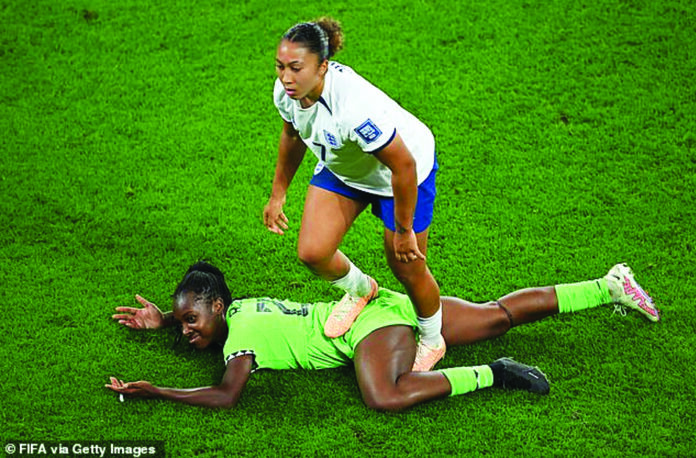
Lauren James stamping on Michelle Alozie

England forward Lauren James has apologised for her red card during the Women’s World Cup last-16 win over Nigeria and says she will learn from the experience.

She was sent off following a VAR review for stamping on Michelle Alozie’s back in a tie England won on penalties. James will be suspended for Saturday’s quarter-final against Colombia.

“All my love and respect to you. I am sorry for what happened,” she said on social media to Alozie. Also, for our England fans and my team-mates, playing with and for you is my greatest honour and I promise to learn from my experience.”

The 21-year-old was one of the stars of England’s group games, with three goals and three assists.

England also released a statement: “Lauren is really sorry for her actions which led to the red card and is full of remorse. It is wholly out of character for her. ”

Fifa has not put a time frame on when a decision will be made but could extend her ban to more than one game – which could see her miss the rest of the tournament even if England go all the way.

England added: “We will be supporting Lauren throughout and will be putting forward representation on her behalf.

“We fully respect Fifa’s disciplinary process and will not be making any further comment until after any decision has been made.”

Nigeria’s Alozie, who plays for Houston Dash in the US, had posted: “We are playing on the world’s stage.

“This game is one of passion, insurmountable emotions, and moments. All respect for Lauren James.”

Credit: bbc.com

Kyle Walker agrees to STAY at Manchester City

0
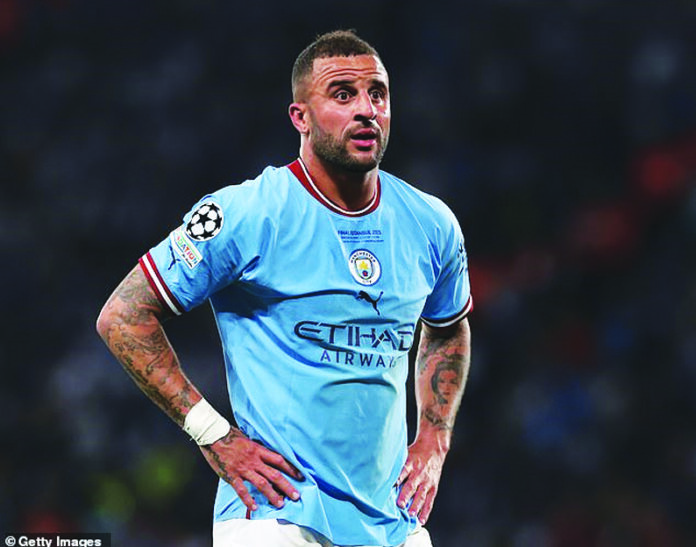
Kyle Walker

Kyle Walker has U-turned on his previous decision to join Bayern Munich and will instead continue at Manchester City for another season.

The England and City right-back was tipped for a summer move to the Bundesliga champions after rejecting a new contract offer to extend his career in Manchester.

But, after fresh talks with Pep Guardiola, has been convinced to carry on and will reject a move elsewhere this summer in favour of staying in the Premier League.

Guardiola recently issued a plea to Walker for him to continue his time at the club, highlighting the 33-year-old’s importance within his squad.

‘Kyle [Walker] and Bernardo [Silva], what can I say?’ Guardiola told reporters . ‘They are so important to us. We want them and will do everything.

‘We want him to stay because he wants to stay. We will do everything. Replacing these two would be so difficult.’

Walker will now listen to City’s contract proposal that is worth more than Bayern’s offer as he prepares to commit his immediate future to the Treble-winners.

Credit: dailymail.co.uk

Tottenham sign Wolfsburg defender for initial £34m

0
Micky van de Ven, Wolfsburg to Tottenham

Tottenham have signed defender Micky van de Ven from Wolfsburg in a deal worth an initial 40m euros (£34m).

The fee for the 22-year-old could rise to a reported 50m euros (£43m) with potential add-ons.

Van de Ven, who captained Netherlands Under-21s in this summer’s European Championship, has signed a six-year contract.

He could be named in the Spurs squad for Tuesday’s game at Barcelona (19:00 BST), their final pre-season friendly.

He is their fourth summer signing following the arrivals of England midfielder James Maddison, Italian goalkeeper Guglielmo Vicario and Israel winger Manor Solomon.

Van de Ven played 33 Bundesliga games last season, having joined Wolfsburg from Dutch side Volendam for £3m in 2021.

Predominantly a left-sided centre-back, he made six of his 36 appearances in all competitions last season at left-back.

Spurs travel to Brentford for their opening Premier League game of the season on Sunday.

Credit: bbc.com

Newcastle sign defender Tino Livramento in £40m deal

0
Tino Livramento

Newcastle United have signed Southampton defender Tino Livramento in a deal worth up to £40m. The deal is worth an initial £32m and the 20-year-old Englishman has signed a five-year contract.

Livramento, who joined Southampton from Chelsea for £5m in 2021, is Newcastle’s third summer signing.

“Tino is a very talented young player with an exciting future ahead of him so we are delighted to sign him,” said manager Eddie Howe.

“At 20, he already has lots of attributes that I admire, but he also has the potential and drive to really grow with this team.”

Livramento made only two Southampton appearances last season after suffering an anterior cruciate ligament injury in April 2022.

He came on as a substitute in their final two Premier League games against Brighton and Liverpool.

Livramento played 32 matches in 2021-22, including 28 in the Premier League.

Newcastle, who finished fourth in the table last season, have signed Italy midfielder Sandro Tonali and England winger Harvey Barnes this summer.

They host Aston Villa on Saturday in their first game of the season.

Credit: bbc.com

Saglemi Housing Project: Mahama Is Pissed Off!

0
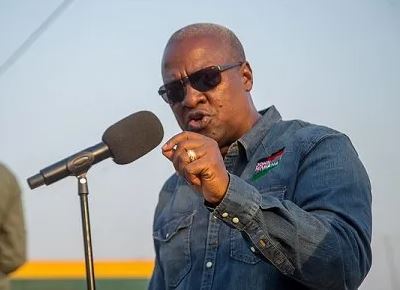
Former President John Mahama

Former President John Mahama, who was the Vice President and later the President in 2012 when the controversial Saglemi Housing Project commenced, is livid over the delay in completing it. This is because 1,560 units out of the entire 5,000 which he inaugurated in June 2016 have been “abandoned” by the Akufo-Addo government.

Saglemi Housing Project

In a post on his social media handles on Monday, August 7, 2023 John Mahama chastised the government for prioritising the construction of a National Cathedral over the Saglemi housing project.

He said that it was “unacceptable for Akufo-Addo to spend over half a billion cedis on a National Cathedral project that has ultimately failed due to corruption and is now abandoned, yet refuses to commit funds to complete a housing project that will benefit thousands of Ghanaian families.”

He continued that the New Patriotic Party (NPP) government intentionally abandoned the Saglemi housing project “simply because it was initiated by John Mahama and the NDC administration.

“The misplaced priorities of a government that claims it is unable to raise money to complete the Saglemi housing project and yet is willing to spend half a billion cedis on the largest civil excavation in Africa is a humiliating slap in the face of Ghanaians who entrusted Akufo Addo with their mandate.

“Just think about the countless number of Ghanaian families who could have had decent living conditions over the past 7 years and the individuals who could have had a place to truly call home in Saglemi,” he wrote.

THE PROJECT

The facility was meant to be a 5,000-unit residential complex with one- to three-bedroom flats for low-income earners. The entire 5,000 units were to sit on 300 acres of land. Phase one of the US$200 million project saw the construction of 180 blocks comprising 1,506 flats.

NO PHOTOSHOP

In June 2016, when Mr. Mahama was addressing the ceremony to inaugurate the 1,506 flats, he took a swipe at the then opposition NPP, saying that they “refused to see and they said these buildings are Photoshop.”

Mahama promised to organise an excursion for critics to witness at firsthand the project at Saglemi and corroborate what was contained in the famous Green Book.

“We cut the sod a few years ago for work to begin, and work has been ongoing. It is supposed to be the first phase, which is 1,500 housing units; the entire project is 5,000 units and we started with 1,500 units. These are some of the 1,500 units you can see physically.

“I’m saying physically because there are some people who see but refuse to see, and they said these buildings are Photoshop. After this visit, I don’t know what else they will do; maybe they will photoshop the building behind me as I stand here, but these are real.”

He said, “If they like, I can organise an excursion for them to come here and see for themselves what is happening here.”

INHABITABLE

Meanwhile, upon assuming office and assessing the status of the project, the Akufo-Addo government was convinced that the 1,506 housing units that Mahama inaugurated in June, before being voted out in December 2016 were not habitable.

According to government, the facility lacked basic amenities to ensure comfortability for the residents and thus, it set out to right the wrong.

MORE FUNDS

Speaking at the ceremony to break ground for the construction of 8,000 housing units in Pokuase last Tuesday, President Akufo-Addo said the government would have incurred more debt in an attempt to complete the Saglemi Housing Project.

“We are aware of the delays and setbacks encountered during the execution of this project. The issues about the scope of work and the money expended on the Saglemi project have been taken to the Criminal Investigations Division of the Ghana Police Service for investigation, which has resulted in criminal judicial proceedings.

“However, in the meantime, to forestall the project from deteriorating, the Minister of Works and Government has actively engaged the government, cabinet, the Ministry of Finance and the office of the Attorney General on the completion of the project.

“It has been established that in addition to the $198 million already expended on the project, the government has to raise additional funding to the tune of $46 million to complete the infrastructural works. That is for water, electricity and drains to mitigate flooding.

“Further, $68 million is required to complete the buildings and other essential onsite infrastructure works like the waste holding bay, sewage treatment plants and the development of socio-economic and civic infrastructure such as basic schools, clinics and shops,” he stated.

DISPOSE OFF

The government, after satisfying itself on the initial investment and the additional funds required, directed the Ministry of Works and Housing on October 31, 2022, to explore the possibility of “disposing off” the project covering the 1,506 housing units.

It was to be disposed off at its current value to a private sector entity to complete and sell the housing units to the public at no further cost to the government.

The government has decided, according to the Minister for Works and Housing, Francis Asenso-Boakye, who also spoke at the Pokuase event, to “re-invest” the proceeds to be realised from the sale into affordable housing projects.

MEASURES

In November 2022, a technical working group consisting of representatives from various state and independent professional institutions was inaugurated to draw a roadmap to procure a private sector entity to complete the Saglemi Housing project.

The public procurement authority has granted approval for the ministry to engage the Ghana Institution of Surveyors to determine the current value of the project and also engage a transactional advisor to facilitate the sale.

It has been projected that the current value of the project will be determined no later than September 30, 2023.

A Transactional Advisor would be engaged not later than October 30, 2023, and procurement of a private sector entity to complete the project would be completed not later than June 2024.

The Ghanaian Chronicle