Home Blog Page 1686

NPP constitutes 2024 campaign team

0
NPP Flagebearer, Dr. Mahamudu Bawumia waving the party flag after President Akufo-Addo handed over the leadership to him

The New Patriotic Party (NPP) has constituted its campaign team for the December 2024 general elections.

The names of the persons making up the team was contained in a statement signed by the General Secretary of the NPP, Justin Kodua Frimpong.

Issued on Monday, February 19, 2024, barely ten months to the polls, the party say it is counting on the cooperation of all stakeholders as it seek a historic third consecutive general elections victory.

The NPP, at its National Executive Committee and National Council meetings held on Monday, February 19, 2024, approved the proposed structure for the Party’s 2024 national campaign and appointed some individuals to serve on the various national campaign committees.

There is a National Campaign Coordinating Committee (NCCC), which shall oversee the work of all other Committees.

The NCCC shall be chaired by the 2024 Presidential Candidate, Dr. Mahamudu Bawumia and his running mate.

The National Chairman, General Secretary and Regional Chairpersons shall also serve on the National Campaign Coordinating Committee.

Below are the names and the specific roles:

A. CAMPAIGN ADVISORY COMMITTEE

1. H.E John Agyekum Kufuor
2. H.E Nana Addo Dankwa Akufo-Addo
3. All members of the National Council of Elders
4. Rt. Hon. Frederick Worsemao Blay
5. Madam Elizabeth Ohene
6. Rev. Joyce Aryee
7. Hon. Akosua Frema Osei Opare

B. CAMPAIGN OPERATIONS

1. Justin Kodua Frimpong (Director)
2. Henry Nana Boakye (Deputy)

C. CAMPAIGN CHAIRMAN AND STRATEGIST

1. Hon Dan Botwe (Chairman)
2. Mr. Frederick Oware (Deputy)
3. Nana Akomea (Deputy)

D. CAMPAIGN MANAGEMENT

1. Hon. Frederick Opare Ansah (Campaign Manager)
2. Dr. Antoinette Tsibu-Darko (Deputy – Research and Administration)
3. Hon. Osei Bonsu Amoah (Deputy – Parliamentary Campaign)
4. Dr. Ibrahim Anyars (Deputy – Presidential Campaign)

E. ELECTORAL AFFAIRS
Peter Mac Manu

F. SENIOR CAMPAIGN AIDES

1. Ing. Kwabena Agyei Agyepong
2. Mr. John Boadu
3. Mr. Kofi Dzamasi
4. Dr. Susana Alo
5. Mr. Salifu Saeed
6. Mr. Samuel Awuku
7. Hon. Anthony Abayifa Karbo
8. Dr. Nyame Baafi
9. Hon. Nii Adjei Sowah

G. CAMPAIGN COORDINATORS

1. Hon. Joseph Cudjoe (Coordinator –Identifiable Groups)
2. Hon Mavis Hawa Koomson (Coordinator – Coastal Zone)
3. Hon. Dr. Nana Ayew Afriyie (Coordinator- Middle Belt Zone)
4. Hon. Dominic Nitiwul (Coordinator – Northern Zone)

H. SPOKESPERSON FOR THE PRESIDENTIAL CANDIDATE
Dr. Gideon Boako

I. CAMPAIGN COMMUNICATIONS DIRECTORATE

1. Mr. Dennis Edward Miracles Aboagye (Director of Communications)
2. Mr. Yaw Adomako Baafi (Deputy)
3. Mr. Akbar Khomeni (Deputy)
4. Mr. Maxwell Krobea Kwabena Asante (Coordinator, Social Media)

J. RESEARCH DIRECTORATE
Dr. Isaac Owusu Mensah

K. FINANCE AND FUND-RAISING
Dr. Alolo Mutaka

L. LEGAL DIRECTORATE

1. Frank Davies (Chairman)
2. Gary Nimako Marfo (Deputy)

DIPLOMATIC LIAISON
Amb. Edward Boateng

Mahama’s 24-Hour Economy Is A Hoax! … Don’t fall for it – Jinapor

0
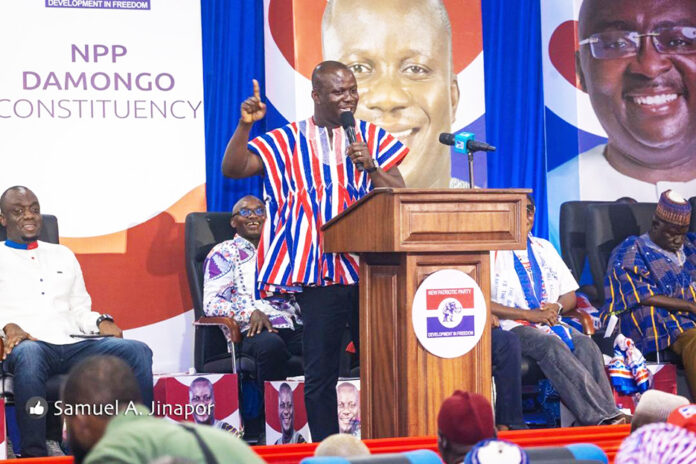
Samuel Jinapor (MP) speaking to the supporters

The Minister for Lands and Natural Resources, Samuel Abu Jinapor, has pooh-poohed the 24-hour economy mantra of the opposition National Democratic Congress (NDC).

According to him, the John Dramani Mahama-led opposition NDC is not trustworthy to carry through the promise, owing to their track record from 2013 to 2017. According to the Member of Parliament for Damango, it was the government, led by the same John Mahama, which plunged the nation into an erratic power supply that collapsed businesses in a 12-hour economy and cannot, therefore, be taken serious to implement a 24-hour economy.

He said this last Saturday, February 17, 2024 at his acclamation as the Parliamentary Candidate for the Damango constituency in the Savannah Region. He told the supporters that NDC itself is struggling to explain the policy, stating that since its inception the party
has never been able to make any substantive policy propositions to the Ghanaian people.

“All of a sudden, from nowhere, out of the blue, they say 24-hour economy. And when you ask them what the 24-hour economy means, they either say Jack Toronto or something else. They are not able to explain it. And sometimes they say it will mean that Ghanaians will have an economy not by day alone, but by day and night, 24-hours. “But the last time they were in government, from 2013 to 2017, for the four years that they were in government, they subjected this country
to dumsor,” Jinapor argued.

He continued, “They subjected this country to erratic power supplies and, therefore, when they were in government, even in the day, not in the night, in the day, tailors could not work; in the day, there was no economy for welders; in the day, there was no economy for carpenters; in the day, there was no economy for fitters; in the day, there was no economy for thousands, hundreds, and millions of Ghanaians in the day, not in the night.

“When they were in government, in the day, they couldn’t supply power; they couldn’t supply electricity. So any small-scale businesses and enterprises that all lived under it for four years had to close shop, had to close the economy and had to close their enterprises

They did not have a 12- hour economy; they did not have a day economy, and today
these same people are now turning around to come and tell us that they will give us a
24-hour economy. Even a day economy, even a 12-hour
economy, you could not provide it to Ghanaians when you were in government. How are
you going to be able to provide a 24-hour economy?”

COUNTER
The 24-hour economy policy was announced before the NPP flag bearer, Dr. Mahamudu
Bawumia, outlined his vision for the next chapter of Ghana. He has stated his vision to
build on the foundation the Akufo-Addo-led government has laid in the last seven years
to further transform the economy.

The focal point of his vision is the digitization drive, which he believes hold the key
to the economic transformation of the nation, considering that the world has gone digital.
He is credited with the implementation of the drone system, which delivers emergency
medical supplies to remote areas across the country.

Dr. Bawumia is also praised for the implementation of interoperability and the Ghana Card system among others

The Legacy Of KON At The Information Ministry

0
Mr Oppong-Nkrumah with his then Deputy, Fatima

In the dynamic landscape of governance and communication, the tenure of Kojo Oppong Nkrumah as Minister for Information has been marked by an unprecedented wave of transformation and innovation.

As President Akufo-Addo moves him to the Ministry of Works and Housing, it is imperative to reflect on his remarkable legacy and the enduring impact he has had on reshaping the Ministry of Information into a beacon of transparency, accountability, and modernization.

Throughout his tenure, Minister Kojo Oppong Nkrumah has championed a comprehensive overhaul of the Ministry’s operations, ushering in a new era of proactive communication and public engagement. One of his most notable initiatives has been the establishment of the Minister’s Press Briefing, a bi-weekly forum that serves as a direct line of communication between the government and the Ghanaian public.

Through these briefings, Minister Oppong Nkrumah has provided timely updates on government policies, projects, and initiatives, fostering transparency and trust in the government’s actions.

Mr. Oppong Nkrumah has been at the forefront of leveraging technology to enhance communication and information dissemination. The introduction of the Bonsu Platform, a digitized online platform developed in collaboration with the Information Services Department (ISD), has revolutionized government communications by streamlining the gathering of data and feedback from various ministries, departments, and agencies (MDAs).

This platform not only facilitates real-time reporting of government activities but also empowers government Public Relations Officers (PROs) to combat misinformation and engage with the public more effectively.

Moreover, Minister Oppong Nkrumah’s vision for a modernized ISD has led to the refurbishment of the department’s media infrastructure and the launch of the Ghana Today website.

These initiatives represent a significant step forward in combating the spread of fake news and disinformation, providing Ghanaians with a reliable source of accurate information on government projects, policies, and programs.

By investing in state-of-the-art technology and reimagining traditional communication channels, Minister Oppong Nkrumah has positioned the ISD as a key player in promoting media professionalism and public trust.

In addition to his focus on communication and technology, Minister Oppong Nkrumah has prioritized capacity building within the media sector. Through initiatives like the Media Capacity Enhancement Programme (MCEP), he has spearheaded efforts to train journalists and equip them with the skills and knowledge needed to fulfill their role as the fourth estate in Ghana’s governance system.

By investing in the professional development of journalists, Minister Oppong Nkrumah has strengthened the media’s ability to hold government accountable and contribute to national development.

His commitment to transparency and accountability is evident in his support for initiatives like the State of the Agencies Report and the establishment of the National Information Research Center (NIRC).

These initiatives empower citizens with access to information about government activities and enable data-driven decision-making, reinforcing the government’s commitment to good governance and democratic principles.

As Minister Kojo Oppong Nkrumah prepares to assume other government responsibility, his legacy of transformation and innovation at the Ministry of Information will endure as a testament to his dedication to serving the Ghanaian people.

His visionary leadership has laid the foundation for a more transparent, accountable, and technologically advanced government communication apparatus, leaving an indelible mark on Ghana’s democratic journey.

By Kwaku Nyarko

Communications Consultant 

Police smoke-out MOMO vendor killers at Walewale

0
IGP Dampare directing one of the night patrols from the police control room

Police intelligence-led operations arrested two suspects in connection with robbery and killing of two, including a mobile money vendor last Monday at Walewale, in the North-
East Region.

The suspects, who were nabbed on February 17, 2024 barely five days after committing the act, are Zakaria Yamusa alias Vandam and Fatao Issah. A release from the Police administration, dated February 17, 2024 and signed by the Director, Public Affairs, Assistant Commissioner of Police (ACP) Grace Ansah- Akrofi stated that the suspects on robbery spree that day shot and killed the two, including the mobile money vendor.

The suspects, who also caused injuries to seven (7) others during the attack, have
since been in police custody. Meanwhile, the Inspector General of Police (IGP), Dr George Akuffo Dampare, has personally spoken to all the injured persons, except one, who is yet to be reached, as well as the families of the two deceased victims.

The IGP assured them of a thorough police investigation.
Also, the North-East Regional Police Commander has led a team of officers to
visit the injured persons at the hospital to commiserate with the deceased families.

The release continued that the intelligence led operation is still ongoing to get all the
other perpetrators arrested. In a related development, police intelligence is on the heels of those who, at dawn of Thursday, February 15, 2024 stabbed to death a businessman at Ashaiman.

The Tema Regional Police Command in a release named the victim as 47-year old Eric Baidoo, a second hand clothes dealer. According to the police, at dawn of last Thursday, the deceased went to Kufour Station at Ashaiman to board a vehicle to
Accra Central to commence the day’s activities, when he was attacked to surrender his bag, but he resisted and subsequently stabbed the victim several times in the
stomach.

Both Police and Member of Parliament (MP) for Ashaiman in separate statements dispelled assertions widely circulated in social media that deceased was a soldier.
The rumours which gained currency led to apprehension of possible military attack again on Ashaiman. It will be recalled that close to a year ago, following the murder of Private Sheriff of the Ghana Armed Forces, platoons of armed soldiers backed by armoured vehicular and helicopter movements stormed Ashaiman and subjected residents to beatings.

GIS organizes Health Walk for personnel of the Service

0
Personnel of GIS during the health walk

Over the weekend, the Ghana Immigration Service organised a fitness walk for its Officers and Staff of the Service drawn from the National Headquarters, Kotoka International Airport, Tema and Central East Regional Commands.

The walk, which took place in the early hours of the morning, saw participants gather at the GIS headquarters in Accra before embarking on a brisk walk through the city streets.

The walk, aimed at promoting physical well-being, healthy lifestyle choices and for socialisation among its personnel.

Participants chatted and laughed as they walked, enjoying the camaraderie and the opportunity to exercise.

Personnel of GIS engaging in aerobatics after the walk.

The health walk ended at the GIS headquarters, where the officers and staff engaged in aerobics, led by physical training instructors from GIS Training Schools.

Deputy Comptroller-General, Legal Operations and Command Post, Mr. Laud Affrifah addressed the Officers following the walk and stated that since it is an election year, they must continue to be physically fit for their jobs in order to maintain national security.

The walk, in his words, was being held with the intention of ensuring that Officers and staff remain physically fit, and it would progressively become more regular.

The GIS’s head of public affairs, Chief Supt. Amoako-Atta, also told the media that maintaining physical condition was crucial to their job at the GIS and that occasions like these reinforce their ties as a team.

Additionally, he stressed on the significance of maintaining physical fitness because it was their responsibility to ensure national security.

In attendance were the Deputy Comptroller-General, Operations and Command Post, Mr. Laud Affrifah, Deputy Comptroller-General, Legal, Research and Monitoring, Mr. Philip Peter Andoh, Deputy Commissioner of Immigration (DCOI) Maud Quianoo,Assistant Commissioner of Immigration (ACI) Lawrence Agyapong (Chief Staff Officer), among others.

Akomea asks: Is Bawumia the disgrace to the north?

0
Nana Akomea

I have seen a video of Mr Fifi Kwetey, shouting to an audience in Northern Ghana, that Dr Bawumia was a disgrace to the North and warned voters in the North not to vote for Dr Bawumia, on account of his “disgraceful” behaviour. Dr Bawumia’s behaviour that caused
Mr Fiifi Kwetey to warn voters in the North against him, is not clear, but l remember
another lamentation about ”disgraceful” behaviour against another politician from the North.

‘This particular lamentation came from another NDC politician, Mr Martin Amidu. Mr Amidu, unlike Mr Fiifi Kwetey, is actually a politician from the North. Mr Amidu was also a deputy Attorney General, a vice presidential candidate of the NDC and Attorney General and Minister of Justice, and also the first occupant of the Office of Special Prosecutor.

Mr Amidu, in 2015, when John Mahama was president, had cause to describe President Mahama as a “disgrace” to the North and to Northern politicians. Mr Amidu believed that President Mahama’s tolerance of corruption was so disgraceful that it would be difficult for the country to vote for another Northerner to become president.

In Amidu’s words “…because of his behaviour, for the next 20, 30 years this country will not vote for a Northern President and he is disgracing me as a Northerner and l don’t like it”. If Fiifi Kwetey is looking for a politician who has been a “disgrace” to the North, he need not look further than in his party, as testified by a Northern NDC politician

Feature: Ghana’s Future Secured With NPP And Dr. Bawumia

0
John Kumah

Not long ago, the Vice President and the presidential candidate of the great New Patriotic Party (NPP) outlined his vision for Ghana should Ghanaians elect him President in 2025.

The carefully thought-through speech will go down in the annals of Ghana’s politics as one of the most comprehensive, coherent, cogent, targeted, solution-oriented, and very promising speech. Not only did Dr Bawumia give Ghanaians a flavour of a Ghana we aspire to, but he concretely demonstrated that it was achievable despite the name-calling by naysayers.

The sprouting of uniquely identified ideas, the clearly thought-through solutions, and his mindedness and foreboding of tomorrow clearly show that, indeed, Dr Bawumia derives his greatest joy from solving problems. Kudos, Mr. Vice President.

Now, I will delve into a few of the things Dr. Bawumia spoke about at the lecture and try to provide my perspective on them. The first on my list is the impact digitalisation could have on domestic revenue mobilisation.

It is undeniable that domestic revenue mobilisation efforts have, over the years, undergone several reforms. Many of the tax reforms have looked at enhancing tax administration and compliance. The creation of the Ghana Revenue Authority (GRA) was one such reform that helped address fragmentation in tax administration in Ghana.

The revenue assurance and compliance enforcement (RACE) initiative was another reform instituted to help close loopholes in the tax system and move tax revenue to GDP to the Sub-Saharan average of 18 percent in the short to medium term.

Ghana’s current tax revenue to GDP is circa 13 percent, way below the sub-regional average. It needs no saying that tax administration faces many challenges. There are many informal sector activities which currently are done outside the tax bracket.

There are many businesses conducted via new media, and many do not pay taxes. The GRA has, over the years, initiated a raft of measures to broaden the tax network, but the result has been nothing short of success.

The Bawumia tax reform hinged on digitalisation and is truly aimed at addressing the imbalances in tax administration where a few pay taxes and many free rides because there is no system to trace and track them. A fully digital tax office will increase the tax bracket, it will be fair, the tax burden will be bearable by all, and evasion will be reduced. The free-rider problem will be addressed with this initiative.

Next on my list relates to Dr. Bawumia’s vision for education in Ghana and how the digital evolution will help improve the quality of education in Ghana. Ultimately, Bawumia’s plan is to ensure that every Ghanaian student is equipped with the skills that will make him/her savvier and more competitive than any other student from any part of the world.

Already, the digital revolution has started with the expansion of access to free Wi-Fi and laptops in many schools in Ghana.

The free SHS policy will be sustained to ensure each Ghanaian has access to at least a secondary education. Enhancing focus on TVET education will enhance the training of skilled workforce for the Ghanaian job market while taking advantage of the African market under the African Continental Free Trade Area.

The repositioning of the education system towards STEM, Robotics, Artificial intelligence, and vocational skills will not only help Ghana meet the 4th Industrial Revolution but also become relevant in the increasingly competitive job market.  The Bawumia education plan will seek to improve every stakeholder (students, teachers, and education administrators) in the education strata.

Infrastructure at every level will be enhanced and positioned to be the springboard for producing Ghanaian future captains in every facet of society. Dr. Bawumia’s idea of ensuring we build consensus on education will eliminate the ad hoc approach to education policymaking in Ghana.

Under Dr Bawumia, every Ghanaian will experience the digital revolution, and every Ghanaian student will have the requisite tools to be able to compete and participate in the fast-changing technological world.

Any Ghanaian child will have the skill set required to compete for any job, anywhere in the world. The connectedness of the world makes it possible to live in Ghana and work remotely in any part of the world. Bawumia will bring back the Ghanaian dominance in education.

Another view of Dr Bawumia that resonates with me is his call on all of us Ghanaians to rebuild our soft power and re-orient our faculty to one of possibilities. Ghanaians have endured many adversities (political and economic) in the past.

In many of such difficult times, we have prevailed because of our strong mindset of possibilities. Our belief in ourselves as a people, and our determination to do good for ourselves have always driven us to fight on, even when our strength is depleted.

We never give up until the work is done. The need to uphold our soft power has never been clarion than now. The idea of introducing a growth mindset curriculum to help students build critical skills such as problem-solving, risk-taking, opportunity spotting and design thinking is long overdue.

Dr. Bawumia’s power sector reform agenda is quite interesting, especially for those concerned about climate change. The plan is to shift the power generation motley from fossil fuel sources to renewables such as wind and solar. The energy sector has been a big drain on the economy, especially from the power purchase agreements of the independent power producers.

The sustainability of many of the ‘take or pay’ IPPs is in doubt, and there is a need to find cheaper, efficient, and reliable alternatives. The vision of Dr Bawumia to diversify the power production mix by introducing 2,000MW of solar and wind power by the end of his first term is encouraging and will be a big saving on the public purse.

It will equally bring relief to electricity users through a reduction in electricity cost. The view of making Ghana an electricity production hub is commendable, and its added advantages, including improvement in services, job creation, and forex earnings from electricity export, will positively impact the economy.

There are a gamut of issues Dr. Bawumia discussed, including the introduction of the golden age for the maximization of benefits from natural resources, using AI to transform agriculture, a digital approach to fighting corruption, measures to support the cedi, policy of industrialisation for jobs, and the development of a credit system are some of the novel ideas that must be supported.

Quite clearly, Dr. Bawumia has the magic wand to build on what President Akufo Addo has done over the past 7-years.This government has set the base for Dr. Bawumia to move Ghana into the next chapter of Ghana’s development, where IT IS POSSIBLE for every Ghanaian to live their dreams and where impossibilities become possible.

By John Kumah, Deputy Finance Minister

Ghanaians must sustain prevailing peace in the country -NCCE

0

Ms Kathleen Addy, the Chairperson of the National Commission for Civic Education (NCCE) has appealed to the citizenry to help sustain the prevailing peace in the country.

“We want peace in Ghana, because we don’t have anywhere to go,” she said.

Ms Addy made the appeal at a community engagement on Preventing and Containing Violent Extremism (PCVE) at Titiaka, a farming community in the Kadjebi District of the Oti Region.

The programme was sponsored by the European Union and was being undertaken in 59 Districts in Ghana’s eight Northern Border Regions.

The face-to-face engagement aims at engendering peace, tolerance and participation in the fight against violent extremism.

She said citizens from other countries like Nigeria, Togo, Benin and Burkina Faso among others prefer coming to Ghana because of the relative peace we are having, so nothing should be done to disturb this peace.

“Let us open our minds and be mindful that the upcoming 2024 Presidential and Parliamentary elections will not divide us,” she said.

Ms Addy said as human beings, misunderstandings were bound to occur, but how we resolve them peacefully matters the most. She added that there is the need to tolerate divergent views and respect others’ rights and legitimate interests.

Mr Robert Kwesi Boame, the Oti Regional Director of the NCCE, called on the participants to report suspicious characters to lawful agencies for prompt action, as threat of terrorists attacking communities was real.

He said terrorist attacks in neighbouring countries such as Burkina Faso, Togo and Nigeria posed a serious threat to Ghana’s peace and security, and it called for security consciousness among the citizenry, as the country was not immune to such attacks.

Mr Setriakor Kwesi Gagakuma, the Deputy Oti Regional Director of NCCE asked the participants, especially the youth, not to be lured into joining violent extremist groups, as they were the target of terrorist recruiters.

He also advised landlords, opinion leaders and chiefs to check the background of visitors who come to their communities, as terrorists often camouflage themselves as visitors and carry out their activities.

Mr Sena Nyabi, the Chief of Titiaka, appealed for the reshaping of the roads from Koto-Nkwanta to Titiaka and the provision of a Teachers’ Bungalow for the Titiaka D/A Primary School. The participants commended the NCCE for organising the programme.

From Daniel Agbesi Latsu, Titiaka (Oti Region)

Gold dealer allegedly defrauded by Ghanaian and Nigerian collaborators

0
Some gold bars

Farhad Omedi, a United Arab Emirates citizen, has allegedly been defrauded by two Nigerians and a Ghanaian to the tune of US$60,000.00 in gold deal.

The suspects have been named as Jacob Sunday Olatunji, 39 (driver/engineer), Israel Olawale Omoley, 51 an Architect and Ghanaian Baffour Abraham.

Currently, the police have managed to arrest the Nigerians, who were residing at Dawhenya and Lakeside respectively.

The two have pleaded not guilty to conspiracy to commit a crime and defrauding by force pretence, when they appeared before the Accra Circuit Court, presided over by His Honour Samuel Bright Acquah, relieving His Honour Isaac Addo.

The court, on February 13, 2024 admitted the accused persons to bail in the sum of            GH¢1 million each and ordered that they deposit their passport with the registry of the court.

The case will be recalled on February 20, 2024.

How it all happened

Chief Inspector Jonas Lawer narrated to the court that sometime in the month of January, this year, one Abass, who is currently in Dubai, introduced Omedi, the Complainant, to Baffour Abraham, now at large, as a gold dealer living in Ghana.

After the introduction, the two started having conversation. Baffour sent the Complainant an invitation visa in the name Mpohor Mines Company, in the Western Region, to enable him travel to Ghana to enable commencement of their business.

On January 22, 2024 the Complainant arrived in Ghana and was received by Jacob Sunday Olatunji, who drove him from the airport to Baffour.

Without wasting time, Sunday and Baffour took the Complainant to On Time Security Company, at Achimota, in Accra, where 30 kilos of gold bars were shown to the Complainant in an effort to convince him that Baffour was a real gold dealer.

Five kilos of gold were randomly picked out of the 30 kilos by Baffour, in the presence of the Complainant for refinery test, which same proved positive when tested at Sewia Mining Limited, also at Achimota.

Sunday and Baffour succeed in convincing Omedi, but he could only afford a kilogramme of the gold at the cost of US$60,000.00.

All arrangements for the supposed gold to be exported by air were put in motion and on January 30, 2024 Omedi, together with Baffour, boarded Changan CS55 vehicle with registration number GW 1271-20 and driven by Sunday to the Kotoka International Airport, alongside their precious cargo.

Upon arriving at the Airport, Baffour called three unknown Customs officers to facilitate the documentation process and to enable the Complainant to travel with the gold to Dubai.

The said Customs officers came for the gold and promised to deliver same to the Complainant at his final departure stage.

The Complainant was convinced after seeing the customs officers in uniform and moreover, was not scared for having his US$60,000.00 in the letter box of the above mentioned vehicle on-board by Sunday as the driver.

Baffour was said to have left with the Customs officers, but the Complainant, after waiting for several minutes became worried and came down from the vehicle to watch around and to make a call.

Immediately he got down from the vehicle, Sunday sped off, together with the US$60,000. All efforts made by the Complainant to trace them proved futile.

On March 2, 2024 a case was made to the police and intelligence led to the arrest of Sunday and Israel Olawale Omoley at their hideout in a Hotel at Dawhenya.

A search conducted on them led to the retrieval of five metal bars in yellowish colour and a small safe, which contained an amount of US$3,500 and GH¢30,000.00 in Israel’s room.

The court was told that during interrogation, Israel stated that the metal bars were given to him by Baffour, as well as the US$3,500.00.

C/Ins Lawer said efforts are underway to apprehend Baffour, adding that the case is still under investigation.

Monetisation could deprive Ghana of free and fair elections -GII Manager

0
Mr. Boadi addressing the participants

Mr Michael Kwame Boadi, Fundraising Manager at Ghana Integrity Initiative (GII) has expressed fear that the integrity of the 2024 elections could be compromised if the monetisation of political campaign in the country is not checked. To him, monetisation of political campaigns in the country could deny the citizens free and fair elections.

According to him, a recent CDD report had stated that the cost of political campaign had increased by 59% from 2016 to 2020, pitching the cost of political campaign to about US300,000 to elect a parliamentarian in Ghana.

Speaking at a Zonal Workshop for Youth Leaders, which included some selected Assembly members, political parties, Non-Governmental Organisations and the media from the Ashanti, Western and Western North regions, Mr Boadi noted that taking into consideration an MP’s average monthly salary of GHc¢20,000 it would take about three to four years to be able to pay off that debt.

He also disclosed that the CDD study further shows that there are incidents where persons engage in serious organised crime that involves political party financing and that this practice robs the country of the integrity of elections.

A section of the participants

The theme for the workshop was: “Securing Ghana’s Stability during the 2024 Elections against Serious and Organised Crime Threats.”

The GII manager suggested that moves be made to reduce the effects of Serious Organised Crime during elections in Ghana to ensure free and fair elections.

He also reiterated the need to meet the youth groups because they are the victims and the perpetrators of the Serious Organised Crime with the hope that they would spread the message to ensure that the crime is reduced in the 2024 general elections.

Petra de-Graft-Johnson, Advocacy and Legal Advice Centre (ALAC) Officer, on behalf of Madam Mary Adda, Executive Director of Ghana Integrity Initiative (GII) stated that the workshop was geared towards addressing a matter of paramount importance in safeguarding Ghana’s stability in the face of Serious and Organised Crime (SOC) threats during the upcoming 2024 elections.

According to her, the momentous occasion marks a collaborative effort between key Civil Society Organisations which includes the Ghana Integrity Initiative, in consortium with the Ghana Anti-Corruption Coalition (GACC) and the Africa Centre for Energy Policy (ACEP), that have all generously supported the course with funding from the Foreign, Commonwealth and Development Office (FCDO).

She noted that the gravity of the challenges posed by Serious and Organised Crime and its corrosive impact on the democratic fabric of Ghana cannot be overstated, adding that in response to these concerns they stand united in a collective effort to increase public awareness on the issues of SOC and its attendant corruption during and post elections.

She said the collaboration exemplifies the power of partnerships and collective action in confronting challenges that transcend individual capacities.

According to the GII Executive Director, their dedication to transparency, integrity and good governance serves as a beacon for others to follow.

She stated that they embarked on a strategic and multi-faceted approach with the aim to develop a comprehensive strategy to identify, prevent and combat serious and organised crime that may jeopardise the upcoming 2024 elections in Ghana.

The strategy, she said, like a well-crafted symphony, requires the harmonious collaboration of all stakeholders to ensure its effectiveness.

She indicated that they recognise the pivotal role of the youth in shaping the destiny of our nation, hence engaging them in comprehensive civic education programmes as a conscious investment in building a well-informed electorate.

She said that awareness, as the cornerstone of civic participation, will be enhanced through programmes that enable the youth to comprehend the consequences of serious and organised crime on the electoral process.

The Ghanaian Chronicle