Home Blog Page 1607

Ntanor community gets young ladies’ queen mother

0
Nana Hemaah Akosua Kwao Abigail I

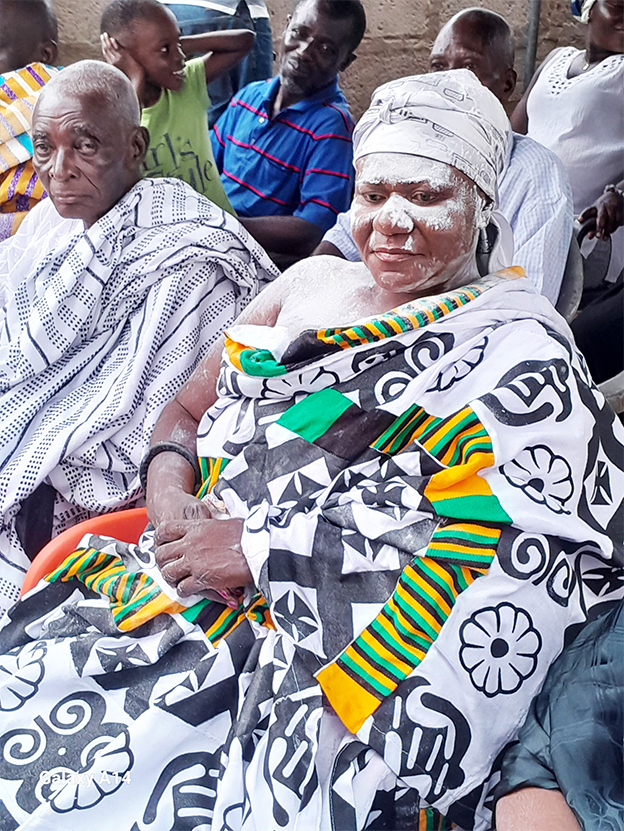
A 51-year-old business woman, Abigail Kwao, has been enstooled as a young ladies’ Queen mother for the Ntanor community near Koforidua-Effiduase in the New Juaben North Municipality of the Eastern region with a stool name Nana Hemaah Akosua Kwao Abigail I.

The newly enstooled queen mother is highly revered by the community for her sense of braveness, her ability to galvanize and solve problems, and being a role model to young girls in the community.

Historically, the new young ladies’ queen mother is the first woman to be enstooled as the Queen mother for ladies in the community since the inception of the sub-chief for the Ntanor tradition area.

Her swearing of Oath of Allegiance to the Ntanor chief, Nana Otubour Gyan Kwasi I and his Elders was met with thunderous cheers from the gathering, an indication that she had been accepted by the people.

Nana Otubour Gyan Kwasi I advised the new Queen mother to be diligent in serving the people of the community at all times.

He asked the new Queen not to lord it over the women whilst appealing to the women to also support her in achieving her dream of developing not only young women to become good future leaders, but to promote peace and unity towards the development of the area.

Nana Hemaah Akosua Kwao Abigail I assured the community of her commitment and readiness to use the position to solve problems confronting the community.

“I will make sure I use my position as Queen for young ladies to address challenges facing women in the area and find appropriate strategies to solve them,” she said, adding, ” Education is important and I will do my best to see to it that young girls in my community will be educated or learn a skill to aid their lives for survival”

She stated that she would seek to improve education and implement bylaws to prevent truancy and promote learning among young people in the area.


K’DUA ready for 67th Independence Day celebration

0
The charged security personnel during the walk

Without any last-minute challenges, The Chronicle can state that all is set for the Eastern Regional capital, Koforidua, to host the 67th Independence Day parade.

The people of the region, especially the regional capital, would not watch this year’s Independence Day anniversary parade on their TV screens, but will have the opportunity for live participation.

The flabearers of the various security bodies during the walk

The display of some heavy security vehicles and military helicopters flying over the Eastern Region as part of parade rehearsals has reduced the venue, the Koforidua Youth Resource Centre, to a tourist attraction, as residents, both old and young throng the centre to watch the training, almost on daily basis.

There has been heavy vehicular and human traffic following the influx of people, most especially the security men and women to Koforidua.

A drive from Old Estate SSNIT to the main central business hub which takes about 20 minutes can now take a commuter about an hour.

All the major four (4) roads leading to Koforidua have been awash with mini billboards of the big six (6) of Ghana’s independence and the hoisting of Ghana flags, drumming home the significance of the ceremony.

As part of the preparation, the security agencies on Saturday took to the principal streets of the regional capital for an endurance walk.

The endurance walk was led by the Commanders of the various security agencies in the region, including the Eastern Regional Police Commander, DCOP Emmanuel Twumasi-Ankrah, DCOI Faisal Dish, Immigration Commander, ADP Thomas Seidu, Regional Prison Commander and ACFO Madam Jennifer Naa Yarley Quaye, Regional Commander of the Ghana National Fire Service.

Some constituents of the New Jubean South municipality cheerfully cleaning their surroundings

In a post endurance walk interview, the commanders of the various security agencies in turn expressed confidence and their readiness not only to put up a good display during the ceremony but also to ensure total security before, during, and after the ceremony.

After the walk, the security agencies joined the New Juaben South Municipal Assembly to clean up the municipality, particularly the entrance to the venue.

Managers of the Assembly are of the view that making cleanliness a top priority of the municipality was in the right direction to confirm the city’s image as a center for tourism and economic activity.

According to Edward Abazing, Municipal Coordinating Director, “Koforidua will be hosting high-profile dignitaries during the Independence Day festivities, making cleanliness a top priority. Our city’s image as a center for tourism and economic activity depends on it.”

He disclosed that the cooperation of residents with the New Juaben South Municipal Assembly was ample demonstration and determination of the municipality to set a shining example of civic responsibility ahead of the Independence Day Celebration.

Mr. Abazing noted that the participation of the traders and motorists who somehow suspended their activities on that day to ensure maximum involvement in the clean-up exercise was a point of rekindling the community’s spirit and promoting a culture of cleanliness.

The theme for this year’s Independence Day parade is: “Our Democracy, Our Pride,” with a focus on reinforcing democratic values and promoting peace, particularly in light of the upcoming 2024 Presidential and Parliamentary elections.

The parade, which is expected to be graced by high profile personalities, including the Ivorian President, Alassane Ouattara, as the Special Guest of Honour will feature 21 contingents of security agencies, representatives from 11 schools and various traditional groups, all set to participate in the activities.

The Eastern Regional Minister, Seth Kwame Acheampong, on Friday joined the Muslim community in prayers for the sustainability of religious harmony and the success of the independence anniversary celebrations.

Parliament approved $195m for African Games -Minister

0
Chamber of parliament

Mr. Mustapha Ussif, the Minister of Youth and Sports says Parliament approved an amount of $195,255,153 for the construction of sporting facilities for the 13th African Games, to be hosted by Ghana.

The Youth and Sports Minister made this disclosure during a press briefing in Accra on Monday, March 4, 2024 where he also clarified issues on the $47 million in operational expenses for the Local Organising Committee (LOC).

According to Mr. Ussif, contractors of the Borteyman Sports Complex, University of Ghana Sports Stadium and the Games Village have all been paid their total sums.
The Minister gave a breakdown of the sums given to contractors, which includes – Contracta Construction UK Ltd ($145,086,057) for Borteyman Complex, Consar Ltd ($34,102,135) for University Sports Stadium and Mawums Ltd ($16.066,961) for Games Village.

Clarifying issues about the $47 million in operational expenses for the LOC, the Sports Minister said this covered expenses from when the committee was inaugurated in 2020.
“This estimated amount is earmarked to be used by the LOC for the general organisation of the competition, which started after the LOC was formed in October 2020.

“Areas of expenditure by the LOC include, technical meetings with TCAG, preparation of relevant guidelines, rules, regulations and manuals, sensitisation, management of the Games (games management system), accommodation for athletes, volunteers and officials (totalling about 13,000 participants), internal transportation, airfare for officials, catering services (feeding of about 13,000 participants), security, allowances for volunteers and officials, accreditation, medical equipment, medals for athletes among others.

“This amount will also cover the payment of rent for the LOC office accommodation, logistics, the purchase of equipment, anti-doping services, and members’ allowances,” Mr Ussif stated.

He also clarified that the LOC had not procured any new vehicles for their operations, as all vehicles being used for the games had been hired.
The Sports Minister also stated the need for the facility to be kept in top shape after the games for it to be beneficial to the people of Ghana, especially with the Borteyman Facility, which would be converted into the University of Sports Development.

Mr. Ussif was grateful to President Nana Addo Dankwa Akufo-Addo for his vision and continuous support for the Sports Ministry in the provision of these facilities for the people of Ghana.
The preliminary events of the 13th African Games have already started with table tennis, ahead of the opening ceremony slated for Friday, March 8, 2024.

By Simon Asare

GNA


Work with independent mind -CJ tells new magistrates

0
The newly sworn in magistrates

Chief Justice Getrude Sackey Torkornoo has charged 23 newly sworn-in magistrates to work with an independent mind and be guided by the principles of equity and fairness.

The charge was in respect of the peace and stability being enjoyed by the country, which is as a result of the durability of the legal regime.

The new magistrates were, therefore, urged to be mindful of the oaths they have taken and stay faithful to the solemn promises they have made to the nation.

Justice Torkornoo was addressing the appointed magistrates on Monday, 4th March, 2024 at the Law Court Complex in Accra.

She said the citizens have confidence in the durability of the legal regime, hence judges are expected to ignore and erase personal feelings and biases in the adjudication of suits.

“It is not of a Judge’s job to please, but if done right, judicial decisions must bring satisfaction. This requires extreme dedication, integrity and unyielding adherence to principle,” she stated.

Furthermore, the magistrates were urged to be guided by the principle of property, independence, continuous learning and competence.

“I urge you to continue on the path of learning, because this career is an academic and intellectual one. Ensure that you remain abreast of the ever evolving trends of the legal and judicial procedures and practice, and their operation with and through technology,” she advised.

Mrs Torkornoo assured the new magistrates that she has committed herself and tenure to the improvement of the overall conditions of justice delivery in the country.

Alfred Tuah, Deputy Minister for Justice and Attorney General urged the magistrates not to be lord to themselves and trespass into the jurisdiction of others.

He said their appointment, to move from the bar to bench, speaks volumes of their professional skills and personal character. They are, therefore, encouraged to perform their duties without fear, favour, affection or ill-will.

In order not to go overboard, they were further reminded that their powers are highly circumscribed and that they are at the lower base of the judiciary.

“…don’t behave like some judges elsewhere who may even want to question the basis of the Attorney General in entering a nolle prosequi.

“And such a process, which was even signed by a deputy Attorney General and that process was moved by a state attorney, but a judge of the lower bench said he was not going to take it and refer to that process as a letter.

“And that process ought to have gone with a letterhead of the Attorney-General, so disgusting. That is the power that you have, don’t abuse the power, respect the power and … into the powers of others.”

Ephraim Agbesi Dzakpasu, President of Greater Accra branch of the Ghana Bar Association and on behalf of the National President of the Bar Association, urged the magistrates to be impartial arbiters and not tin-gods.

He said they are charged with the responsibility to protect individual liberty and fundamental human rights of citizens, in all disputes that will come before them.

Mr Dzakpasu was particular about magistrates who will be sent to areas where the district court is the only court and would have lawyers visiting on few occasions.

“There may be the temptation of such a magistrate behaving like a tin god and act with impunity. However, it is the expectation of the BAR that you will resist that act,” he stated.

The 23 magistrates are; Miss Anastacia Yaa Agyeiwaa Karimu, H/W Bright Ajosagi Akoande, Miss Dromo Afarley Djarbeng, Miss Jeroma Tawiah Owusu, Ms. Claudia Naa Anorkai Akuokor Abbey, Mrs. Melissa Selorm Dadson, Ms. Georgette Carmel Lutterodt, Mrs. Josephine Valeen Akorfa Akpanya-Hlover and Mr. Christian Mawusi Ntow.

The others are Mrs. Christabel Awo Tei Sasraku, H/W Stephen Tabiri, H/W Comfort Asamoah Sarpong, Miss Gloria Afua Kesewa Asamani, H/W Bitam Lari, H/W Juliana Millicent Ocran, Mr. Eric Kwarteng, Mr. Emmanuel Wiafe Adu, Mr. Jehoshaphat Achina Nyarko, Mr. Eugene Obeng-Ntim, Mr. Iddi Adama, Mrs. Olivia Acquah-Dadzie, Mr. George Wellington Arhin and Mr. Godson Etse Kumado.


I’m ready for political appointment –Rex Omar

0
Rex Omar

Ghanaian musician and politician, Rex Omar, has expressed his willingness to accede a political position if he is given the opportunity.

He made this statement in an interview on Joy FM‘s Showbiz A-Z.

Rex Omar, a staunch member of the National Democratic Congress (NDC), explained that he would gladly accept the appointment if the task falls within his ambit.

“I will [accept a political appointment] because now I think I am of age and I think if I am given any appointment that is within my capacity, I will be able to contribute positively to the development of this country,” he told the host Kwame Dadzie.

Asked if he would want to hold a position at the Ministry of Tourism, Arts and Culture, he answered that “when we get to that road, we will cross it because at the end of the day all these positions are political appointments and so long as you are smart and intelligent and you know what is going on in this country, wherever they put you, you can deliver if you really want to.”

Expressing his opinion on the state of Ghana’s democracy, the ‘Abiba’ hitmaker said governance of the country will be better if the term for the presidency is reviewed.

He said the current 4-year term is not enough for any government to make a meaningful impact on the economy. “Because America does elections every four years, we also jump on the bandwagon but the question is, America’s democracy is over 200 years. We just started, okay. So look at our situation,” he said.

He suggested that a six-year term would give room for the government in power to perform creditably.

Credit: myjoyonline.com

Editorial: While passing the anti-gay bill may be good, we must consider its potential implications

0
Editorial

The recent passage of the Proper Human Sexual Rights and Ghanaian Family Values (Anti-LGBTQ) Bill by the Parliament of Ghana has sparked significant debate and concern, both domestically and internationally.

The bill aims at promoting proper human sexual rights and Ghanaian family values and proscribes the promotion and advocacy for LGBTQ+ practices. The Bill is yet to be given assent by President Akufo Addo.

While the intentions behind the bill may be well-meaning, it is crucial to carefully consider its potential implications, particularly in light of the economic consequences outlined in the recent report.

Most Ghanaians have expressed their joy at the passage of the anti-gay bill because it will go a long way to promote proper human sexual rights and Ghanaian family values. However, the happiness has been curtailed by a plea from the Ministry of Finance to President Akufo-Addo not to assent to the recently passed anti-LGBTQ bill by Parliament.

In a press release on Monday, March 4, 2024 the Finance Ministry cautioned that approving the bill could result in significant financial consequences for Ghana. According to the Finance Ministry’s statement, Ghana stands to lose a substantial amount of World Bank financing, estimating a potential loss of USD$3.8 billion over the next five to six years.

This was after the Finance Minister, Dr. Mohammed Amin Adam, convened an Emergency Meeting with Chief Director and Director of the Ministry, the Governor and 1st Deputy Governor at Bank of Ghana (BoG) and the Commissioner-General of GRA to ascertain the immediate impact of the passage of the Bill on the implementation of the 2024 Budget.

The Report summarised deliberations at the meeting and provides recommendations for the consideration of the President. The report indicated that if the President gives consent to anti-LGBTQ bill, it is likely to affect our relationship with the International Monetary Fund, which will go a long way to affect the financial Aids offered to us.

This loss of financial support would have profound consequences for our economy, jeopardising crucial development initiatives and undermining our ability to achieve our national goals outlined in the 2024 Budget, according to the finance ministry.

However, the report further advised that if the President decides sign the bill, then there has to be a structured engagement with local conservative forces, such as religious bodies and faith-based organisations to communicate the economic implications of the passage of the Anti LGBTQ Bill and to build a stronger coalition and a framework for supporting key development initiative that are likely to be affected.

It also advised that there should be an effective engagement with conservative countries, including the Arab countries and China. This could help trigger resources to fill in the potential financing gaps to be created.

In the light of these concerns, we urge the President to carefully deliberate on his decision regarding the bill. Rather than rushing to sign it into law, we believe that a more prudent approach of bringing all stakeholders to the table to initiate a national dialogue on the matter will be the best way to go.

This national dialogue should involve a wide range of stakeholders, including government officials, civil society organisations, religious leaders and political parties. The goal of this dialogue would be to thoroughly examine the implications of the bill from both social and economic perspectives and to explore alternative solutions that uphold human rights while also addressing concerns about family values.

Furthermore, we echo the recommendation put forth by the Ministry of Finance to engage with international partners and explore alternative sources of funding to mitigate the potential loss of World Bank financing and strengthening partnerships with conservative countries and leveraging the principles of the Ghana Beyond Aid agenda could help to fill the financing gap and support key development initiatives.

Ultimately, the decision on the Anti-LGBTQ Bill should not be taken lightly. It is imperative that the President takes the time to carefully consider the economic and social ramifications of this legislation and to engage in a transparent and inclusive dialogue with all stakeholders. By doing so, we can ensure that our policies are not only grounded in our shared values but also contribute to the country’s long-term prosperity and stability.

As a nation, we have overcome many challenges in the past through dialogue and cooperation. We are confident that by coming together to address this issue, we can find a balanced approach that respects the rights of all citizens while also safeguarding our economic well-being.

Forward Ever, With A New Ideology Going Forward

0
The Author, Mr Kwadwo Afari

Every March 6, Ghanaians celebrate the birth of a nation. In the many years that have passed, since the Union Jack was lowered, and the red, gold, and green with the black star in the middle was raised to the joyous roar of ‘freedom,’ followed by the song: ‘There is freedom for us’, much has changed since then —–the corporatist, paternalistic welfare state has run out of money, while the freedom and independence promised the people still eludes them.

Any patriotic Ghanaian may be aware that citizens are alienated from the 6th March celebrations. There are no spontaneous citizen gatherings where participants celebrate their hard-won independence the way they know best —– parties, bonfires —- without the state hanging over their necks. March 6th has become a partisan day of force when the state and politicians exhibit the power of the coercive state.

Schoolchildren are forced to march under the sun; the leader is seen taking the salute with the security forces showing their intimidator powers and ordinary citizens are left out or simply do not care.

What, exactly, has happened to Ghana since 1957? What does being independent today mean —and what should it mean?Freedom at last! This euphoric cry, which rang across Ghana that March day, is still, but an echo.

What does “independence” mean when Ghana continues to depend on neo-colonial institutions? Is there “liberation” when our leaders continue to fail in their promises of prosperity, and social justice?

As we celebrate Ghana’s independence this month, it is good to look at our leaders, past and present, and see how their actions and inactions have contributed to the continuous underdevelopment of this rich and blessed country.

In this context, how should we remember our founding fathers, especially Kwame Nkrumah? Partisans hail him as a “liberation” hero who led the fight to end colonial rule, while others still insist that his transformation into a malicious dictator after “independence” taints whatever good he achieved in his earlier years.

Freedom was just a slogan. Shortly after independence, democracy, pluralism, and competition were denounced as both alien and “imperialist dogma.” A one-party state rule was imposed on the people, concentrating power in the hands of one individual to determine who gets what in Ghana.

For a country that prides itself on the motto ‘Freedom and Justice’, there are a few things that seem, well, off. Almost all Ghanaian leaders have rejected the freedom the free market gives individuals. Especially, Nkrumah, the first president, harboured a deep distrust and distaste for the freedom the free market brings and gives. He falsely perceived it as an extension of neo-colonialism and imperialism.

State dominance of the economy is always wrong and leads to poverty. It is not part of Ghanaian culture. Traditional Ghana was never socialist. It had private ownership of the means of production, such as land, labour, and capital, and fostered a spirit of entrepreneurship, free enterprise, and free trade.

Trade flourished in pre-colonial Ghana, with commercial routes crossing the country. Ghanaians were free to engage in trade and business without needing permission from their chiefs. The market, not the chiefs, determined prices.

Ghanaians did not envisage that freedom would ever mean looking to the government or technocrats for their economic salvation. Also among those disillusioned with the promise of freedom are young people.

Young people have experienced several traumas over the past 20 years— economic and financial crises, a pandemic, —and have carried much of the burden. To the young, the state offers jobs, “opportunity,” and the legitimation of envy. Therein lies the path to cultural decline and eventual collapse

We now know that big government with —the cronyism, corruption, and oppressive taxes that have made living a virtuous life unbearable. The country is on the brink of an economic collapse as politicians, intellectuals, and mediocre businessmen now only take from the state, and cannot create or add value.It would have been inconceivable that Ghanaians would trade their liberties for the lie of perpetual economic security via the state.

Sixty-seven years on, it seems a “convenient consensus” has emerged, on the need for a mixed economy welfare state, and multi-party democracy. However, we have not reached the end of political division in this country.

What we have, is worse today than it has been since the United Party (UP) and the CPP fought over independence. Indeed, the angry prejudices, paranoia, and folklore ricocheting through social media, and talk radio, enjoy much greater intensity today than they did half a century ago.

Of course, our freedom now gives us free speech and free and fair elections. As important as these commitments are to our country, many Ghanaians, especially those in the rural areas, remain alienated—not only from the wealth of the nation but from the independence story.

We have not made profound strides toward a more just society. A sober view of our history requires honesty about the history of our independence and the persistence of poverty in Ghana.

Any political system, which gives big powers to one person or a few always degenerate into tyranny. Economic progress suffers, as always when the state controls the economy. Poor planning and coordination result in the dislocation of industries, low morale, lack of discipline and accountability, nepotism, disincentive to produce, and chronic shortages of goods and services. Black markets naturally emerge; bribery and corruption thrive, lining the pockets of the elites and making them even more powerful.

We need to move on. Nevertheless, before we can do that we need to dismantle the oppressive state, give back the people their lost freedoms,and reach for a Ghanaian solution to the problem of wealth creation.

Real freedom would dismantle the de facto apartheid factions of partisanship and cronyism, which those in power use in government to advance their interests and exclude everybody else, thus leading this country into economic disaster.We need a new ideology going forward.

Because our politicians no longer even pretend that their pursuit of power is not rooted in any commitment to ideas, we are using the word “ideology” to describe, in a neutral manner, some set of reasoned and coherent principles and policies, however mistaken, around which a society can be organized. We call ideology “the commitment to the values of ideas.”

We need a new revolutionary mindset and ideas to move this country forward. The old ideas and belief that the government is the main driver of growth and innovationthat came to fruition in 1957 and continuedid not stand the test of time because they were faulty from the start. This errant belief threatens our fiscal solvency and our ability to solve the serious problems we face as a nation.

As we mark the sixty-seventh anniversary of our nation’s founding, it is important to remember that freedom is not just a catchphrase. Freedom is about morality and taking ownership of one’s own actions. It is about striving for personal growth and contributing to society. Freedom is about acknowledging the unique qualities of each individual and acknowledging the immense advantages of free markets.

As we celebrate independence, we should not focus oncreating a dystopian country with oppressive attacks on personal property, and regulations that drive away private initiative.

Our focus should be to confront and defeat the political forces that continue to promote a major government role in our lives and push the cause for cooperatives that can neither be scaled up nor regulated. Market policies are required to address the persistent poverty and allow the poor to utilise their talents.

We need visionary leaders who understand that the best way to address pressing public problems is to empower private individuals and businesses. The government-first approach of our politicians is tricky because it replaces entrepreneurial innovation with government rules and regulations. Unless reversed, this government-centric approach will undermine our ability to adequately resolve many pressing challenges.

By Kwadwo Afari

The views expressed in this article are the author’s own and do not necessarily reflect The Chronicle’s stance.

3 remanded in GH¢620k alleged gold scam transaction

0
Court

A 59-year-old car dealer accused of swindling a businessman off GH¢620,000 in a gold transaction has been remanded into Police custody by the Achimota Circuit Court.

Gbegoueu Evrard, a French national, is said to have collected the money under the pretext of selling to the complainant, Hayford Boadi, gold but failed. Evrard is facing a charge of defrauding by false pretences.

His accomplices are Ernest Kweku Antwi, a 32-year-old aluminum fabricator and Jordan Ansah, a 24-year-old private security man.

Evrard and his two accomplices have been jointly charged with conspiracy to commit crime, to wit, defrauding by false pretence.

Antwi and Ansah have pleaded not guilty to the charge.

Evrard’s plea could not be taken by the court because there was no French interpreter available. It, therefore, preserved his plea.

The court, presided over by Mr Isaac Addo, ordered the Registrar of the court to make arrangement for a French interpreter to assist the court at the next sitting, on March 13, 2024.

Assistant Superintendent of Police (ASP) Stephen Ahiale said the complainant was a resident of Dunkwa-on-Offin in the Central Region.

Prosecution said during the year 2021, Evrard told a witness that he had a friend in Ghana who dealt in refined gold.

The prosecution said the witness contacted the complainant and informed him about the business which he (the complainant) expressed interest in.

ASP Ahiale said the complainant later contacted Evrard on mobile phone through the said witness to import the raw gold and Evrard told them that his friend, who was a gold dealer, needed some money to perform some rituals on the gold before it could be sold out.

Prosecution said to convince the complainant and the witness, Evrard took photographs of himself and the said gold and forwarded them.

Based on that representation, the complainant parted with GH¢620,000 in bits to Evrard, through the witness, for the said rituals.

However, after Evrard collected the money, he failed to honour his promise and “kept tossing the complainant and witness with different stories.”

In February 2024, the witness lured Evrard with another Gold business transaction for a white man client in Accra.

Prosecution said Evrard on hearing the quantum of money involved, he quickly conspired with Antwi and Ansah and one Abdallah, now at large, to defraud the witness.

The prosecutor said Evrard invited the witness to meet him in Accra in a few days to see the said gold.

Prosecution said the witness on his arrival in Accra from Ivory Coast reported the case to the Police for investigations.

On February 20, 2024 Evrard met the witness in Accra and took him to a gated house at Lapaz Fishpond to meet one Abdullai, who was his partner for the said gold business.

While the said business meeting was going on in the house, the Police swiftly entered and arrested the three accused persons with five coated metallic objects, looking like refined gold bars in their possession.

Prosecution said Abdullai, however, managed to escape through a back door of the house.

The court was told that the exhibits were being forwarded for an Assay testing and report to enhance investigations.

By Joyce Danso

GNA

Mr Ibu suffered a cardiac arrest –Actors Guild of Nigeria

0

National President of the Actor Guild of Nigeria (AGN), Emeka Rollas has confirmed the death of actor John Okafor, popularly known as Mr. Ibu.

In a post on Instagram, Mr Rollas revealed that the actor, who had been unwell for months, died of cardiac arrest.

The actor was unable to survive and passed away on Saturday, March 2. He was 62.

“Sad day for Actors Guild of Nigeria. Kate Henshaw lost her mother earlier today and Mr Ibu suffered cardiac arrest according to his manager of 24 years, Mr Don Single Nwuzor. I announce with a deep sense of grief that Mr Ibu didn’t make it. May his soul rest in peace,” Mr Rollas’ post read.

In October 2023, family of the actor revealed that he had been battling some health issues and had undergone multiple surgeries.

He had earlier made a passionate appeal and announced a fundraiser to offset his medical bills at a Lagos hospital.

Mr Ibu had said he had been hospitalised for two weeks because of a “strange and dangerous illness”.

The actor later celebrated his birthday, hopeful of a speedy recovery.

However, on 6 November 2023, Mr Ibu’s leg was amputated, barely a month after he solicited prayers and financial assistance from his fans.

The Enugu-born actor, prior to his death, featured in more than 200 Nollywood movies.

Credit: myjoyonline.com

Falana asks govt to review fuel subsidy removal

0
Femi Falana and a fuel pump nozzle

President Bola Tinubu had on his inauguration declared an end to the subsidy era, triggering a hike in the prices of petroleum across the country. But in recent times, the World Bank and the Chief Executive Officer and Managing Director of Pinnacle Oil and Gas Limited Mr. Robert Dickerman claimed that the Federal Government is still paying subsidy for the product.

Citing these claims, Falana in a Sunday statement called on the government to respond to them and also review the policy.

“Curiously, the Nigerian National Petroleum Corporation Limited has not deemed it fit to deny the serious allegation that fuel subsidy has been restored. Since there is no provision for fuel subsidy in the 2023 and 2024 Appropriation Acts the federal government should, without any further delay, confirm or deny the serious allegation and end the opacity surrounding the importation of fuel from foreign countries,” Falana said.

“It would be recalled that after the Muhammadu Buhari administration announced that it had removed subsidy on petrol, it turned around to spend N11 trillion on the so-called “under-recovery” within a period of 8 years.

“Therefore, instead of urging Nigerians to continue to endure the hardship caused by the removal of subsidies on petrol, the Bola Tinubu administration. If the federal government is spending as much as N1 trillion on fuel subsidy per month, it is high time the policy was reviewed in the interest of the Nigerian people.”

Credit: channelstv.com


The Ghanaian Chronicle