Media personality, Serwaa Amihere whose intimate video has been circulated online has reported the case to the Police.
The state has formally charged three individuals before the Circuit Court in Dansoman who are suspected to be behind the circulation of the video.
The accused have been identified as Edem Saviour Ketti, CandyloveKwakyewaa Ababio, and Henry Amponsah, also known as Henry Fitz, who is currently at large.
The charges brought against the trio include conspiracy to commit the crime of non-consensual sharing of intimate images, as well as the actual non-consensual sharing of such images, in violation of the Cybersecurity Act 2020.
According to the statement of offense, the accused individuals allegedly conspired together to coerce Serwaa Amihere into paying them sums of money, threatening to distribute her prohibited visual recordings on social media if the demanded amounts were not paid.
The incidents are reported to have occurred in Accra in December 2023 and April 2024.
The court documents reveal that the complainant, Serwaa Amihere, received demands for payments of GHS 5,000 and GHS 20,000 from individuals claiming to possess her nude images and videos.
Despite allegedly making payments, the accused proceeded to post the intimate content on social media platforms.
Edem Saviour Ketti was apprehended by law enforcement officers at his hideout in Dzorwulu on April 3, 2024, and during investigations, he admitted to using his Ghana Card to register the mobile money account implicated in the extortion scheme.
However, Henry Amponsah, also known as Henry Fitz, remains at large, prompting ongoing efforts by authorities to apprehend him.
The case has drawn widespread attention, highlighting the prevalence of cyberbullying and the unauthorized dissemination of private content.
It serves as a sobering reminder of the need for stringent measures to protect individuals’ privacy and combat online harassment.
The accused individuals are expected to appear before the court.
The suit underscores the importance of safeguarding individuals’ digital privacy rights and holding perpetrators of cybercrimes accountable for their actions.
The trial of 27 people charged in connection with the Panama Papers money laundering scandal has started in a Panamanian criminal court. The leak of secret financial documents in 2016 revealed how some of the world’s wealthiest people stashed their assets in offshore companies.
The defendants include Jurgen Mossack and Ramon Fonseca Mora who founded the now defunct law firm, Mossack Fonseca. They face money-laundering charges but say neither they, the firm nor its employees were involved in unlawful acts. In 2017, the firm said it was the victim of a computer hack and that the information leaked was being misrepresented.
If found guilty, Mr Mossack and Mr Fonseca could face up to twelve years each in prison. The leak, which included a collection of 11 million financial documents, implicated more than a hundred politicians, including then-heads of state and government, billionaires and sports stars.
It also highlighted how tax havens like Panama and the British Virgin Islands were used by the rich and powerful to allegedly hide their wealth andavoidtax.
Rescuers search for survivors after two boats carrying migrants capsized
At least 38 migrants and refugees, including children, have died after their boat sank off the coast of Djibouti, the United Nations migration agency has said, after their bodies were recovered.
The International Organization for Migration (IOM) said in a post on X on Tuesday that at least six others are missing and presumed dead, and that 22 survivors are being assisted by its representatives in the East African country, along with local officials.
This adds to nearly 1,000 people who have been recorded to have died or gone missing after embarking on the “Eastern Route” since 2014, the IOM said.
The treacherous journey on the infamous route takes migrants from Ethiopia, Somalia and Djibouti in the Horn of Africa through Yemen to other Arab countries in the region.
The route continues to see an increase in migrant journeys despite the dangers, with people seeking better livelihoods and with larger numbers of women and children travelling alone, according to the IOM.
Foreign Secretary Lord Cameron has met former President Donald Trump in Florida, before heading onto Washington DC for talks. The former PM is in the US for talks with senior government officials about the wars in Gaza and Ukraine.
It is not unusual for foreign secretaries to meet opposition candidates during visits abroad.
Lord Cameron has previously criticised Mr Trump, who will likely stand for the Republican Party in the US election.
During Lord Cameron’s visit to the US, he is expected to speak to US Secretary of State Anthony Blinken about support for Ukraine and bringing stability to the Middle East, the UK’s Foreign, Commonwealth and Development Office said.
Republican lawmakers have been blocking a proposed $60bn (£47bn) military aid package for Ukraine for months.
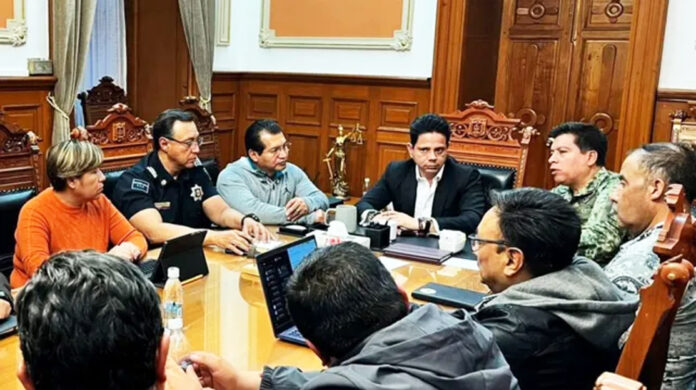
Tlaxcala state security officials held an emergency meeting
A policeman has died in the Mexican city of Zacatelco after being beaten by residents enraged over the murder of a taxi driver.
The officer reportedly intervened when locals set upon two men suspected of killing the taxi driver.
Several other policemen were also injured by the mob of angry neighbours.
Residents of Zacatelco have complained about crimes going unpunished.
According to local daily El Sol de Tlaxcala, four men tried to rob an elderly taxi driver of his car, killing him when he resisted.
Locals who had observed the incident gave chase and caught two of the four suspects, beating them in the local square.
State police intervened and saved the suspects, but the group then turned on the officers, seizing two of them and attacking them. One was rescued by his colleagues and is being treated for severe injuries. But the second one, a state police officer, was held for several hours, the local paper reported.
He was finally freed after police reinforcements arrived, but later died of his injuries in hospital.
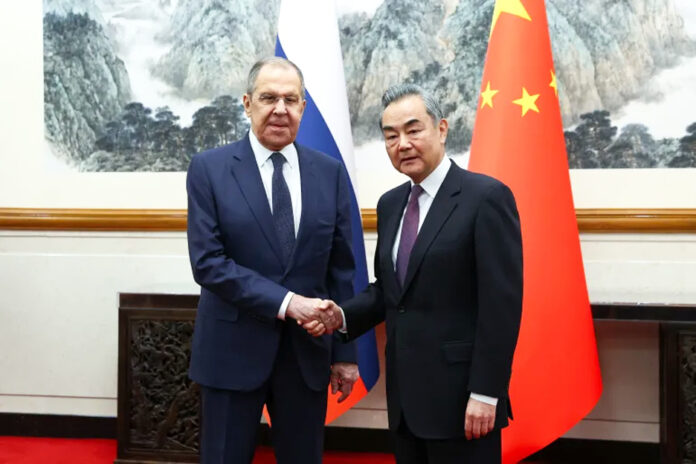
Chinese Foreign Minister Wang Yi welcomes his Russia counterpart, Sergey Lavrov
Russia and China have agreed to discuss ways to deepen their security cooperation in Asia and Europe to counter attempts by the United States to impose its will on the region, Foreign Minister Sergey Lavrov has said.
“For a long time, there was a Euro-Atlantic security structure in the form of NATO … as well as the OSCE [Organization for Security and Co-operation in Europe],” Lavrov said in Beijing on Tuesday after talks with his Chinese counterpart Wang Yi.
But these were not “structures within which it is possible to conduct meaningful negotiations and agree on something based on a balance of interests”.
As Russia’s war in Ukraine grinds on, Lavrov said Moscow and Beijing had agreed to “start a dialogue with the involvement of our other like-minded people on this issue”.
The United States calls China its biggest rival and Russia its biggest threat. At a news conference after the meeting, Wang did not explicitly mention the US, NATO or the war in Ukraine, but said that China and Russia should “oppose hegemonism and power politics, oppose the monopoly of international affairs by a few countries”.
French and British soldiers march together in Paris
French and British troops on Monday swapped roles and took part in an unprecedented changing of the guards ceremonies outside the palaces of each other’s head of state to celebrate 120 years since the Entente Cordiale. The Entente Cordiale was a diplomatic agreement signed between the United Kingdom and France in 1904. It marked the end of centuries of intermittent conflict and competition between the two nations, particularly in colonial territories.
The agreement resolved various colonial disputes between France and Britain, mainly in Africa. It also paved the way for closer diplomatic and military cooperation between the two countries.
Although it was not a formal alliance, the Entente Cordiale was a significant step towards the alignment of British and French interests, particularly in the face of rising tensions in Europe leading up to World War I.
The agreement was driven largely by growing militarism across Europe, which saw Germany pushing to develop its armed land forces and maritime forces.
Getting older often can bring on extra weight and fat. But the one place you can lose padding is in your feet. That’s bad, because you need the cushioned layer to protect your tootsies from daily pounding. You may feel pain in the ball of your foot and heel. Shoes with cushions or custom-made foam shoe inserts called orthotics may help. Or your foot doctor may suggest another treatment like filler injections to replace the fat pad.
Cracked Heels
Mature skin makes less oil and elastin, which leaves it drier and less supple. Without regular care, your heels may harden, crack, or hurt. Being overweight worsens the problem. Special creams called keratolytics help slough off the tough top layer. Follow up with a pumice stone to remove dead skin. Apply moisturizing lotion every day. If your heels get swollen and red, talk to your doctor. You may need a prescription ointment.
Ingrown Toenails
Sometimes, the side of a nail (usually on the big toe) grows into the skin. It can happen at any age, but it’s more common in older folks. Your toe may swell, hurt, and get infected. Sweaty feet, being overweight, and diabetes all add up and raise your chances for an ingrown toenail. To prevent it, avoid cutting your toenails too short or wearing tight shoes. In severe cases, your doctor may have to remove the nail root.
Osteoarthritis
By the time you reach your 50th birthday, your feet may have trekked 75,000 miles or more. All that wear and tear or a previous injury can lead to osteoarthritis. It happens when cartilage, a flexible tissue that prevents friction, breaks down. That lets bone rub against bone. Most people who get it are over 65.
Flat Foot
Many babies are born with flat feet, but more than 80% outgrow it. Some adults get flat feet because of an injury or things like obesity, diabetes, and high blood pressure. Tendons that support your arch get damaged and flatten your feet. It can hurt. A giveaway is that your feet jut out, so most of your toes are visible from behind your leg. Normally, you’d see only the fourth and fifth toes. Orthotics, physical therapy, braces, and surgery can help.
Achilles Tendinitis
The Achilles is the tendon you use to flex your foot when you climb stairs or go up on your toes. Age and lowered blood supply can weaken the tendon. Your heel or the back of your ankle may hurt. Rest, icing, and medication can help fight the swelling. Don’t ignore the problem. You could need surgery for serious tears.
Diabetic Foot Ulcer
Diabetes can damage your nerves so that you may not feel small cuts or wounds. Your feet also might tingle, feel numb, or have jabbing pain. Foot ulcers can start as something small like a blister, but then get bigger and infected. They’re a major cause of amputations in people with diabetes. Keep blood sugar controlled, and check your feet often. See a doctor right away if you see anything odd.
Gout
Gout is a painful form of arthritis is most common in middle-aged men. It happens when a waste product called uric acid collects as crystals, often in the big toe. It can swell, stiffen, and hurt a lot. Your doctor may prescribe medicine to ease the swelling. You may feel better in about a day. Exercise, eat less red meat and shellfish, go easy on alcoholic beverages and sugary foods, and drink lots of fluids to help prevent future attacks.
Bunions
These are painful bony lumps that grow along the inside of your foot at the joint where your big toe meets your foot. Bunions grow slowly as the big toe angles inward. Tight, narrow, shoes like high heels may worsen them. That’s why bunions appear much more often in women. They can run in families, too. Icing, special pads, and shoes that aren’t too tight help. Your doctor might suggest surgery in serious cases.
Hammertoe
It’s an abnormal bend in the middle joints of your toe. It’s usually your “second” toe, next to the big one. But it also can affect the third, fourth, and fifth toes. You’ll notice an unusual shape, and you may have some pain when you move it, as well as corns and calluses from the toe rubbing against your shoe. Your doctor can treat it with special footwear, pain meds, and sometimes surgery.
Claw Toe
This kind of misshapen foot is similar to hammertoe. But instead of just the middle joint, claw toes also affect the joints closest to the tips of your toes. Your toes curl and dig straight down into the floor or the soles of your shoes. Claw toes grow stiffer with age. If you can move them, try strengthening exercises like picking up a marble or piece of paper with your toes.
Fungal Infections
Less elastic skin and weaker immunity can invite more fungal infections in seniors. The sole of your foot may scale and itch. If it’s not treated, the infection can spread to your toenails. Treatment includes antifungal creams and sometimes pills. Fungus is hard to kill, so use your medication for as long as directed. Tip: Don’t smear cortisone creams on the rash. They weaken the skin’s defenses and worsen the infection.
Your Excellency, Alhaji Dr. Mahamadu Bawumia, Vice President of the Republic of Ghana,
I stand here very excited, elated and humbled by your response to the invitation to join me in the launch the strategic framework of the vision that I intend to implement during my tenure as Chief Justice of the Republic, a journey that started on June 12th 2023. Thank you very very much for taking time off your busy schedules to participate in today’s program.
On 12th June 2023, I articulated my views from the window of one who had worked actively in court rooms as a legal practitioner from 1987 and as a judge since 2004. Over this period, I have become acutely aware of the dread that citizens have of coming to court because of potential wastes of time and expenses incurred in their bid to access justice.
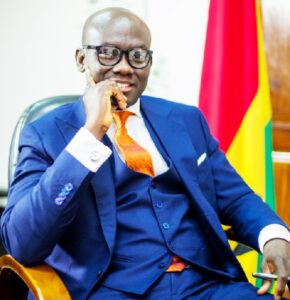
Attorney General Godfred Dame
Since 2004, when I joined the Judiciary, I have actively worked in all the different facets of the reform initiatives commenced by the four Chief Justices I was privileged to work under, before the mantle of the responsibility was placed on my shoulder to continue from where they left their treasured contributions to the nation’s justice delivery systems.
I speak of Chief Justice George Kingsley Acquah of blessed memory, Chief Justice Georgina Theodora Wood, Chief Justice Sophia Akuffo, and Chief Justice Kwasi Anin Yeboah.
Through the experience of working in the Judicial Training Institute, as supervising judge for commercial courts, in administration of various programs and committees of the Judiciary, and the E-Justice journey of the Judiciary, it became clear to me, and at this point, I quote from my speech delivered on 12th June 2023 ‘that to speed up the efficiency and effectiveness of our systems, so much more is needed for and from the Judiciary than determination and avowed purpose.
There is a need to expedite the national digitalization agenda to allow for easier networking of all stakeholders. There is a need to increase the budget of the judiciary to allow us room to expand our infrastructure in the automation and digitalization agenda, because undoubtedly, the efficiency of court processes and administration is assured with more deliberate use of technology.
There is a need to increase our budget to make learning, library and operational resources available to all judges and staff in order to enhance the speed with which both judicial and administrative decisions are made and communicated to stakeholders.
There is the need for the judiciary to make itself accountable by increasing transparency in the process and output of our judgments and decisions through real time publications of decisions, especially when it comes to decisions on land ownership, and other areas of law that affect the economy and social stability of the country.
There is a need to harness the attention of external stakeholders in the justice delivery relay, for improving excellence in their own services, in order that they do not compromise the quality of justice.
These external stakeholders include auctioneers, valuers, surveyors, bailiff services, lands commission, and other registries for assets which invariably become relevant in the cross hairs of litigation.
As Chief Justice therefore, I wish to express my determination to relentlessly seek the support of the legislature in matters of the budget of the judiciary and the support of both the executive and legislature for accelerated infrastructure in technology, and for innovative models of doing business with technology. The expansion of electronically accessed library services will require support.’
In the book ‘Way of the Peaceful Warrior: A Book that changes lives’ by Dan Millman, the character Socrates is quoted as saying, ‘the secret of change is to focus all of your energy, not on fighting the old, but on building the new’
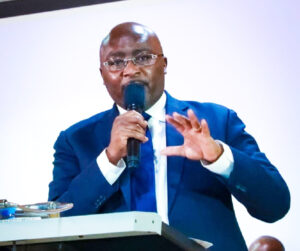
Dr Mahamudu Bawumia
I am therefore glad to report that after I left Jubilee House with my instrument of investiture, I immediately set to work to develop a strategic framework to guide decision making, inform operational planning and delivery, and help measure progress in the achievement of the desired change to efficient and effective justice delivery.
My leadership directions in this planning has focused on tackling the seemingly systemic difficulties that appear determined to dim the efforts of previous Chief Justices to activate the efficient and effective delivery of justice with various reform initiatives.
Interestingly, barely weeks after commencing work as Chief Justice, and during the period of developing this vision statement, I received a visit from a cherished Ghanaian leader, Apostle Eric Nyamekye, the Chairman of the Church of Pentecost. He took me aside, as Moses’ father-in -law Jethro must have done, when he saw Moses wearing himself out as a Judge, without the support of dependable partners in his leadership tasks.
The esteemed Apostle pointed out to me that in order to obtain extensive support beyond the cluster of help that the Judiciary was used to working with, and the needed cooperation of the people of Ghana that I must serve, I should consider articulating the distinct goals within the Vision shared on June 12th 2023, and share same with the nation, with the objective of mobilizing support from as wide a national and international base as can be obtained. Sir thank you very much.
The Judiciary is not known for speaking beyond the corridors of the courts, and so it will not surprise me if many find this morning’s event odd. However, I have taken this step of doing so, because as Albert Einstein is quoted as saying, ‘we cannot solve our problems with the same thinking we used when we created them.’
Clearly, since justice emanates from the people of Ghana and is only administered by the Judiciary by the direction of article 125 (1) of the 1992 Constitution, it is meet and right to engage the people for whom the justice sector works, to walk with us and help us in solving the difficulties faced in the smooth administration of justice.
Nana Chair, Your Excellency, Distinguished ladies and gentlemen, this Strategic Framework has been given the title ‘LEADing Justice’. LEAD is an acronym for Law, Ethics, Assets, Due Process and Digitalization.
Law.
Why is it necessary to cast a strategic vision to increase the knowledge of law when all Judges are trained lawyers, and indeed, no one can join the judiciary unless they have first obtained the full qualifying proficiency in law, and a required level of experience?
The reality is that the Judiciary works within the Public Service institution called the Judicial Service of Ghana. Staff of the Judicial Service of Ghana, currently numbering more than seven thousand officers, are all experts in their own field, and join the service on the basis of their recognized expertize. However, they are not lawyers. Indeed, only a very insignificant number are lawyers.
And yet the ultimate reason for anyone coming to court is for an order, a ruling or a judgment. Any court order, ruling or a judgment must strictly comply with law and legality, in its content, and also in the process by which it was arrived at.
For this reason, no matter how beautifully filled with law an order, ruling and judgment is, if it was reached through a process that did not satisfy the tenets of legality, it stands the danger of being overturned, reversed, varied, or sometimes quashed altogether. That process of arriving at an order, ruling or judgment is managed not only by the Judge, but a myriad number of people who form part of the relay in justice delivery.
Thus in their daily work, Judges are expected to deliver justice with supporting staff, who have almost zero knowledge of the basic ingredients of justice – law and legality. The import of the language of the law, the effect of time on legality, the effect of skipping any process and procedure is largely not known to the vast majority of the thousands of staff who work with Judges.
As they conduct their administrative duties, they do so with knowledge from their own skill sets and proficiencies, and not the nuanced appreciation of the effect of law on actions. Avoidable mistakes, errors, and distortions of the requirements for due process therefore abound in the work of the courts and these affect court users with much loss, expense, delay and frustration.
The framework of vision presented today is therefore calling for a bold and multiplied outlay of paralegal learning to be made available to all the thousands of Judicial Service Staff, and the countless professionals who work with the Judiciary to deliver justice.
These professionals include police investigators, prosecutors, mediators who supplement the court’s work with alternate dispute resolution services, external court service providers such as process servers, valuers, surveyors, financial experts, all types of experts, auctioneers, etc etc.
As important as paralegal learning is to the professionals who must help judges to deliver orders, rulings and judgments that pass the unimpeachable test of legality, the citizen must also be assisted to understand the systems used in court, so that their journey in seeking justice will be less affected with abuse, missteps, and failures that deprive their rights and entitlements.
On June 12th 2023, I said that ‘the raising of facilities to create world class centers of judicial (and legal) learning, the production of manuals, practice directions, and resources to assist litigants in our courts, will not only increase the efficiency of support services but also reduce untoward abuse of administrative and judicial discretion, while raising financial resources for the Judiciary.
Nana Chair, I am more than excited to announce that as part of the immediate (first two hundred days) goals set out in this vision statement, I have been greatly assisted and helped to produce various paralegal learning materials for accounting professionals, process servers, interpreters, court clerks, recorders and secretaries, and registrars working with the courts.
The Judicial Training Institute, working with our technology and innovation teams, have also trained our first cohort of faculty members in how to deliver on line training with effective adult learning models, because the cost of training thousands of people physically, bringing them from around the country will be simply prohibitive.
So much of training will now be delivered on line, with structured pre- delivered materials, and post training exercises, to ensure that actual learning is done, before certification is given.
ETHICS
Nana Chair, Your Excellency, as stated earlier, the letter ‘E’ in this strategic framework stands for the word ‘Ethics’. I deeply crave, along with all our well-wishers I am sure, to change the tags of ‘corruption’ ‘ineptitude’, and ‘inefficiency’ around the Judiciary and Judicial Service of Ghana. We cannot do this without the support and attention of all stakeholders.
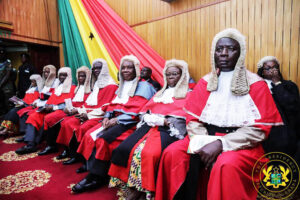
Supreme Court Justices
The Bangalore Principles of Judicial Conduct and the Latimer House Principles are international instruments that Ghana’s Judiciary are committed to. In order to shake off these tags, training needs to be supplemented with consistent culture changing strategies to deepen ethical models of work in the courts.
Judicial administration must close the gaps through which court users are subjected to exploitation and rent seeking behavior. This demands the removal of as much of the human inter-facing that court work is exposed to. Court officials are expected to work with independence, with impartiality, competence, and integrity.
Much of these ethical values are lost in the heavy traffic of human inter-facing between court officials and court users, including unknown brokers functioning around the courts. The vision for producing culture-changing re-orientation programs cannot be achieved without the active partnership and support of stakeholders, including communities of businesses, and donors.
Indeed as we speak, steps are being taken to revert to the opening and closure of assizes, which ensured that jurors remained with the judiciary for only a short season. The current situation where one juror can be attached to the courts for years, leaving their full time work for long periods, and earning from both institutions through the same public purse, needs to be seriously deconstructed.
In order to do so effectively, this vision contemplates the engagement of the private sector in jury services, as is the situation in virtually every country. I wish to humbly ask for the cooperation of the private sector in implementing strategies such as this, because we need to increase the ethical contents of integrity and efficiency in criminal justice delivery.
I am glad to report that as part of my immediate goals, which prioritizes the provision of directions, guidelines, and manuals to increase transparency and due process in court work, twelve items that range from Administrative Guidelines and Practice Directions, are available to be revealed to the public today, along with the Vision Statement. They cover
Practice Directions on Commercial Pre-Trial Settlement under order 58 as amended by CI 133
Practice Directions in Respect of Prerogative Writs Involving Chiefs and Chieftaincy Issues
Practice Directions on Award of Cost
Practice Directions on Plea Bargaining
Practice Directions on Adjournments and Adoption of Proceedings in Part Heard Trials
Practice Directions on Court Connected ADR under Order 32 as Amended by CI 133
Practice Directions for Determination of Applications for Injunctions to restrain Burial of a Deceased Person
Administrative Directions to Aid Expeditious Disposal of Trial by Jury
Administrative Guidelines on Using the Supreme Court Registry
Administrative Guidelines on Generation of Suit Numbers
Administrative Guidelines for procedures For Online publication of judgments and rulings
Administrative Guidelines on Court room Proceedings
Under the implementation of the goals in this Vision, Manuals and Guidelines will be multiplied for the use of stakeholders, and to cover the myriad lines of court work, levels of court, divisions of courts, the functions of external service providers etc etc. The purpose of this is to increase transparency, competence, due process and integrity in court work.
How far and fast can we go?
It is said that if you want to walk fast, go alone. But if you want to go far, travel with others. I earnestly do not think that when dealing with such a national responsibility as justice delivery, anyone can even move fast when walking alone.
This is why the Judiciary seeks partners in developing effective programs for culture change, and other interventions that will increase ethical models of work in the Judicial Service of Ghana.
Article 125 (1) of the 1992 Constitution states that ‘justice emanates from the people and shall be administered in the name of the Republic by the Judiciary.’ It is my respectful view that the Judiciary owes a duty to draw the attention of the nation to how the nation is handling matters of justice in various facets of life – Commercial justice in the way the financial sector is handling issues of interest rates and debts, social justice through cultural practices around family and inheritance, juvenile justice, and justice for the vulnerable, to the extent that the knowledge presented is gleaned from data from courts.
Your Excellency, Nana Chair, in a few more weeks, I intend to call a Land Conference for discussion on the huge numbers of land disputes streaming across all regions of our country.
What is causing so much litigation over land, when land is the most effective source of equity and capital for business and prosperity? Could the high cost of doing business in Ghana be related to the incessant litigation over land? How are we affecting the peace index of the nation, through this high volume of land litigation? What must we all do differently?
As administrator of justice on behalf of the citizenry, I deem it my bounden duty to call for such conversations that will assist us all to break these high walls against the easy flow of capital and investments into our country because of the uncertainty of security of investment in landed property.
You will find that goals such as this, are provided for in the framework we are gathered to launch today. Please walk with us to go far in achieving all the goals set out in this Strategic Framework of Vision so that as a nation, we can practicalize ethically compliant behavior in the Judicial Service and the Judiciary, and within our social economy.
ASSETS, DIGITALIZATION, DUE PROCESS
I will now address the ‘A’ which stands for Assets, along with ‘D’, which stands for Due Process and Digitalization. While the goals set for obtaining assets are very broad, ranging from capacity building for a well trained work force, high use of technology, the consistent, assured and well-negotiated support of partners, good housing for all judges and all senior to medium level staff, allow me to dwell on one set of assets that must be prioritized, and for which the Judiciary seeks urgent partnership.
The digitalization of our paper records. We are all familiar with the position that the Driver and Vehicle Licensing Authority is the Registry of interests in cars and regulating authority over who can drive in this country.
We are also familiar with the position that the Lands Commission is the registry for interests in lands. What I crave your indulgence to notice is that the Judicial Service of Ghana is the general registry for all rights, entitlements and obligations that are the subject matter of orders, rulings and judgments from the courts. We have your records on your rights, and we keep your records on your rights.
The courts have been existence for more than a century. Anyone whose family issues, commercial interests, employment rights have been pronounced on must find these records in the courts. But what is the state of our documentation? It is very difficult to contemplate.
Nana Chair, Your Excellency, there is an urgent need to build a modern archive center to store all records emanating from the courts in a coherent and orderly manner that can be easily retrieved whenever citizens and court users need their records. At the same time as the records are being stored, they must be digitized for electronic storage and easy retrieval. Because citizens cannot wait when they need their records for us to wade through the boxes and heaps.
Again, it is only after digitization that we can even remotely anticipate effective e-justice. Because virtual trials cannot be conducted without electronic dockets. It is a strong goal of this Vision Statement to move registries into paper less modes as soon as possible.
The LEADing Justice vision is anchored on a high use of technology to increase speed and transparency in the justice delivery process. Goals have been set for digital libraries so that all staff and Judges will have access to learning, notwithstanding which part of the country they are in.
Goals have also been set to obtain centrally managed transcription rooms for early processing of court proceedings so that requests for court processes cannot be affected by localized interests within the court room.
This will remove the burden of court users paying court room recorders for producing transcripts of their proceedings. It ensures that records are made available to stake holders without unnecessary waste of time and costs through travelling to a registry, queuing to pay for a record, and being told to go and come back for the said record. It should be possible to serve parties who have nationally recorded phone numbers and email addresses electronically, while we wait for all citizens to obtain phone numbers and email addresses.
We have 439 courts now, thanks to the dedicated commitment of Government since 2020, through the District Assembly Common Fund, to make courts accessible to all citizens. The Judiciary is extremely grateful for the 100 new courts that we keep commissioning. All of these courts are making orders, and churning out proceedings.
Beyond this, there are also many justice delivery processes that if supported electronically and digitally, will reduce inefficiency, costs and uncertainty in litigation. Land mapping, verification of property details from records on property rates with District Assemblies, verification of details of vehicles from DVLA, verification of account holding in banks during execution processes, can all be easily done via dedicated and authenticated e-processes between the courts and the relevant institution, saving staff from institutions spending productive time in court just to relay information. Many of these electronic verification processes will cut out the horrible specter of forgeries that the courts sometimes experience.
To achieve these goals, the JSG is requesting for active partners that do not insist that we must employ procurement models that prevent the achievement of the goals set. Partners who will walk far with us, appreciating the independence, impartiality and integrity of the Judiciary, and help us to achieve fast. Partnerships in programs that are not limited to one year, two years, or three years, but medium and long term periods that enable validation and stability of all systems introduced.
Every stakeholder is kindly invited to share ideas and resources with us, for the Judiciary is a public institution created to administer justice that first emanates from the citizens. All facilities being discussed are designed to enable the acceleration of court services for the nation. With the support of all stakeholders in justice delivery, we can build together, build faster, and build stronger.
Still on the subject of Assets, I must tell the story of one heart-warming partnership that is already yielding results: the partnership between the Judiciary and the Ghana Bar Association. It started in the Kaneshie court, which had suffered old and tired chairs at the bar, heat, and a very sorry state of protection of documentation.
Last Christmas, under the able leadership of its national executive, the Ghana Bar Association committed to a ‘one lawyer, one chair’ facility for all courts across Ghana. The Memorandum of Understanding reached to cover this relationship clarified that the judiciary would determine the specifications of chairs, locations, and numbers of chairs needed, and the Bar would buy the chairs to ensure decent furniture in court rooms, thereby lessening the budget for court room furniture for the whole nation. Within weeks, the Greater Accra Regional Bar, had provided new chairs, and fans for the kaneshie court rooms.
This leadership drive is already being replicated in other court rooms around the country. The Volta Regional Bar, the Bono Regional Bar, the Western Regional Bar, have all moved in this direction. I am confident that very soon, the effect of this partnership will be felt in the ambiance of any court room that would have otherwise suffered a lowering of standards because of the heavy toll on the budget of the Judicial Service.
It is many of such institutional partnerships that we seek, partnerships that quietly implement any gap in access to justice, so that the effect of the rule of law will continue to translate to increase in investments, stability of capital, and the peace of the nation, at an accelerated rate.
Court Complex
Nana Chair, Your Excellency, in closing, allow me acknowledge with gratitude the kind help and support of all Judges, staff, lawyers and external friends in this journey of leadership that is less than one year old.
The support of my colleagues on the Supreme Court, the support of the Court of Appeal bench, including retired Judges, the support of the Judicial Council, the General Legal Council and its committees, and the support of the entire legal sector, has been outstanding. The Judges, Lawyers and Staff who help to produce any guideline, direction or manuals will be duly acknowledged for posterity.
But today, I must especially acknowledge the help of those who have helped in producing the first compendium of Guidelines, Directions, and Manual before us. They are
Practice Directions on Award of Cost:
H/L Ernest Owusu Dapaah JA
H/L Justice Dorothy Kingsley Nyinah
H/H Ellen Ofei Ayeh
Charles Idan
Practice Directions on Adjournments and Adoption of Proceedings in Part Heard Trials in Courts:
H/L Justice Richard Adjei-Frimpong (JSC)
H/L Justice Yaw Darko Asare (JSC)
H/L Justice Bright Mensah (JA)
H/L Justice Dorothy Kingsley-Nyinah
H/H Jojo Hagan
H/H Arit Nsemoh
H/H Afia Owusuaa Appiah
Practice Directions on Commercial Pre-Trial Settlement under High Court Civil Procedure Amendment Rules 2020, C. I. 133:
H/L Justice Angelina Mensah-Homiah (JA)
H/L Justice Jerome Noble Nkrumah (JA)
Alex Nartey
Practice Directions on Court Connected ADR under High Court Civil Procedure Amendment Rules 2020, C. I. 133:
H/L Justice Koomson (JSC)
H/L Justice Angelina Mensah-Homiah (JA)
H/L Justice Jerome Noble Nkrumah (JA)
Alex Nartey
Practice Directions in respect of Prerogative Writs involving Chiefs/Chieftaincy Issues
H/L Justice Samuel Alan Brobbey (JSC) (Rtd)
H/L Justice Philip Bright Mensah (JSC)
H/H Angela Attachie
Practice Directions on Plea Bargaining 2024
H/L Justice Afia Serwaa Asare-Botwe (JA)
H/L Justice Marie-Louise Simmons (J)
Evelyn Keelson
Practice Directions for Determination of Applications for Interlocutory Injunctions to Restrain Burial of a Deceased Person
H/L Ernest Owusu Dapaah JA
H/L Justice Francis Obiri (J)
Administrative Guidelines on Procedures for Online Publication of Judgments and Rulings:
H/L Justice Jennifer Abena Dadzie (JA)
H/L Justice Barbara Tetteh-Charway (J)
Administrative Directions on Courtroom Proceedings:
H/L Justice Jennifer Abena Dadzie (JA)
H/L Justice Emmanuel Lodoh (J)
H/L Justice Tandoh Aboagye (J)
Patricia Naa Afarley Dadson
Dennis Adjei Dwomoh
Administrative Directions to aid Expeditious Disposal of Trials by Jury
H/L Justice Afia Serwaa Asare-Botwe (JA)
H/L Justice Angelina Mensah Homiah (JA)
H/L Justice Frederick Tetteh (J)
H/L Justice Lydia Osei Marfo (J)
Administrative Guidelines on using the Supreme Court Registry
H/H Ellen Ofei Ayeh
H/L Samuel Asiedu JSC
Administrative Guidelines on the Generation of Suit Numbers:
John K. Bannerman
Papa Kwasi Maisie
Practice Administrative Directions Editorial Committee:
H/L Justice Dr. Ernest Owusu-Dapaa (JA)
H/L Justice Ama Sefenya Ayittey(J)
Patricia Naa Afarley Dadson(ESQ)
Dennis Adjei Dwomoh (ESQ)
Selali Woanyo (ESQ)
Miss Judith Lois Abena Addo
I must especially mention the secretariats of the Office of the Chief Justice and Office of the Judicial Secretary who have worked tirelessly and with great cheer to bring us to the event of today. I acknowledge members of the planning committee of this event…
God bless you all. God bless our homeland Ghana, and bless the LEADing Justice Initiatives.
The words of President Bassirou Diomaye Faye were honey to taste. Following the bitter ending of the 12-year rule of Macky Sall, highlighted by the widespread belief that France is at the heart of Senegal’s misery, a forlorn country enthusiastically lapped up Faye’s promise of a future untainted by France at his swearing in on April 2.
At a stage, it was not clear who was the public enemy #1: Sall or France?
Sall started well. He came to office in 2012 with solid credentials, looking every inch like what Senegal needed to break away from the incompetence and cronyism of Abdoulaye Wade under whom the country had lost its way.
Sall was an elite with a strong connection to the grassroots. He rallied the opposition against Wade including committing the unthinkable sin of breaking off from the ruling Parti Democratique Senegalaise (PDS) under which he served as minister and then later dragging the president’s son to account before parliament.
Senegalese applauded. When after only a few years as president Sall offered to reduce his own term to set an example, the country said over its dead body. If Senegal could not afford to crown him for life, he must complete his two-term limit of seven years each.
It’s a decision it would later regret. The country had to drag Sall through an economy in a shambles, a country falling apart, and over one dozen dead in street protests to get him out of office. By this time, he had already exceeded his constitutional term limit. Sall, in short, became the very thing that he campaigned against.
France as dirty word
And France? That’s a different story. From Mali to Burkina Faso and from Guinea to Niger, France has become a dirty word, even though the elite in these countries are too ashamed to admit there’s nothing France has done without their helping hand. France is not just a metaphor for underdevelopment. You’ll be forgiven to think it’s probably also the reason some formerly virile folks in the former colonies have lost their libido. It’s not a laughing matter.
Faye’s inauguration address was applauded because in a continent blighted by incompetent gerontocrats he is, at 44, the youngest president in Senegal’s 63-year history. But his speech was just as important. To say enough to France a fric – a perversion ofFranceAfriquethe harmless slogan of cooperation – that has made French West Africa France’s cash machine was a big deal. And Faye said it somewhat elegantly.
Sall is past tense. But promising Senegalese a future outside the grip of France, a grip forged decades before Faye was born, is where the tire meets the road. It’s an ambitious promise made not based on where Senegal is today, but on where it wishes to be.
Dialing back to Senghor
Let’s dial back a bit. Like a number of colonies, especially the French ones, Senegal was a part of France, in law and spirit. Senegal’s first President Leopold Sedar Senghor and an in-law of France, was one of the nine African deputies at the Constituent Assembly in Paris in 1945 that prepared the constitution of the Fourth Republic, which brought de Gaulle to power.
That constitution according to Martin Meredith’s The Fortunes of Africa, “Endorsed the emphasis it placed on the ‘indivisible’ nature of the Union Francaise,” a union which of course included Francophone West Africa.
Anyone in doubt about the value of Union Francaise, need to be reminded that when de Gaulle died in 1970, Emperor Jean-Bedel Bokassa of the Central African Republicwept at the funeral of the man he fondly called “Papa.” Guinea’s Sekou Toure was the exception to Francophone West Africa’s mushy-mushy.
At independence, even though Senegal was better off than a number of other countries, it still relied heavily on French subsidies to pay its bills. Of course, things have changed somewhat in the last six decades, but only somewhat.
On the day that Faye took his oath of office, pledging to cut French wings to size, France remained the largest exporter to Senegal with goods such as medicines, wheat, and copper wire. In the last 27 years, France exports to Senegal have increased at an annual rate of 3.39 percent from $461 million in 1995 to $1.1 billion in 2022.
Of course, Nigeria, Morocco, and Ghana are also popping up on the radar, with Senegal’s intra-African trade growing by about eight percent but it would take more than a passionate inauguration speech to topple French interest, also deeply embedded in the oil and gas sectors by key businesses such as Total, formerly Elf,or BNP Paribas and SocieteGenerale in the financial services.
Scapegoating France?
Is it even necessary to scapegoat France? Of course, it’s the popular thing and perennial French greed, not to talk of the arrogance and condescension of its last two presidents, have not helped matters. But beyond red-meat politics, why should the average Senegalese be given the impression that once France – and all things French – is out of the way, the country would be on its way to a life of happily ever after?
Faye and those in his corner would soon find that the truth is more nuanced. In today’s world, capital or investment, is not monolingual. Whether it’s French, English, Arabic or Mandarin capital, it finds a home wherever it is made welcome, wherever it can find value.
It’s not a matter of patriotic convenience, for example, that Abu Dhabi has conquered European football clubs and real estate. Britain, France, Germany and other European countries where the Emirati kingdom is invested made them feel welcome, whatever the right-wing sentiments in these countries may be.
Twenty-five years ago, this same kingdom, not far from the region where the West likes to call the Axis of Evil, bought the Chrysler Building, one of the most iconic features of the New York skyline, for $800 million! And surely, Faye knows that for all its sabre-rattling against China nearly three percent of US foreign debt is owed to China.
Even though Senegal’s intra-African trade profile is looking up,CFA franc, which is still tied to the French treasury, remains the currency of Francophone countries.Plans by the 15-member regional block, Ecowas, to adopt a single currency since 1987, have gone nowhere. Similarly, Kenyan President William Ruto’s call for a pan-African payment system that would settle intra-African trade outside the dollar has gone nowhere.
Faye’s homework
For Faye to promise freedom from French grip on French money, French medicines and French food, is wishful thinking. The work must start from home, from within. The country must heal after the roller-coaster transitionand also take steps to restore tourists’ confidence. Faye’s government needs to tackle corruption, strengthen the justice system, and help farmers deal with the impact of climate change.
There’s no need to demonise France. A strategic reset of Senegal’s relationship with Paris can begin with Dakar creating an environment that works for investment – wherever it is coming from – while the new government also leverages regional cooperation, especially with moderate Francophone countriesin the region.
And the country is not doing too badly in casting its net wide. China, Russia and India are following closely behind France as Senegal’s deep-pocket trading partners. Investments from these destinations may not speak French but they may just be as unserviceable as those from Paris or elsewhere if Faye does not create the right environment for them to thrive.
The political campaign is over: governance is where the tire meets the road.