Home Blog Page 1422

Canada lists Iran Revolutionary Guards as ‘terrorist’ group

0
Iran Revolutionary Guards

Canada has listed Iran’s Islamic Revolutionary Guard Corps (IRGC) as a “terrorist” entity and urged its citizens in Iran to leave.

The Canadian government made the announcement on Wednesday, saying that the move will help Ottawa with “countering terrorist financing”. “The decision to list the IRGC through the Criminal Code listing regime sends a strong message that Canada will use all tools at its disposal to combat the terrorist activity of the IRGC, conducted both unilaterally and in knowing association with listed terrorist entities such as Hezbollah and Hamas,” the Canadian government said in a statement.

Iran on Thursday condemned Canada’s listing as an “unwise and unconventional politically motivated step”, the Fars news agency reported.

“Canada’s action will not have any effect on the Revolutionary Guards’ legitimate and deterrent power,” said Iran’s Ministry of Foreign Affairs spokesperson Nasser Kanaani, adding that Tehran reserves the right to respond accordingly to the listing.

For years, the opposition Conservatives in Canada have urged Liberal Prime Minister Justin Trudeau to blacklist the IRGC.

On Wednesday, Dominic LeBlanc, Canada’s minister of public safety, cited Iran’s human rights record as one of the reasons behind the decision.

“The Iranian regime has consistently displayed a complete disregard for human rights, both inside and outside Iran, as well as a willingness to destabilise the international rules-based order,” LeBlanc said in a statement.

Credit: aljazeera.com

What Is an Allergic Reaction?

0

Some people sneeze like crazy. Others get itchy hives or watery eyes. But whatever the reaction, it boils down to one thing: allergies.

If you have allergies, you have lots of company. As many as 30% of U.S. adults and 40% of children are in the same boat as you.

While your problem may seem to start in the nose or the eyesallergies actually come from an immune system running wild.

Learning why these reactions happen can help you keep things under control and feel better.

Why Allergic Reactions Happen

Your immune system has an important job: to defend your body from invaders such as bacteria and viruses that mean you harm.

But when it makes war on substances it shouldn’t, that’s an allergy.

Peanuts, eggs, or pollen, for example, can trigger reactions. They are called allergens.

During a reaction, your immune system releases antibodies. These are proteins that deliver a message to cells: Stop that substance! The cells then send out histamine, which causes blood vessels to expand, and other chemicals, and these trigger the allergy symptoms.

These antibodies are singled-minded. Each one targets only one type of allergen. That explains why someone might be allergic to peanuts but not to eggs.

You can come into contact with allergens in many ways: through the skineyes, nose, mouth, or stomach. This can cause your sinuses to clog up, inflame your skin, make it harder to breathe, or cause stomach problems.

What Things Most Often Cause an Attack?

Why do some people have such bad allergies and others don’t? Experts don’t have all the answers, but they say family history is important.

Some common allergens include:

  • Animal dander
  • Bee stings
  • Certain medicationssuch as penicillin
  • Dust mites
  • Foods — particularly peanuts, tree nuts, fish, shellfish, eggs, milk, wheat, and soy
  • Insect bites
  • Latex or other materials you touch
  • Mold
  • Plants and pollens

The Symptoms, From Itchy Eyes to Sneezing

Your allergy attacks might range from mild and annoying to more severe and even life-threatening. It all depends on the way your body reacts and how much of the allergen got into your system.

If your allergy is severe, you may have a serious reaction called anaphylaxis. Some cases could be life-threatening and need urgent attention.

Here are some common types of allergies:

Hay fever: Also known as allergic rhinitis, it can cause:

Food allergies: You may feel tingling in your mouth. Your tongue, lips, throat, or face might swell up. Or you could get hives. In the worst cases, you might have anaphylaxis and will need medical help right away.

Eczema: Also known as atopic dermatitis, it is a skin condition. Most types of eczema are not allergies. But the disease can flare up when you’re around things that cause an allergic reaction. Your body’s immune system overreacts to substances, called allergens, that are usually not harmful. You might get hives, itching, swelling, sneezing, and a runny nose. You might have it if you have itching, redness, and peeling or flaking.

Medications: If you’re allergic to a certain drug, you may get a rash, facial swelling, or hives. You could find yourself wheezing. In severe cases, you may develop anaphylaxis.

Stings: If you’re allergic to bees or other insects you may get:

  • A large area of swelling, known as edema, at the site of the sting
  • Itchingor hives all over your body
  • Shortness of breath, wheezing, chest tightness, or a cough

As with some other allergies, such as food and medication, a severe reaction to a sting can lead to anaphylaxis.

Source: webmd.com

GARCC organises dialogue session on child marriage, GBV

0

The Greater Accra Regional Coordinating Council (GARCC), through the Department of Gender, has organised a dialogue session on ending child marriage and Gender Based Violence (GBV).

It was organised with funding from United Nations Population Fund (UNFPA) and the Canadian Government to sensitise participants on their role in reducing GBV, the child marriage legal framework and the implications on the mental health of the child.

The workshop brought together identifiable groups such as Okada riders, apprentices of garage operators and Unit Committee Members at Medie in the Ga West Municipal Assembly, between the ages of 18 and 60 years.

Madam Matilda Banfro, the Greater Accra Regional Director, Department of Gender, said marriage must be consensual and parties must be of age.

She said child marriage occurred when either of the partners was below 18 years.

Madam Banfro said research showed that child bride rate in the Greater Accra Region was 11 per cent.

The Regional Director said girls in the rural areas were twice more likely to be child brides.

Madam Banfro acknowledged that there were legal frameworks which prohibited children under 18 years from marriage, but the children were powerless to refuse, when forced into it.

Madam Matilda Banfro

Madam Juliana Abbeyquaye, Eastern Regional Director, Department of Gender, explained that child marriage could be formal where rites were performed or informal where there was no rite, but partners cohabitted.

She said child marriage was mainly caused by poverty, low educational rate, strict adherence to culture and religion, low access to higher education and teenage pregnancy among others.

Madam Abbeyquaye said the most successful strategy to prevent child marriage was the investment in girls’ education and keeping them in school.

She called on community, traditional and religious leaders to work together to address gender inequalities and harmful cultural practices that contributed to child marriage.

Madam Jemima Marfo, a health officer, Ga West Municipal Health Directorate, said the health implications of child marriage included teenage pregnancy, urinary tract infection, obstetric fistula, cervical cancer and depression.

She said according to studies, three out of every five Human Immunodeficiency Virus (HIV) infected persons in Ghana were between the ages of 15 to 24 years.

Mr Rees Oduro, a Deputy Director, National Narcotics Control Commission, described drugs as any substance that brings changes to the body after using them either internally or externally.

He said any drugs taken without doctor’s prescription was drug abuse and people usually abused drugs for the pleasure, high performance, as stimulants and depressants.

The Deputy Director said research revealed that a married girl below the age of 18 years risked mental depression, which usually leads to her abuse of drugs.

By Priscilla Oye Ofori

GNA

Chosen And Appointed To Bear Fruit

0
Dr. Joyce Rosalind Aryee, Executive Director, Salt and Light Ministries

“You did not choose me, but I chose you and appointed you to go and bear fruit—fruit that will last. Then the Father will give you whatever you ask in my name.” (John 15:16, NIV)

INTRODUCTION

Just as a gardener carefully selects and nurtures each plant to produce its best fruits, so too has God chosen and appointed each of us as branches in His son so we can bear fruit. Today, let us explore together what it truly means to be chosen and appointed by God, and how we can bear lasting, abundant fruit that glorifies Him in every aspect of our lives.

To be chosen means, to be selected, picked, settled on or decided between, opted for, adopted, preferred, approved, elected, ear-marked. Likewise, to be appointed means to be designated, named, delegated, inducted, commissioned or authorized.

In the scripture quoted earlier and in 1 Peter 2:9-10, we discover a sense of privilege. God has decided on us as His children – He has adopted us; taken a firm decision to adopt us.  He has settled on us and given His full approval to us.  Isn’t this awesome?

THE PRIVILEGE OF BEING CHOSEN

You see before we were in Christ, we were in bondage to sin, self and Satan.  Because of this bondage we were neither able nor free to serve God.  But Christ has set us free through His finished work on the cross.  It is a gift of God – Eph. 2:8-9 says that: it is by grace that you have been saved through faith – and this is not from ourselves.  It is the gift of God – not by works so that none of us can boast.

By Christ’s accepting God’s offer of selecting us – we have bound ourselves to Him as His disciples. It is not we who have chosen Christ.  On the contrary it is He who, in His grace, approached us by the power of His Spirit with a call and an offer made out of His love.

God’s purpose in choosing us is that our lives might be productive for Him.  It’s a relational thing. God has brought us into a relationship with His Son, Christ Jesus so that we would manifest in our lives that same features of fruitfulness which the Lord showed in His life, and it is as we recognize our standing in Christ Jesus and appreciate what it means in our daily living that we are able to bring forth the fruits of righteousness, love and power.

Our lack of fruitfulness is mainly due to the fact that we have compartmentalized our lives: –We label certain things as spiritual and associate them with Christian growth and maturity. But at the same time, we leave vast areas of our lives – areas we label secular – undiagnosed, undisciplined, and totally untouched by the power of the Holy Spirit.  The result is that we waste a great deal of time, we expend a great deal of energy over things that are of little importance and we fail to discipline in every area of our lives.


CHOSEN FOR SPECIFIC PURPOSES

God choosing us to be fruitful is not only a great source of blessing to others: it also brings a great measure of reward to ourselves.  From our reading in John 15 especially vs. 11-17, we can list a number of things from which we are chosen and to which we are called.

  1. JOY:We are chosen for joy and remember that JOY is a fruit of the Spirit.  As sinners redeemed by grace, God has given us His joy to be our strength. It does not matter how hard the Christian way is, it still that way of joy because we are hidden in Christ and have our lives in the power of the Holy Spirit.


  1. LOVE:We are chosen for love.  God chose us because of His love and He thus sends us into the world to love one another.  We are not in competition with one another, nor indeed in dispute, hated or quarrelling with one another.  As Christians love is to be the key distinctive between us and non-Christians.  We are to live in such a way that shows love to one another and even to our enemies.  Jesus says in John 13:34-35 that by love for one another the whole world will know that we are His disciples.


  1. AMBASSADORS: We are chosen and appointed as Christ’s ambassadors – we are to represent Him and the kingdom of God throughout the world – our homes, schools, our work places, our communities and the entire world.  Wherever we find ourselves we must first remember our calling.  We are representatives of Christ.  We are to reveal Christ by our character and then also speak about Him.  All our actions must reveal who Christ us.


  1. ADVERTISEMENTS: Jesus has chosen us as His advertisements.  We are to reveal who Christ is.  No tree bears a different fruit, when you pass by a tree; the real conviction you have of that tree – especially when it’s supposed to be in the season of fruiting – is the fruit that shows on the free.  The only way we can advertise Christ is to be like Him – and God has made this possible by gifting us with the Holy Spirit to indwell us and to actually teach us, guide us and help us to grow daily to be like Jesus – Phil. 2:13 says that God is at work in us giving us the desire to obey Him and the power to do what pleases Him.

To be continued!

                                                                                                                                             Stay Blessed!

Please continue to join us on Asempa 94.7 FM – Sundays 5.30 am., Sunny 88.7 FM – Tuesdays 5:30 am; and YFM 107.9 – Sundays 6.30am; for our Radio Bible Study as well as Sunny FM 88.7 FM every Sunday at 3:30 pm. for Hymns and their Stories.

Feature: When a Thief is Being Pursued, Thieves Will Join in the Pursuit Re: The NDC and Sale of State Assets.

0
Feature

When will Ghanaians rise up against the deceits of some politicians? This, ideology of it-is-only-wrong-when-my-opponent-is-doing-it, is complete nonsensical and must not be encouraged.

In this day and age, the NDC and socialists are saying that it is wrong to sell state assets to political office holders and those linked to the corridors of power. Like seriously? Yes, this confirms what I always say that, “when a thief is being pursued, thieves will join the pursuit.”

I cannot believe that the NDC will today rise up against the sale of state assets to the private sector.

Let us go down memory-lane. And since it is now about SSNIT, let us begin with SSNIT:

SSNIT and its Assets: The National Youth Organizer of the National Democratic Congress (NDC), George Opare Addo on behalf of the NDC has voiced strong opposition to the proposed sale of SSNIT hotels, urging all Ghanaians to recognize the gravity of the situation as it directly affects their investments and rise up against the sales of shares of some SSNIT hotels to a private company owned by Hon. Bryan Acheampong, MP and Minister of Food and Agriculture.

“I am a shareholder of SSNIT, you are a shareholder of SSNIT; anyone who contributes to SSNIT is a shareholder. You should be worried about how your investment is going,” he stated. The question is when did the NDC realise that sale of SSNIT assets affect the Ghanaian contributor to the SSNIT Pension Fund?

Jesus Christ in Matthew 7:5, is telling the NDC to first remove the log in its eye before attempting to remove the speck in NPP’s eye.

SSNIT was established in November 1972 to take contributions from workers into a pension fund. With lots of funds, coming in monthly to play around with, SSNIT invested into real estates, medical facilities, hospitality business and a bank. In the real estate business, SSNIT built the SSNIT Flats across the country and sold it out to people at prices well above the reach of the ordinary SSNIT contributor.

SSNIT also went into putting up hotels and rest houses, using the workers’ contribution. If today there are financial problems in the administration of these businesses which will adversely affect the workers’ contribution, it is only proper for the Trust to offload its assets to a company that can lift up the business and make the workers’ contribution safe and sound.

How did the NDC make workers lose their investments in SSNIT? Let us look at the Social Security Bank.

SSNIT established and solely owned the Social Security Bank (SSB) which was officially opened on January 17, 1977, and used workers’ contributions as its capital. This bank which became one of the leading banks in the country, generated enough funds for the Trust to be able to pay good pensions.

But, the NDC in July 1995, made SSNIT divest 20% of its shares in the bank. And by December 1999, foreign corporations took over 72% of the bank’s shares and changed its name to SSB. SSNIT lost control of the bank and with that the Ghanaian worker lost his life-time investment. The bank was now fully private.

In March 2003, Société Genérale stepped in and took over 51% of the shares and changed the name of the bank to SG-SSB in March 2004. With its shares going up to 52.4%, Société Genérale had the bank’s name changed to Société Genérale – Ghana in March 2013. Today, Société Genérale, holds 56.70% shares in the bank, which was established to invest in the ordinary worker’s future. Today, SSNIT holds only 19.40% shares and cannot take final decisions of the bank it funded with workers’ contributions.

Nana Akomea of the NPP came public to say that, the minority shareholder in the SSNIT hotel in Cape Coast is a high ranking NDC member; the SSNIT catering rest houses in Tamale, Sunyani and Kumasi now belong to another high-ranking NDC members and they all bought them when NDC was in power. He added that unlike the NDC bigwigs who know next to nothing about managing hotels, SSNIT is selling shares of some of its hotels to Bryan Acheampong who has proven that he can turn around hotels that are not making profit.

Because of the NDC, the Ghanaian worker today has lost his investment in SSNIT and retires into pension only to receive monthly allowances that is far below the national minimum wage.  The money he spends on transportation to the bank for his monthly pension, is half of his pension. It is the NDC that destroyed the workers’ contribution, not the NPP.

Ashanti-Goldfields: Before 1994, Ghana had 55% shares in Ashanti-Goldfields, making us the absolute decision maker. But Rawlings and the NDC sold out 30% of its shares in 1994 to private entities, most of which fronted for people in power or were European cronies. Only $400 million was gained from the sale and which was never felt our pockets, since the cedi devalued seriously in that era.

Between 1993 and 1997, the cedi depreciated 228.85% from ¢520.00 to ¢1,277.50 to $1.00. During Rawlings’ tenure as a democratically elected president, from 1993 to 2001, the cedi depreciated 1,277.50% from ¢520.00 to ¢7,163.00 to a dollar. And during his total of nineteen years as head of state of Ghana, Rawlings with the PNDC and NDC made sure the cedi depreciated 260,372.73% from ¢2.75 to ¢7,163.00 to $1.00.

Going on, after offloading the 30% shares, the NDC went ahead and sold the remaining 25% shares Ghana had in Ashanti Goldfields. Today, even though Ghana is the number one gold producer in Africa, the country holds no shares in AngloGold Ashanti, which bought Ashanti Goldfield. No Ghanaian is member of management of AngloGold Ashanti but on the board, a Ghanaian, one Kojo Busia can be found, joining on December 31, 2022.

Because of the NDC, even though Ghana is producing more gold in Africa, we have no say in that sector. We must be back to the colonial era, for this is what the NDC has done to Ghana. Recklessly disposing of national assets all in the name of enriching-the poor-by-impoverishing the rich, and today as a result of this insanity, Ghanaians in general are poorer now than in 1981 when Rawlings bust unto the political scene.

In summary our Ashanti Goldfields was sold on silver platter and we never felt it in the economy. Meanwhile, some people were shot and killed for economic mismanagement and abuse of power.

GIHOC Nsawam Cannery: This factory was in full operation, processing foods, especially fruits in a zone where fruits like pineapple and oranges were cultivated on a very large scale. It was however sold out for agbeli kalaklo, to Rawlings’ wife the First Lady, Nana Konadu Agyeman Rawlings through her political NGO, the 31 DWM. What is the state of the factory now?

GNTC Supermarkets: These were state owned, retail shops which competed on the same level with foreign owned shops like Kingsway and UTC. Then, the NDC made sure they were giving away for pocket change to cronies and politicians. Today, the GNTC Supermarkets are empty and serve as shelters for the homeless.

GIHOC Tema Boatyard: This was once the most vibrant boatyard in the whole of West Africa with most shipping companies using this base to service their vessels. This was sold to an NDC guru and since then, its operations had dropped, making it a museum piece.

State Hotels: Let us remind ourselves of what happened to the Star Hotel in Cantonments, Accra. This hotel went to a crony of the then First Lady, Nana Konadu Agyeman Rawlings. The hotel which was fully in operation was closed down, demolished and the land used to put up residential apartments.

These are but a few of what the NDC did to Ghana with state assets, so, if today, SSNIT is finding it difficult operating its hotels due to lack of adequate funds and decides to offload majority of its shares to the private sector, the NDC and socialists should just shut up. Shame unto them.

I want to believe that on top of the agenda of the NDC, it plans to sell SSNIT hotels to its members, as it did in the past, if by the unlikely event, it wins the 2024 Elections. But, NPP jumped the gun, hence this useless, hypocritical protest.

Some people would say, what I presented is to seek equalisation. The NDC always uses this word, equalisation, when it is referred to acts it committed while in power but complaining against same, when out of power.

Before the NDC should use that word as an escape route, it must be bold and honest enough to admit it did wrong in past, apologise to Ghanaians and come out with advice. I say, advice, not to arrogantly condemn. I am in no way seeking equalisation, but only going along with the teachings of Christ in Matthew 7:5.

Now what is it all about protecting state assets that are failing? Government losses lots of money when it continues to maintain assets that are running losses and yet the socialists will want these to be protected and maintained.

Work ethics in most of the state sector, is far removed from ideal acts of principle and professionalism. In most cases, from management down to the low-ranking staff, commitment is normally not a functioning word. So, whether the work progresses or not, once, every month salary will be paid, life goes on.

The private sector is a different ball game, where discipline ranks high. If Ghana is to make it, I will suggest that most of state assets should go to private hands, with government holding very minimal shares in them. At the end of the fiscal year, these companies will pay good dividend to government and the state and it is Ghana which will be the winner.

On the sale of shares of SSNIT hotel, all the NDC is doing now confirms my saying that, when is thief is pursued, thieves will join in the pursuit.

Hon. Daniel Dugan

Lewandowski returns as Poland host Austria 

0
Poland striker Robert Lewandowski

Austria expect Poland striker Robert Lewandowski to start Friday’s Group D game, with both sides hungry for victory after losing their opening matches to France and Netherlands respectively, but coach Ralf Rangnick will not be making many changes to accommodate him.

Although Poland’s record goal-scorer missed the 2-1 defeat by the Dutch due to an injury picked up in a friendly against Turkey, Austria coach Rangnick and captain Marcel Sabitzer are convinced he will be back in action on Friday.

“It doesn’t change our way of playing a lot, basically they will play the way they have been played. Lewandowski is the (main) player in Poland, everyone tries to pass to him, especially if they counter at speed,” Rangnick told reporters.

“In Munich, I had the joy of playing together with him for one year, therefore I know his qualities,” midfielder Sabitzer said.

“I know he’s an exceptional player but for us as a team, when it comes to tactics, nothing will change.”

The Austrians lost 1-0 to France in their opening game and with Netherlands awaiting in their final outing, they will be looking to get a win against Poland to give themselves the best possible chance of going through.

“The team that wins tomorrow holds the good cards and has a good chance of going through to the next phase, so therefore it’s a game you have to win, that’s absolutely clear to us,” Rangnick said.

Sabitzer said his side was ready for the pressure that comes with a must-win game. 3

Credit: espn.in

Slovakia, Ukraine face off in an intriguing Group E game

0
Zinchenko, Ukraine

Two teams which experienced very contrasting starts to their Euro 2024 campaigns, Slovakia and Ukraine, face off in an intriguing Group E clash on Friday.

memorable 1-0 win over Belgium, courtesy of two fortunate disallowed Belgian goals, put the Slovakians within touching distance of a place in the knockouts.

Meanwhile, Ukraine suffered a demoralising 3-0 defeat at the hands of unfancied Romania.

All is not lost for Serhiy Rebrov’s team, far from it, and it is certainly plausible that the two sides beaten on matchday one go on to both win in this round of games.

But, with Belgium up next, Ukraine know that one more hammer blow could be terminal for their hopes of a second trip to the Euros knockouts.

It is hard to see Francesco Calzona making many changes to his Slovakia team.

Denis Vavro was an injury worry to face Belgium but made the starting XI while Ondrej Duda came off with cramp late on, but is not yet said to be a worry for this game.

A disastrous start threatens to derail Ukraine’s campaign but Slovakia were a little fortunate to beat Belgium. If that luck doesn’t hold, they lack the firepower to be considered favourites.

Credit:  standard.co.uk

Netherlands welcome France in group of death

0
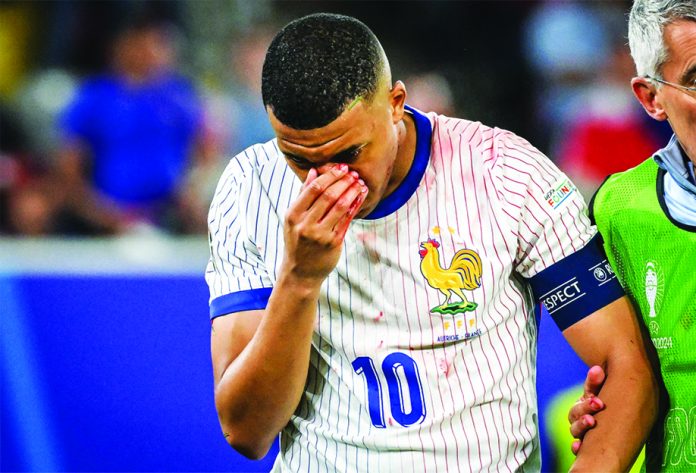
Kylian Mbappe wil be absent due to a broken nose

A battle of the Group D behemoths headlines Friday’s Euro 2024 fixtures, as the Netherlands and France pit their wits against one another at the Red Bull Arena for the right to guarantee last-16 progression.

Ronald Koeman‘s men fought back from a goal down to sink Poland 2-1 in their opening affair, while Les Bleus also scraped a narrow success over Austria, albeit one that was marred by an injury to their star man.

Leading the way over France courtesy of their superior goals scored tally, the Netherlands will guarantee themselves a top-two finish by winning Friday’s match, which would also represent their fourth straight victory after 4-0 friendly thrashings of Canada and Iceland in their warm-up fixtures. Before being quickly reunited with their Dutch foes in the same finals section, France eased to a 4-0 battering of Oranje at home and also scraped a 2-1 victory in the preliminary section, leaving Didier Deschamps‘s men with history firmly on their side this week.

As was the case with the Netherlands, Les Bleus’ opening success of the tournament – a 1-0 victory over an in-form Austria thanks to Maximilian Wober‘s own goal – did not come without a strenuous effort, although they could have usurped Oranje into first place had Kylian Mbappe not spurned a glorious one-on-one.

Memphis Depay, Netherlands

While the Real Madrid new boy could not smash the ball home on that occasion, he sparked serious concern when he smashed his face into the shoulder of Kevin Danso, receiving a broken nose and a yellow card for his troubles; he came back onto the pitch without permission amid a substitution farce.

However, Mbappe’s assist for Wober’s own goal means that second-placed France will also be through to the last 16 with victory on Friday, and Deschamps’s men have found a resilient defensive streak when it matters most, recording three clean sheets on the spin.

French media have reported that Mbappe will have to sit out Friday’s crunch clash, and Deschamps is expected to call upon record goalscorer Olivier Giroud to fill the void; the 37-year-old has been dealing with some groin pain, but nothing that should impact his availability. As Mbappe’s lightning burst of pace was critical to France picking the Austrian lock, his expected absence robs Les Bleus of their X-factor for Friday’s tie of the titans, where defences could come out on top.

The Netherlands may have been in free-scoring mode for most of the past year, but Deschamps’s defence are one of the toughest nuts to crack right now, and this blockbuster may very well end without the net bulging once.

Credit: sportsmole.co.uk

Opuni ‘Sacked’ From Supreme Court

0
Dr Stephen Opuni

The Supreme Court, by a unanimous decision, has dismissed Dr Stephen Kwabena Opuni’s prayers for the Apex Court to overturn the ruling of the Court of Appeal that his trial at the High Court should not start afresh.

The five-member-panel did not only dismiss the appeal for lacking merit, but also affirmed the Court of Appeal’s decision to set aside the ruling of the Accra High Courtto start the six years trial anew.

The members of the panel were Chief Justice Gertrude Sackey Torkornoo (presiding), Justice Mariama Owusu, Justice Henrietta Mensa-Bonsu, Justice Ernest Gaewu and Justice Yaw Darko Asare.

Grounds for the appeal 

The grounds for Dr Stephen Opuni’s appeal at the Supreme Court were that the Court of Appeal judges committed an error of law when they held that the trial high court judge exercised his discretion wrongly when he ordered the case to be started de novo.

According to him, the settled practice in criminal trial was that when a pending criminal case is assigned to a new judge, the judge is obliged to start the case de novo.

Supreme Court

He contended that the settled practices of the courts could only be changed by statute. He said the panel of the Court of Appeal erred when they held that in view of the fact that the case has been on the cause list since 2018, the exercise of the trial court’s discretion to start the trial de novo was not proper, but was arbitrary, capricious, uninformed and contrary to the policy rationale of Article 296 of the 1992 Constitution.

The Court of Appeal erred when they substituted the discretion of the trial judge to start the trial de novo with their discretion.

There was also an error in law when they refused to follow the binding decision of the full bench of the Court of Appeal, sitting as the Supreme Court, in the case of Harlley v Ejura Farms ll977l2 GLR 179 to the effect that settled practices of the courts can only be changed by statute.

Furthermore, there was an error when the panel ordered the trial court to adopt proceedings on the grounds that the accused persons have a right to a speedy trial under the 1992 Constitution.

The ruling was in the wrong direction when the panel disregarded the effect of the observation of the demeanor of witnesses in a criminal trial. According to the appellant, the entire ruling cannot be supported having regards to the evidence.

The appellant was, therefore, praying the superior court to set aside the ruling of the Court of Appeal and restore the ruling of the trial court judge to start the case de novo.

Background 

Following Justice Anokye’s ruling to start the trial de novo, after retirement of Justice Honyenuga, who was then handling the case, Godfred Yeboah Dame, the Attorney-General and Minister for Justice, appealed against the decision and the appellant court set aside the High Court ruling.

Per the Appeal Court ruling, the High Court was to adopt proceedings from where the retired Supreme Court Justice, Clemence Honyenuga, left off after almost six years.

Justice Kwasi Anokye Gyimah, who took over the case in March last year and ruled to start the criminal trial afresh, because it would be unfair for him to adopt the proceedings of Justice Honyenuga, who was transferred and Justice Aboagye Tandoh appointed to take over.

The unwillingness of the prosecution witnesses to testify became a major hurdle for the A-G and his team to file their witness statements when it was ruled that the case should started afresh.

So far, Dr. Opuni, since the retirement of Justice Clemence Jackson Honyenuga in the year 2023 and removal of the subsequent judge, Justice Kwasi Anokye Gyimah, had closed his case by calling a total of 11 defence witnesses.

Seidu Agongo and Agricult Ghana Limited, second and third accused persons, have opened their defence and had so far called five defence witnesses.

The GH¢271 million cocoa fertiliser case is being currently heard by a summary judge, Justice Aboagye Tandoh.

Dr. Opuni is the immediate past Chief Executive of COCOBOD, while Seidu Agongo is a businessman and supplier of the lithovit fertiliser, which is at the centre of the trial.

The three have been charged with defrauding by false pretence, contravention of Public Procurement Act, causing financial loss to the state and corruption of public officer.

Housing Ministry to dig into financial background of Saglemi bidders

0
Kojo Oppong Nkrumah, Minister for Works and Housing

The Ministry of Works and Housing has announced that it will conduct a thorough financial and technical background check on bidders for the Saglemi Affordable Housing Project.

To this end, the Ministry has initiated a process to contract an independent evaluation entity, to be approved by the Public Procurement Authority (PPA), to carry out this task on its behalf.

The independent evaluation entity will scrutinize the financial records of the bidding companies, including their assets, liabilities, and credit history, and submit their report to the Ministry.

This move is aimed at preventing a repeat of the project’s previous failures, which were largely attributed to financial mismanagement.

The Saglemi Houses

Minister for Works and Housing, Kojo Oppong Nkrumah, revealed this on Wednesday, June 19, 2024 when he shared an update on the government’s request for private proposals for the completion and operationalisation of the Saglemi Affordable Housing Project with the Parliamentary Press Corps.

According to the Minister, the report by the independent evaluation entity will guide the selection of one of the bidders or a consortium of bidders for the completion of the Saglemi Affordable Housing Project.

The Ministry expects to receive bids from private developers on July 8th, 2024 and will hand them over to the independent evaluation entity for scrutiny.

The selected developer will be expected to demonstrate a strong technical and financial foundation to undertake the project, which is estimated to require an additional $100 million to complete.

So far, $200 million has been spent on the project, which has resulted in the partial completion of 1,506 units. The additional funding will be used to complete the remaining works, including water, electricity and sewage systems.

Ten private local and international bidders have expressed interest in completing the Saglemi Affordable Housing Project, which marks a significant milestone in the revival of the stalled project launched in 2012 to provide 5,000 housing units.

The Ministry’s move to invite private developers to complete the project is seen as a strategic step to address the country’s housing deficit, and the project’s revival is expected to bring relief to many low-income families struggling to access affordable housing.

Additionally, the Ministry has directed the State Housing Company to contract an entity to re-award another housing project initiated by former President Kufuor in Koforidua for completion. The Ministry is also in the process of breaking ground for about 800 housing units.

By Stephen Odoi-Larbi 

The Ghanaian Chronicle