Home Blog Page 1159

Marriage is a bed of thorny roses -Van Vicker celebrates 21st wedding anniversary

0
Van Vicker and wife Adwoa

Renowned Actor Van Vicker and his wife Adjoa are celebrating their 21st wedding anniversary.

In an Instagram post on Wednesday, October 16, Van Vicker reflected on their enduring relationship, describing marriage as a “bed of thorny roses.”

Regardless of the “thorny” description of marriage, Van Vicker expressed gratitude to God for how far he has brought his marriage and praised his wife, Adjoa, for being by his side for 30 years.

“Today is my 21st wedding anniversary. I am grateful to God. Marriage is a bed of thorny roses. It has extremely lovely times and really trying moments. In all moments, ‘THE WILL’ is key. Getting married to the ‘right’ person is critical (knowing the person substantially). Staying ‘in love’ is paramount (not just ‘loving’ your spouse)

“And finally for me, it’s ‘the desire’ to want to stay married (in the absence of abuse). The culminated effect of these 3 points may transcend those thorns in the roses. Prickly as they may be, however, the internal remedies are sufficient to let you move to the next day and the next and for years.

“Regardless of the thorns love is still a beautiful thing. I have no regrets about being married and staying married. I pray for Grace to continue this beautiful struggle. I am blessed to have my wife Adjoa Van Vicker by my side all these years. I have known her for 30 years of life. Happy anniversary to us”, he wrote on Instagram.

Creative arts key to economic growth -Bawumia

0
Dr Mahamudu Bawumia

Vice President and NPP flagbearer, Dr Mahamudu Bawumia, has called for greater investment and strategic focus on the creative arts sector to boost national development.

Speaking to industry stakeholders, he stressed the importance of supporting Ghanaian creatives to thrive in an increasingly digital world.

“We’ve been working with MUSIGA, GHAMRO, and the private sector to create a platform that can help track royalties and facilitate revenue management for musicians and other creatives,” he said.

According to him, Ghana must do more to ensure that creatives can benefit from their work.

The Vice President acknowledged the challenges faced by Ghanaian artists in maximizing returns from their work.

“We need to take proactive steps to ensure our creatives can grow and contribute to the national economy,” he urged, adding that the development of a local music streaming platform is a step in the right direction.

Dr. Bawumia also emphasised the need to foster collaboration between the creative arts sector and other industries.

“The creative arts are key to economic growth, and by working together, we can make sure this sector thrives,” he stated.

As the government continues to support initiatives that empower creatives, Bawumia stressed that the local streaming platform is only one of several steps needed to ensure sustainable growth in the industry.

Shatta Wale gets Bawumia to speak pidgin English

0
Shatta Wale and Veep Bawumia

The Vice President and Flagbearer of the ruling NPP government, Dr Mahamudu Bawumia, met with stakeholders in the creative arts sector on Wednesday, 16 October 2024.

Addressing the stakeholders, Dr Bawumia emphasised the need for a homegrown solution to enable Ghanaian musicians to achieve better financial rewards from their work. This new platform is expected to provide a fairer revenue model for Ghanaian creatives, allowing them to better track and collect royalties.

One memorable moment during the meeting occurred when Shatta Wale, the self-proclaimed Dancehall King, posed a question and requested that the Vice President respond in pidgin.

“I want to know what you have for our fans out there… and that’s the street… And Your Excellency, I will please plead with you, when you want to respond to what I’m saying, for today and for the people out there on the street, just say it in pidgin small for me,” Shatta Wale asked with a touch of humour.

In characteristically engaging style, the Vice President and flagbearer of the ruling party also responded in pidgin.

Bawumia’s response

“The thing wey dey my heart, be the people wey dey suffer for the country. I be patron of ‘let’s lead Ghana.’ I be farm labourer before, I be cleaner, taxi driver before, so I know how people dey suffer, my heart dey the streets. The thing wey I dey do all be how I for help the streets. Free SHS and digitalisation dey come help everyone, so if I come government I sabi the thing I go do to help everyone.”

Dr Bawumia’s meeting, held on Wednesday, 16 October 2024, was attended by prominent figures in the creative economy, including Shatta Wale, Samini, and Kuami Eugene.

Credit: pulse.com.gh

Australian territory resumes jailing 10-year-olds

0
Jailing 10-year-olds

Children as young as 10 will soon be able to be jailed once again in Australia’s Northern Territory (NT), after the government there lowered the age of criminal responsibility.

Australian states and territories have been under pressure to raise the age of criminal responsibility from 10 to 14, in line with other developed countries and UN advice.

Last year the NT became the first jurisdiction to lift it to 12, but the new Country Liberal Party government elected in August has said a reversal is necessary to reduce youth crime rates.

It has argued that returning the age to 10 will ultimately protect children – despite doctors, human rights organisations and Indigenous groups disputing that logic.

They say the research indicates the laws will not reduce crime and will disproportionately affect Aboriginal and Torres Strait Islander children.

The NT already jails children at a rate 11 times higher than any other jurisdiction in the country, and almost all of them are Aboriginal.

The territory’s new government says it has a mandate after an overwhelming election victory following a campaign that promised being tough on crime.

It argues being able to criminalise children younger will help divert them away from future crime.

Many places across Australia have declared they are in the grips of a youth crime crisis, and a string of violent incidents this year have prompted a series of youth curfews in the NT city of Alice Springs.

Credit: bbc.com

Kenya deputy president in hospital ahead of impeachment vote -lawyer

0
Kenyan Deputy President Rigathi Gachagua

Kenyan Deputy President Rigathi Gachagua has failed to appear in Senate to testify at his impeachment trial, with his lawyer saying that he has been taken ill.

The deputy president, who was present in the house in the morning, had been due to appear from 14:30 local time (11:30 GMT) to defend himself before a vote was due on Thursday evening about whether to remove him from office.

“The sad reality is that the deputy president of the Republic of Kenya has been taken sick, very sick, and is… in hospital,” said his lawyer Paul Muite.

Sittings have been suspended until 17:00. Speaker of Parliament Amason Kingi said they were expecting the deputy president to take the witness stand then.

The speaker said the case could then proceed without him, or “for exceptional reasons” he could be appear later, citing a rule of the trial procedures.

Speaking to local Citizen TV, Senator Daniel Maanzo said this was an exceptional trial and another “new exceptional situation has arisen that is not even anticipated by the law”, saying they would make submissions to push the speaker make a judgement.

He said the deputy president “just looked tired” but had lunch at his office with other senators who had said he was fine, with everyone expecting him to appear for his defence.

Two-thirds of the 67 senators are required to oust him.

He faces 11 charges, including corruption, inciting ethnic divisions and undermining government.

As the trial began on Wednesday, the deputy president pleaded not guilty to each of the charges as they were read out in the house. He has described the impeachment as a “political witch hunt”.

An overwhelming majority of MPs in the National Assembly last week voted to approve his impeachment, setting the stage for the Senate trial.

He has fallen out with President William Ruto, just two years after they were elected on a joint ticket.

Credit: bbc.com

Trump calls 6 January US Capitol riot a ‘day of love’

0
Donald Trump

Donald Trump has described the US Capitol riot of 6 January 2021 as a “day of love” during a campaign event just weeks before the presidential election.

The former president claimed the thousands who travelled to Washington DC that day did so because “they thought the election was a rigged election”.

On 6 January, a mob breached the US Capitol building in an effort to deny the certification of Joe Biden’s election win, forcing lawmakers to flee. Several deaths, including that of a police officer, have been attributed to the events that day.

Trump has spent years making false claims that the vote was rigged. The event continues to divide America.

During his “town hall” event in Miami, Florida, Trump was challenged to win back the vote of a man who said he had been disturbed by what happened after the Republican lost the 2020 vote.

“Nothing done wrong at all,” Trump said in a lengthy response.

“There were no guns down there. We didn’t have guns. The others had guns, but we didn’t have guns. And when I say we, these are people that walked down — this was a tiny percentage of the overall which nobody sees and nobody, nobody shows. But that was a day of love.”

He recalled addressing a group of “hundreds of thousands” during a speech elsewhere in Washington DC.

“They didn’t come because of me,” he went on. “They came because of the election. They thought the election was a rigged election, and that’s why they came.”

Trump has been accused of criminal efforts to overturn his defeat, which were recently described in detail in a filing from the federal prosecutor investigating him.

Credit: bbc.com

EU leaders to discuss stricter measures to curb arrivals of asylum seekers

0
EU President Ursula Von der Leyen and Giorgia Meloni in Brussels

European Union leaders are to discuss stricter laws to curb migration following a recent surge in support for the extreme right.

While the conflicts in Gaza, Lebanon and Ukraine are on the agenda at the summit on Thursday in Brussels, a key topic will be how to deal with irregular migrants arriving in the 27-nation bloc by land from the east and by sea from the south.

This is seen by most EU governments as a political and security risk that is driving the rise of populist and far-right parties and influencing elections.

EU Council President Charles Michel, in an invitation letter to EU leaders, wrote,  “We will … focus on concrete measures to prevent irregular migration including strengthened control of our external borders, enhanced partnerships and reinforced return policies.”

Irregular migrants and refugees arriving in Europe last year numbered less than a third of the one million seen during the migration crisis in 2015. In the first nine months of this year, the number fell even more to 166,000, data from the EU’s Frontex border agency showed.

But the number of people arriving at the EU’s border with Belarus surged 192 percent year on year in January-September to 13,195 and the number of arrivals in the Spanish Canary Islands off the western coast of Africa doubled to 30,616, Frontex said.

Credit: aljazeera.com

How to Manage Eczema on the Face

0
Eczema on the Face

Eczema is a group of skin conditions that makes your skin irritated, inflamed, and itchy. One of the common places to get a flare is on your face, especially on your cheeks. The best way to manage eczema on your face is to find out what triggers your flares and avoid contact with those triggers. But if you do have a flare, take good care of your skin by washing your face with gentle, non-soap cleanser and lukewarm water and using moisturizer several times a day.

Eczema on the Face

Eczema is a group of skin conditions that makes your skin irritated, inflamed, and itchy. Your doctor might also call it dermatitis. It weakens your skin’s barrier function, which protects you from outside elements and helps your skin retain moisture. This means that your skin may easily react to irritants and allergens in your environment.

Eczema can show up anywhere on your body, but one of the most common places is your face, especially on your forehead, cheeks, lips, and chin. You may also get it in and around your ears.

Any type of eczema can appear on your face, with atopic eczema, seborrheic dermatitis, and contact dermatitis being the most common types. And it’s possible to get more than one type of eczema at once.

Contact eczema on the face

Contact eczema (or dermatitis) happens when you come into contact with a substance that irritates your skin or triggers an allergic reaction. This type of eczema doesn’t tend to run in families and isn’t linked to other allergic conditions such as hay fever or asthma.

About 80% of the time, contact dermatitis is caused by exposure to an irritating substance, such as:

  • Solvents
  • Detergents and soaps
  • Bleach
  • Nickel-containing jewelry
  • Makeup
  • Hair dye
  • Over-washing with hot water and soap, which can dry your skin out

However, eczema may also come from a reaction that appears a day or two after your skin is exposed to an allergen. Common causes of allergic contact dermatitis are:

  • Poison ivy and poison oak
  • Nail polish
  • Fragrances in skin care products
  • Nickel
  • Thimerosal, which is a preservative found in some topical antibiotics

Symptoms of Eczema on the Face

You may get patches of eczema anywhere on your face from your chin to your forehead. But your cheeks are the most common site to get flare-ups.

Common symptoms of eczema of the face include:

  • Swelling, redness, and irritation (inflammation)
  • A rash with skin discoloration, which may be red, purple, or dark brown depending on your skin tone
  • Itchy skin
  • Dry, flaky, or scaly patches of skin
  • Small bumps or blisters
  • Wrinkled skin under your eyes
  • Sore or uncomfortable skin

Causes of Eczema on the Face

Doctors don’t know exactly what causes eczema. But they think it’s an interplay between your genes and your environment. For instance, people who have atopic eczema often have a personal and family history of eczema, asthma, or allergies.

Factors that trigger a flare-up of eczema can be different for different people. Common triggers of eczema on the face include:

  • Soaps and detergents
  • Air that’s too dry or weather with low humidity
  • Contact with something you’re allergic to
  • Makeup
  • Smoke and other pollutants
  • Rough or itchy fabric, such as wool
  • Emotional stress
  • Eczema on Face Treatment
  • Eczema can’t be cured, and it tends to come and go. The best way to treat it will often depend on what triggers your flare-ups. Your doctor will work with you to figure them out so you can avoid your triggers
  • Skin Care for Facial Eczema
  • One of the best ways to treat your eczema is to take good care of your skin. For instance:
  • Keep your skin moisturized.Try using thick creams (such as Cetaphil or Eucerin) and ointments (such as Aquaphor or Vaseline) rather than thinner lotions. The best time to moisturize is right after you wash your face. If ointments are too greasy, try using them only at night. Also, choose moisturizers or lotions for gentle or sensitive skin. You’re looking for moisturizers that don’t have fragrances or dyes that can trigger an eczema flare.
  • Clean gently. Soap can irritate your skin, but washing with water alone may not be enough, especially if your face is oily. Use a gentle non-soap cleanser or a medical emollient instead. Pat dry with a soft towel.
  • Watch the temperature.Use only cool — not hot — water on your face, and for as little time as possible.
  • Skip makeup. Don’t use cosmetics when you have a flare. The chemicals in makeup can irritate your skin further and prolong your flare-up.


American Corner partner CJID, Dubawa to educate journalists ahead of impending elections

0
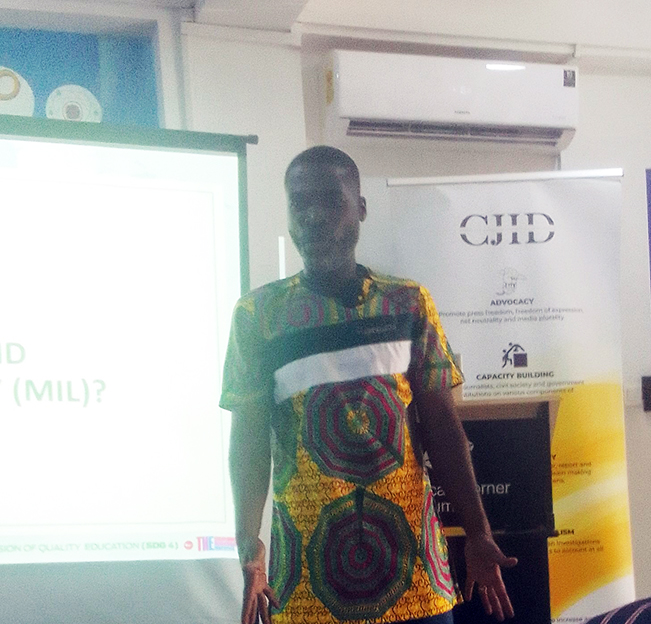
Nana Kwadwo Jantuah engaging participants

The American Corner in Kumasi in conjunction with the US Embassy Ghana, Centre for Journalism Innovation and Development (CJID) and Dubawa (an online news outlet) have organised a two-day workshop for media personnel in Kumasi.

The workshop focused on how journalists would be circumspect in the dissemination of information prior, during and after the December 7 elections.


A section of participants.

The American Corner is an educational and cultural center that is open to the general public to acquire knowledge and also collaborate with like-minded individuals. The American Corner is supported by the U.S. Embassy Ghana.

The two-day workshop, which commenced yesterday (October 17) will end today (October 18, 2024) under the

theme: “Building the Electoral Information Literacy and Fact-Checking Skills of Tertiary Students and Journalists”.


The workshop was designed in several modules, such as Media and Information Literacy, Understanding Information Disorder, Fact-Checking, among others to help participants in their reportage.

It also taught participants to verify their “Source and Content” before publication, and also how to differentiate between “credible news and information disorder (fake news)” with much emphasis on the fact that “information disorder “is disruptive.


The participants were urged to be fact-checkers, and also fast-check their news before publication.

Among the facilitators of the workshop were Nana Kwadwo Jantuah, Nhyira FM and Nathan Tetteh Gadugah, Dubawa.

Building With God: Lessons From Proverbs 14

0
Dr. Joyce Rosalind Aryee, Executive Director, Salt and Light Ministries

“The house of the wicked will be overthrown, but the tent of the upright will flourish.” (Proverbs 14:11, NKJV)

Introduction

We walk through life, constantly building—whether it’s our careers, relationships, families, or our faith. The process of building requires effort, commitment, and investment. However, the foundation upon which we build is critical to the long-term success of what we are constructing. Proverbs 14:11 draws a powerful contrast between two builders: the wicked and the upright. This comparison holds a profound truth about how we should approach the construction of our lives and what really constitutes true strength and stability.

The House vs. The Tent

Proverbs 14:11 presents an intriguing comparison. It contrasts a HOUSE, symbolizing the achievements of the wicked, with a TENT, representing the efforts of the upright. In the natural world, these two structures seem incomparable. A house is far more stable, permanent, and valuable than a tent. A house, built of bricks and stone, can endure storms and is meant to last for generations. On the other hand, a tent is temporary, fragile, and can easily be blown away by strong winds. In comparing these two, one might assume that the house holds a great advantage over the tent.

However, the wisdom of this proverb turns our worldly assumptions on their head. Despite the apparent strength and superiority of the wicked person’s house, we are told that it will be overthrown. In contrast, the upright person’s tent, fragile and temporary as it may seem, will flourish. Why? Because the strength of what we build in life is not determined by its outward appearance or material worth. Rather, it is determined by the foundation and principles upon which it stands.

The False Stability of the Wicked

The house of the wicked may look impressive. In fact, to the world, it often appears that the wicked prosper, achieving great success through deception, manipulation, or corrupt practices. People might look at their lives and wonder how they’ve built so much so quickly. But Proverbs 14:11 warns us that the external success of the wicked is deceptive. What they build cannot stand the test of time or the scrutiny of God.

Building through lies, cheating, and oppression might yield temporary results, but such structures are inherently unstable. The wicked may create a false sense of stability, convincing themselves and others that their house will last. However, the foundation of their lives lacks the integrity and righteousness required for true endurance. At some point, their house will be overthrown—either through life’s trials or through the judgment of God.

Psalm 127:1 reminds us of this truth: Unless the Lord builds the house, the builders labour in vain.” The efforts of the wicked may seem successful at first, but without God’s blessing and guidance, everything they build is in vain.

The Strength of the Upright

In contrast, the upright build what looks like a mere tent. Tents are temporary shelters, not built to last for years or withstand major storms. Yet, the tent of the upright flourishes because of God’s presence and blessing. The upright may not amass wealth or power as quickly as the wicked, but their success is built on a solid foundation—one of integrity, obedience, and faith in God.

Though a tent may seem vulnerable, it is far more secure than the house of the wicked when it has God’s favor. The key difference is not in the outward structure but in the spiritual foundation. When we build with God and according to His principles, our lives are marked by His blessing and protection.

The upright person’s tent flourishes because God’s presence is there. When God is with us, even the most humble of beginnings can grow and thrive. It may not look like much to the world, but the tent of the upright contains something priceless—God’s favor. As Romans 8:31 says, “If God is for us, who can be against us?” Even a simple tent is indestructible when God is on your side.

Building God’s Way

The core message of this proverb is that what we build in life is far less important than how we build it. The wicked build grand structures, but their methods are flawed. They seek shortcuts, relying on dishonesty or greed. Meanwhile, the upright focus on building in alignment with God’s will and purpose, even if the results seem small or insignificant in comparison.

This proverb challenges us to ask: Are we building the right way? Are we focusing on outward appearances, or are we prioritizing God’s presence and blessing in our lives? It can be tempting to envy the success of the wicked, especially when their lives seem more stable or prosperous. However, the Lord reminds us that He blesses what is built in His way, no matter how small or temporary it may seem.

Jesus also illustrated this truth when He spoke about the wise and foolish builders in Matthew 7:24-27. The wise man built his house on the rock, while the foolish man built on sand. When the storms came, only the house built on the solid foundation stood firm. Similarly, when we build our lives on the firm foundation of God’s Word and His ways, we can be assured that we will flourish, even in adversity.

Conclusion

Proverbs 14:11 calls us to reflect on the foundations upon which we are building our lives. The world may tempt us to pursue the fast and easy path to success, but God calls us to build with integrity, patience, and faithfulness. The wicked may appear to have the upper hand, but their success is fleeting. What truly matters is the presence of God in our lives, because whatever He blesses will flourish.

We are called to build with God’s blessing, trusting that His way is the best way. Though it may seem like we are building a tent compared to others’ houses, God’s presence makes all the difference. The tent of the upright flourishes because it is filled with God’s peace, protection, and favor.

So, as you build your life—your career, family, or ministry—remember to build God’s way. Seek His guidance in every decision and rely on His wisdom. When God is in the midst of what you are building, you can be confident that it will stand the test of time and flourish, even when the world around you crumbles.

Stay Blessed!

Please continue to join us on Asempa 94.7 FM – Sundays 5.30 am., Sunny 88.7 FM – Tuesdays 5:30 am; and YFM 107.9 – Sundays 6.30am; for our Radio Bible Study as well as Sunny FM 88.7 FM every Sunday at 3:30 pm. for Hymns and their Stories.


 

The Ghanaian Chronicle