The Minority Caucus on Parliament’s Lands and Natural Resources Committee has accused the Ministry of Lands and Natural Resources of policy inconsistencies, weak enforcement against illegal mining and negotiating unfavourable terms for Ghana in the Barari DV lithium agreement.
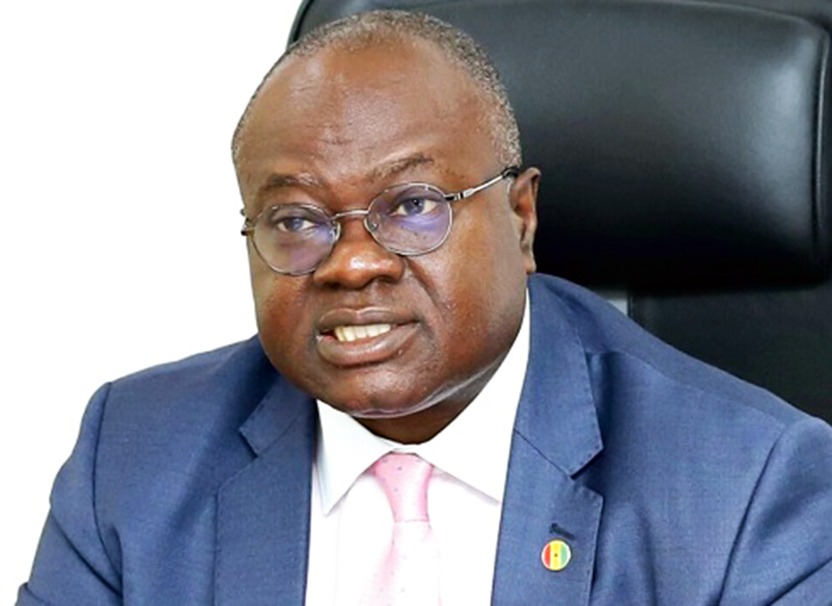
Addressing a press conference in Accra on Thursday, December 19, 2025 the Ranking Member of the Committee, Kwaku Ampratwum Sarpong, said the Ministry’s performance during the Third Meeting of the First Session of Parliament had fallen short of its constitutional mandate, particularly in the fight against illegal small-scale mining, popularly known as galamsey, and the governance of emerging green minerals.
According to the Minority, illegal mining continues to pose an “existential threat” to Ghana’s environment, agriculture, water security and public health, with cocoa farms destroyed, rivers chemically contaminated and forest reserves under sustained assault.
Mr Ampratwum Sarpong pointed to reports from mining-affected communities, naming the Ellembele Constituency, represented by the Minister for Lands and Natural Resources and the Bole Bamboi Constituency, represented by the Deputy Minister, as areas where galamsey activities have become deeply entrenched.
He said these areas had effectively become “headquarters” of illegal mining, with farmers losing livelihoods and communities bearing the social and environmental cost of what he described as state inaction.
While commending the Judiciary for assigning three High Court judges to handle cases submitted by the National Anti-Illegal Mining Operations Secretariat (NAIMOS), the Minority argued that enforcement on the ground remains weak. They cited instances where NAIMOS officers were attacked by illegal miners, equipment destroyed and operations disrupted, forcing withdrawals in some areas.
The Ranking Member questioned the impact of the judicial intervention if arrests and prosecutions were not pursued.
He claimed that in some cases, illegal miners arrested returned to the same sites within days, which he said pointed to weak prosecutions and ineffective enforcement that emboldens illegality.
The Minority further alleged selective enforcement, claiming that while small-scale miners are occasionally arrested, politically connected individuals linked to illegal mining continue to operate without consequence.
According to Mr Ampratwum Sarpong, reports of involvement by political figures are widespread at the community level, yet there have been no arrests, investigations or sanctions against such individuals.
Turning to the Barari DV lithium agreement, the Minority described the government’s handling of the deal as one of the most consequential resource governance issues facing the country.
They recalled that a revised ratification agreement was previously withdrawn following objections from the Minority and civil society, with assurances that a Legislative Instrument (LI) would deliver better financial returns and stronger governance outcomes.
However, the Minority said the substance of the deal remains unchanged, arguing that Ghana’s effective benefit under the revised framework remains at 5 percent, offering no material improvement over earlier proposals.
They described this as deeply concerning, especially as lithium is Ghana’s first green mineral and will set the benchmark for future critical mineral agreements.
The Ranking Member noted that the original Barari DV agreement was negotiated in October 2023 when lithium prices were about $2,250 per tonne and still provided for a 10 percent arrangement even when prices fell to around $800 per tonne by September 2024.
He argued that with prices having recovered to approximately $1,200 per tonne, reducing Ghana’s benefit to 5 percent was unjustifiable.
The Minority also accused the government of policy inconsistency, recalling that the governing party opposed the 10 percent arrangement while in opposition, but now defends a lower outcome in government on the basis that it is what the law allows.
Mr Ampratwum Sarpong argued that the same law gives the Minister discretion to negotiate better terms in the national interest.
Concerns were also raised about stakeholder engagement, with the Minority claiming that inputs from civil society, traditional authorities, mining communities and the Minority itself were not reflected in the final Legislative Instrument laid before Parliament.
They warned that consultations that do not influence outcomes risk becoming mere box-ticking exercises.
On royalty regulations, the Minority criticised the lack of transparency surrounding the Minerals and Mining Royalty Regulations, 2025 saying Parliament had not been provided with the data models, price assumptions or revenue simulations that informed the variable royalty bands for gold, lithium and other minerals.
The Minority cautioned that weak enforcement against illegal mining, inconsistent negotiation outcomes on lithium and opaque royalty regulations raise serious questions about whether Ghana’s national interest is being adequately protected.
They warned that Parliament may be compelled to invoke its constitutional powers, including a possible motion of censure under Article 82, if corrective action is not taken.
Mr. Ampratwum Sarpong called on the Minister for Lands and Natural Resources to urgently correct course by ensuring even-handed enforcement against illegal mining, renegotiating lithium agreements to secure better value for Ghana, and adopting transparent, data-driven royalty regulations in consultation with affected communities.