A senior official of the Ghana Health Service (GHS) has moved to dispel persistent misconceptions about vaccines, especially the belief that giving children multiple vaccines at a time can overload their immune system.
According to him, decades of scientific evidence show that vaccines remain safe and effective whether administered individually or in combination.
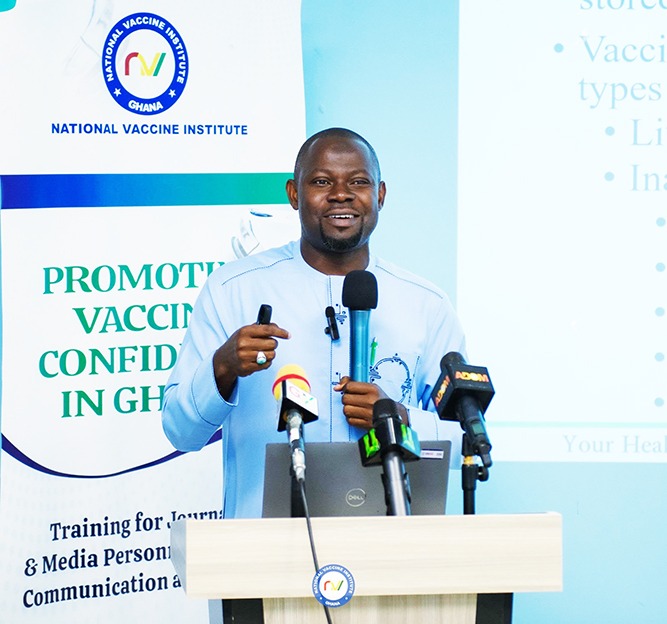
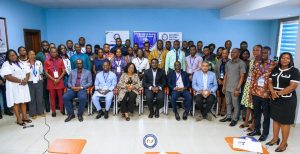
Dr. (Med) Naziru Tanko Mohammed, Deputy Programme Manager of the Expanded Programme on Immunisation (EPI), made this clarification during a two-day capacity-building workshop for journalists and media personnel, organised by the National Vaccines Institute (NVI), in partnership with AMMEREN.
The training was aimed at promoting vaccine confidence in Ghana through accurate public education and strengthened media engagement.
Dr Mohammed emphasised that multivalent vaccines – those that combine protection against several diseases in one vial, have been proven to work just as safely and effectively as single-disease vaccines.
He explained that scientific studies consistently show no increased risk of harmful side effects when vaccines are administered together.
“This widely circulated claim that multiple vaccines can overwhelm a child’s system is simply not true.
“Vaccines under the EPI remain safe whether given separately or combined, as seen with the measles-rubella vaccine,” he noted.
Addressing confusion about vaccine intervals, he explained that certain vaccines such as Pentavalent, Oral Polio Vaccine (OPV), Measles-Rubella (MR), Pneumococcal Conjugate Vaccine (PCV) and Rotavirus require several doses administered at intervals of not less than four weeks.
He stressed that administering these doses earlier than four weeks reduces their effectiveness and such doses must be repeated.
He added that missing a scheduled dose does not invalidate the entire vaccination process. In such cases, immunisation should simply continue from the point where it was interrupted, without restarting the series.
Although delays do not weaken the overall immune response, they prolong the period during which a child remains unprotected.
For this reason, he urged caregivers to follow the recommended schedule closely.
Ghana’s Immunisation Success Story
Dr. Mohammed highlighted the remarkable progress Ghana has made through its immunisation programme over the years. Ghana has successfully eliminated neonatal tetanus since 2011 and has not recorded a single case of wild poliovirus since 2008. The country also went nearly two decades without a documented measles death—from 2003 to 2021—while recording significant reductions in childhood pneumonia and diarrhoea cases.
He noted that no case of meningitis caused by Neisseria meningitidis A has been recorded since the Men A vaccination campaign in 2012 and its subsequent introduction into routine immunisation in 2016. These achievements have contributed significantly to strengthening the health system and have helped reduce under-five mortality from 111 deaths per 1,000 live births in 2003 to 40 per 1,000 in 2022.
Despite these gains, the national immunisation programme continues to face several systemic and logistical challenges. These include Ghana’s heavy dependence on external partners—particularly Gavi, the Vaccine Alliance—for both vaccines and operational support, even as the country is expected to transition away from Gavi support by 2030.
Dr. (Med) Naziru Tanko Mohammed also pointed to the frequent breakdown of cold-chain equipment at the district and health facility levels, which affects the storage and potency of vaccines.
He further revealed that Ghana still experiences disparities in vaccination coverage between districts, with urban and peri-urban areas reporting large numbers of children who are left out of routine immunisation.
In addition, healthcare workers face burnout due to the increasing burden of responding to multiple outbreaks such as cholera, polio, yellow fever and measles.
Rising anti-vaccine activism, misinformation, disinformation and low acceptance of adult vaccines also continue to undermine public health efforts.
A Critical Role for Journalists
Dr. Tanko Mohammed underscored the central role the media must play in sustaining public confidence in vaccines.
He urged journalists to commit to providing accurate information on immunisation, including the benefits of vaccines, the diseases they prevent and the locations and schedules for vaccination services.
He encouraged journalists to actively counter misinformation and myths, and to use town hall meetings, community engagements, blogs, social media platforms and other channels to bring credible information directly to the public.
He called on media practitioners to position themselves as immunisation ambassadors and champions, noting that their work is essential to building and maintaining public trust in vaccination programmes.
“Our progress is undeniable, but keeping these gains requires collective responsibility. Journalists are critical partners in eliminating vaccine-preventable diseases. This is a clarion call for all stakeholders to come onboard,” he said.
For more news, join The Chronicle Newspaper channel on WhatsApp: https://whatsapp.com/channel/0029VbBSs55E50UqNPvSOm2z