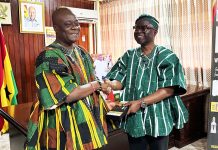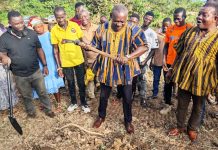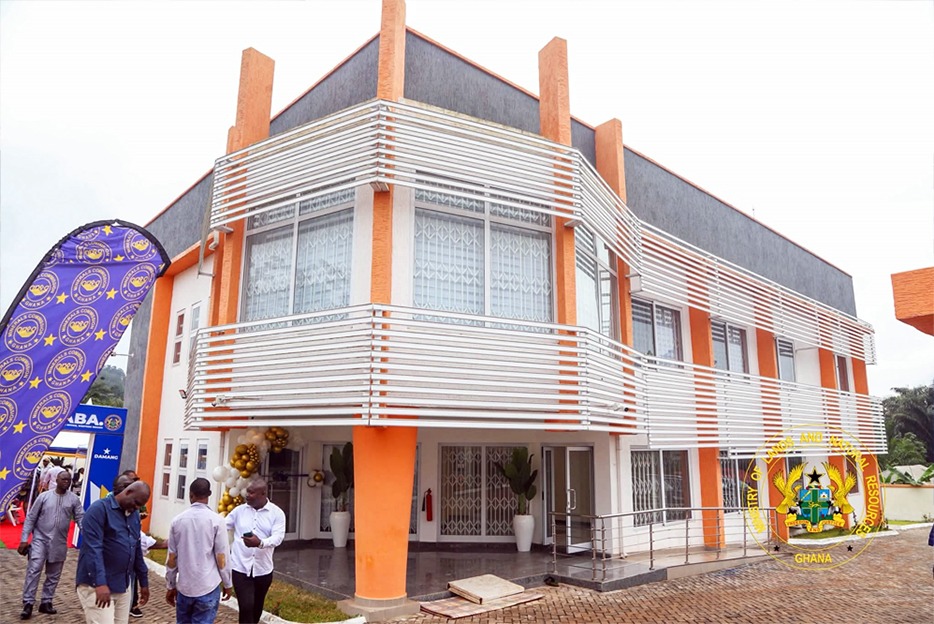
The Minerals Commission has opened a modern GH¢12.3 million district office at Damang, in the Prestea-Huni Valley Municipality of the Western Region, as part of efforts to decentralise the administration of Ghana’s mineral resources and bring regulatory services closer to mining communities.
The facility, commissioned by the Minister for Lands and Natural Resources, Emmanuel Armah-Kofi Buah, is expected to serve as a major operational center for the Commission in the Western Region, providing services including mining licensing, inspection, technical support and monitoring of environmental and safety standards.
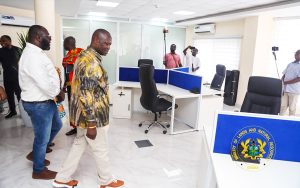
The commissioning ceremony was attended by the Member of Parliament for Prestea-Huni Valley, Robert Wisdom Cudjoe; the Member of Parliament for Tarkwa-Nsuaem, Sheikh Salifu Taylor; the Chief of Damang, Nana Kweku Armah; the Chief Executive Officer of the Minerals Commission, Isaac Andrew Tandoh; the Deputy Chief Executive Officer, Emmanuel Animah; traditional leaders, mining industry stakeholders and staff of the Commission.
Speaking at the ceremony, Mr. Tandoh said the establishment of the Damang office marked a significant milestone in the Commission’s efforts to transform the governance and administration of Ghana’s mineral resources.
He said the Commission was determined to change the long-standing perception that it was a distant regulatory institution operating primarily from Accra.
“For far too long, the perception has been that the Minerals Commission operates as a distant regulatory authority in Accra. We want that narrative to change today,” he said.
According to him, the Commission’s mandate under the Minerals Commission Act, 1993 (Act 405), required more than oversight from the national capital, but demanded a strong presence in the communities and mining hubs that drive the country’s mineral economy.
Mr Tandoh said the decentralisation programme was, therefore, intended to move the Commission away from a highly centralised system of administration and bring regulatory services directly to mining communities.
He described the Damang office as a “pivotal nerve center” for the Commission’s operations in the Western Region, saying its presence would make essential services more accessible to mining companies, communities and other stakeholders.
He explained that residents and industry players would now have easier access to services relating to licensing, inspections, technical support and the monitoring of environmental and safety standards without having to travel to Accra.
“This is not merely a building. It’s about decentralising access to key activities of the Commission so that people are incentivised to do the right thing, obey the laws and work within the confines of the regulations,” he stated.
The CEO also emphasised the importance of local content in the mining sector, saying the Commission wants people in mining communities, such as Damang, to have a genuine stake in the country’s mineral resources.
He said local content should go beyond being a regulatory requirement and become a strategic tool for creating employment, promoting Ghanaian ownership and opening opportunities for local entrepreneurs.
“We are also ready to enforce the law, support genuine investors and empower Ghanaian entrepreneurs,” Mr. Tandoh said.
He charged staff who would operate from the new facility to uphold professionalism, honesty, integrity and transparency in the discharge of their duties.
He assured residents of Damang and the Western Region that the Commission was now closer to them and ready to work with stakeholders towards a prosperous and sustainable mining industry.
Giving an overview of the project, the Deputy CEO of the Minerals Commission, Emmanuel Animah, said the construction of the Damang District Office was part of the Commission’s broader efforts to strengthen its institutional capacity and improve service delivery to mining communities.
He said the project was financed through the Commission’s Internally Generated Funds (IGF), demonstrating its commitment to using internally generated resources prudently to develop infrastructure that would provide long-term value to the institution.
Mr Animah disclosed that the total cost of the completed project was GH¢12.3 million and expressed appreciation to the Damang Traditional Council for donating the land on which the facility was constructed. He described the gesture as evidence of the strong partnership between traditional authorities and the Minerals Commission.
The project was executed by MSC Aquila International, as the contractor, while MSC Fasota Limited served as the consultant.
The Deputy CEO said the facility was designed to provide permanent, suitable and modern office accommodation to enable the Commission to effectively discharge its regulatory mandate within Damang and surrounding communities.
The facility includes administrative offices, meeting rooms, a public reception area, parking facilities, washrooms, storage spaces and other essential building services.
The construction works covered the site preparation, substructure and superstructure, roofing, installation of doors and windows, electrical, plumbing and mechanical works, as well as internal finishing, painting, tiling and ceiling works.
External works included drainage, landscaping, paving and parking facilities, followed by testing, commissioning and handover.
The project commenced on March 8, 2024 and was originally scheduled for completion on February 7, 2025 representing an expected construction period of 11 months.
The facility was eventually completed and handed over on April 28, 2025 after a total construction period of 13 calendar months.
He urged management and staff of the Minerals Commission to take good care of the facility and use it responsibly, stressing that it was a public asset belonging to the people of Ghana.
“Today, we are not merely commissioning a building. We are commissioning an investment in the future of the Minerals Commission and in the quality of service that we provide to the people of Ghana,” he said.
He added that the GH¢12.3 million investment represented a long-term institutional asset that should be preserved for present and future generations.
For more news, join The Chronicle Newspaper channel on WhatsApp: https://whatsapp.com/channel/0029VbBSs55E50UqNPvSOm2z