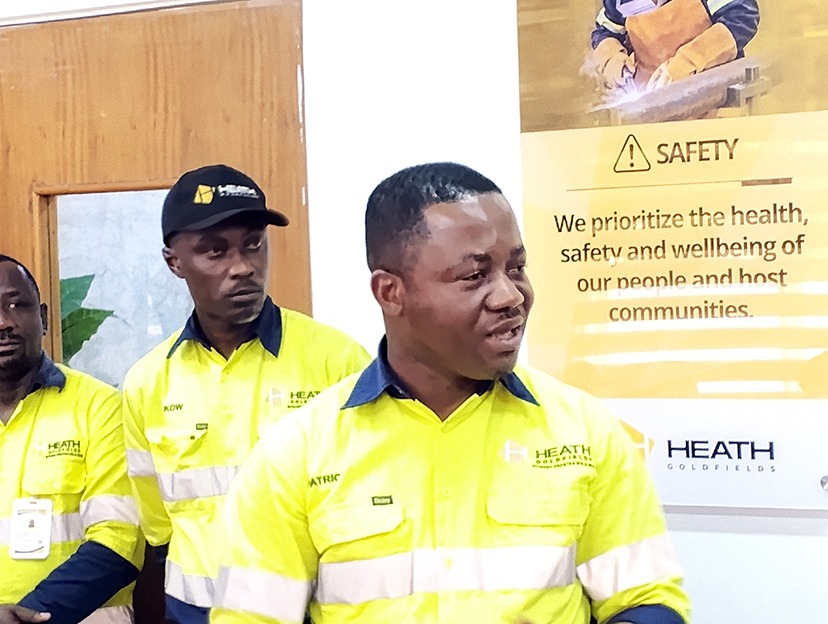
Heath Goldfields, the indigenous mining company operating the Bogoso-Prestea Mine, is targeting the first quarter of 2027 to resume underground mining as it intensifies efforts to dewater and rhabilitate the flooded Prestea underground mine.
The Managing Director of the company, Engineer Patrick Appiah Mensah, stressed the company was pumping an average of 10 million litres of water daily from the underground mine as part of an extensive rehabilitation programme to restore operations.
He said the water level, which had risen significantly before the company took over the mine, had been reduced beyond levels 18, 19 and 20, with the company targeting level 21 as the safe point for the resumption of mining.
Ingineer Appiah Mensah explained that the company had deployed more than 120 workers to the Prestea underground mine to undertake rehabilitation, maintenance and dewatering activities.
He said the exercise, which started in August, last year, was being sustained daily to ensure that the underground workings were safe for mining.
The Managing Director disclosed this when he addressed the Advisory Committee of the Ministry of Lands and Natural Resources, which visited the mine to familiarise itself with the company’s operations and assess progress made since it assumed control of the asset.
According to him, the underground mine represents one of the company’s most important strategic projects, with its reopening expected to increase production, create additional employment and improve the economic fortunes of the surrounding communities.
“We cannot wait to get the underground mine operational,” he said, adding that the company was undertaking several complementary projects to ensure that operations could resume once the water reached the required safe level.
As part of the preparations, Mr Appiah Mensah said the company had ordered new underground mining equipment from Peru, which was expected to arrive in the first quarter of 2027.
He disclosed that members of the company’s technical team had already travelled to Peru to inspect and verify the equipment before shipment.
The rehabilitation programme also includes maintenance of underground railway systems used by locomotives to transport ore from the various mining sections, as well as repairs to the winder headgear and other critical infrastructure.
He said the various activities were being coordinated to ensure that the underground mine was fully prepared for the planned reopening.
$194m invested in mine revival
Mr Appiah Mensah said Heath Goldfields had invested approximately US$194 million in restoring the Bogoso-Prestea mine since taking over the asset, which he described as being in a distressed condition.
He explained that the company did not inherit an operational mine but rather an asset that had suffered years of neglect, with electricity disconnected, processing facilities deteriorating, workers owed salaries and contractors demanding payment for services rendered.
The situation, he said, had also allowed illegal miners to occupy portions of the concession, creating additional security and operational challenges.
He said the company had since restored operations across the various sections of the mine, including the open-pit operations and processing facilities.
The Managing Director disclosed that the company had mined approximately 10.6 million tonnes of ore from its open-pit operations at Bondaye and Bogoso, while the underground rehabilitation continued.
He said the company had also settled approximately US$22.3 million in outstanding workforce-related liabilities inherited from the previous operator, including unpaid salaries, severance payments and pension contributions.
According to him, no former worker was currently owed money by the company in respect of those inherited liabilities.
Local participation in mining
The Managing Director said the company had engaged Ghanaian mining contractors, including a community-based cooperative known as Locoms, to undertake mining activities at Prestea and Bondaye.
He explained that the arrangement involved organising local people into a cooperative, strengthening their capacity and providing them with a mining contract to participate directly in the operation.
He said the initiative was intended to ensure that host communities were not merely recipients of corporate social interventions but active participants in the mining business.
Mr Appiah Mensah further disclosed that the company had about 2,007 people working at the mine, with approximately 72 per cent drawn from communities within its operational catchment area.
He said the workforce included both direct employees and personnel engaged through mining, drilling and maintenance contractors.
He added that the company was also working to improve female representation, which currently stood at about 11 per cent.
Community development and sustainability
Beyond its mining operations, Mr Appiah Mensah said Heath Goldfields had launched a five-year, US$20 million community development programme targeting education, healthcare, infrastructure and enterprise development.
He said the programme was designed following engagements with host communities to identify and prioritise their development needs.
He also disclosed that the company had undertaken approximately US$65 million in in-country procurement during its first year of operations, with US$25.1 million spent on businesses and suppliers within its local catchment communities.
The company, he said, was also pursuing plans to expand the existing 1,200-hectare oil palm plantation inherited from previous operators and develop an oil-processing facility in partnership with Malaysian investors.
The proposed facility is expected to process harvested palm fruits into oil for industrial use, while the broader agricultural initiative would explore other farming and livestock opportunities to support food production and employment.
Mr Appiah Mensah said the company’s long-term objective was to ensure that mining created sustainable economic opportunities that would continue benefiting host communities even after mineral extraction ended.
He noted that the Bogoso-Prestea mine had produced an estimated nine to 11 million ounces of gold since operations began in 1912, making it a significant national asset whose revival was important to both the local and national economies.
He said Heath Goldfields was committed to demonstrating that indigenous Ghanaian companies could successfully mobilise investment, operate major mining assets and deliver lasting benefits to the country.