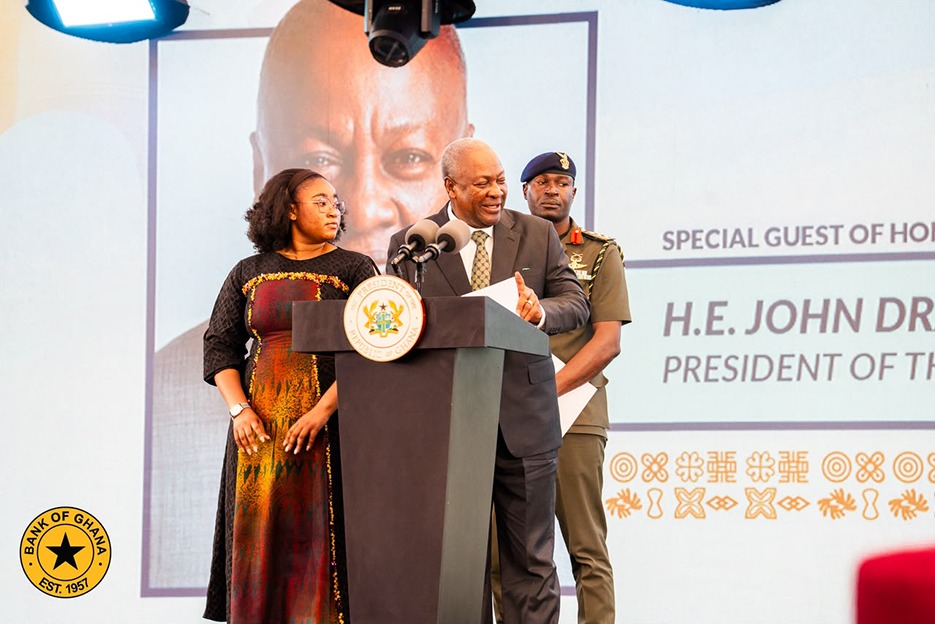
President John Dramani Mahama has called on Ghanaians to regard the cedi as a national symbol that transcends political, religious and other affiliations, saying the currency belongs to all citizens irrespective of the government in power.
He said the cedi should not be identified with any political party or used as a basis for political division, but rather recognised as a shared national asset that reflects the country’s identity, history and aspirations.
“The cedi knows no political parties. It knows no religion. It belongs to all of us,” he said.
President Mahama was speaking at the official launch of the Ghana Heritage Series banknotes at the Bank of Ghana’s headquarters, The Bank Square, in Accra, on Thursday, November 12, 2026.
The launch was held under the theme: “The Cedi, Our Future: Secure and Designed to Last.”
The President said the cedi was more than a medium of exchange, describing it as an important representation of Ghana’s sovereignty, heritage and collective identity.
He said the introduction of the new banknotes provided an opportunity for the country to reflect on its monetary history and appreciate the cultural significance of its currency.
He recalled that before the introduction of modern currency, cowrie shells were used in trade and exchange in parts of the country, noting that the name cedi was itself derived from the Akan word “sedie”, meaning cowrie shell.
According to him, the country’s monetary history was closely connected to its cultural heritage, making the redesign of the banknotes an opportunity to celebrate aspects of Ghana’s past, while looking towards the future.
He said the new notes were designed to tell a Ghanaian story and recognise the personalities, places and cultural symbols that had contributed to the country’s development.
President Mahama described currency as a “quiet ambassador” for a country, explaining that banknotes often communicate a nation’s history and identity to people who encounter them.
He said the images and symbols carried on the notes could therefore serve as reminders of the country’s heritage and the contributions of those who had helped shape its national journey.
The President urged Ghanaians to appreciate the new banknotes beyond their monetary value, saying they represented a common national identity that should be protected and respected.
He also used the occasion to link the future of the cedi to the country’s economic transformation agenda, stressing that the stability of the currency depended partly on Ghana’s ability to strengthen domestic production and reduce its reliance on imported goods.
He said the government was pursuing a $10 billion, four-year economic programme aimed at transforming the country’s productive capacity and building a stronger economy.
Under the programme, he said, Ghana would have to produce more of what it consumed, process more of its agricultural produce and natural resources, and expand its exports.
The President said the country could not sustainably strengthen its currency while remaining heavily dependent on imports and continually requiring foreign exchange to purchase goods that could be produced locally.
He argued that increasing domestic production and adding value to local resources would help reduce pressure on foreign exchange demand while creating opportunities for businesses and workers.
“We must produce more of what we consume,” he said.
He stressed the need for Ghana to move beyond exporting raw materials and importing finished products, saying greater investment in local processing and manufacturing was necessary to build a more resilient economy.
According to him, processing more of the country’s agricultural produce and natural resources would enable Ghana to retain greater value from its resources, expand its productive base and improve its capacity to earn foreign exchange.

President Mahama said the economic programme would be supported by disciplined public financial management and credible monetary policies.
He explained that economic stability required consistency in the management of public finances and policies that strengthened confidence in the economy.
He, however, cautioned against assessing the strength of the cedi solely through economic figures and indicators, saying its performance must ultimately translate into improvements in the everyday lives of Ghanaians.
He said the benefits of a stable currency should be reflected in the purchasing power of households, the cost of goods and services, and the confidence of businesses and consumers.
The President said the country’s economic direction must therefore focus on building an economy in which growth and stability were experienced by ordinary citizens.
On the redesigned banknotes, President Mahama said the new series had been developed with improvements intended to enhance their durability and make them more convenient for everyday use.
He said the notes were produced using reinforced cotton paper and designed to last longer, while their smaller sizes would make them easier to handle and carry.
He said the improvements were also intended to ensure that the currency remained suitable for everyday transactions as Ghana’s financial system continued to evolve.
The President noted that although digital payments were increasingly becoming part of daily economic activity, physical cash remained important to many Ghanaians and continued to play a significant role in the country’s economy.
He said the redesign of the notes was therefore necessary to ensure that physical currency remained secure, durable and fit for purpose.
He also clarified that the introduction of the Ghana Heritage Series did not mean that the existing banknotes would immediately become invalid.
Rather, the new notes would circulate alongside the existing ones, with the Bank of Ghana gradually withdrawing the old series as the new banknotes became more widely available.
President Mahama said the gradual transition would allow the new currency to enter circulation without unnecessarily disrupting transactions and the daily activities of businesses and individuals.
He commended the Bank of Ghana for the work involved in developing the new series and acknowledged the institution’s role in maintaining the country’s monetary and financial system.
He also highlighted the importance of building local expertise and institutional capacity, saying Ghanaian institutions should continue to develop the knowledge and technical capabilities required to manage national responsibilities.
The President’s remarks came as the Bank of Ghana approaches its 70th anniversary in March 2027. The institution was established on March 4, 1957, shortly before Ghana attained independence.
He said the Bank’s history was closely linked to the country’s economic development and its efforts to establish and maintain a national financial system.
President Mahama urged citizens to handle the cedi responsibly, saying the currency was a shared national asset that should be treated with respect.
He said the political and economic fortunes of successive governments should not determine how Ghanaians regard their national currency.
The President maintained that the cedi belonged to the country as a whole and should remain a symbol of unity, national pride and shared responsibility.
He said the new banknotes should remind citizens of their common heritage and the need to work collectively towards a stronger economy.
The Ghana Heritage Series forms part of efforts to refresh the country’s banknotes while retaining the cedi’s role as the national currency.
For more news, join The Chronicle Newspaper channel on WhatsApp: https://whatsapp.com/channel/0029VbBSs55E50UqNPvSOm2z