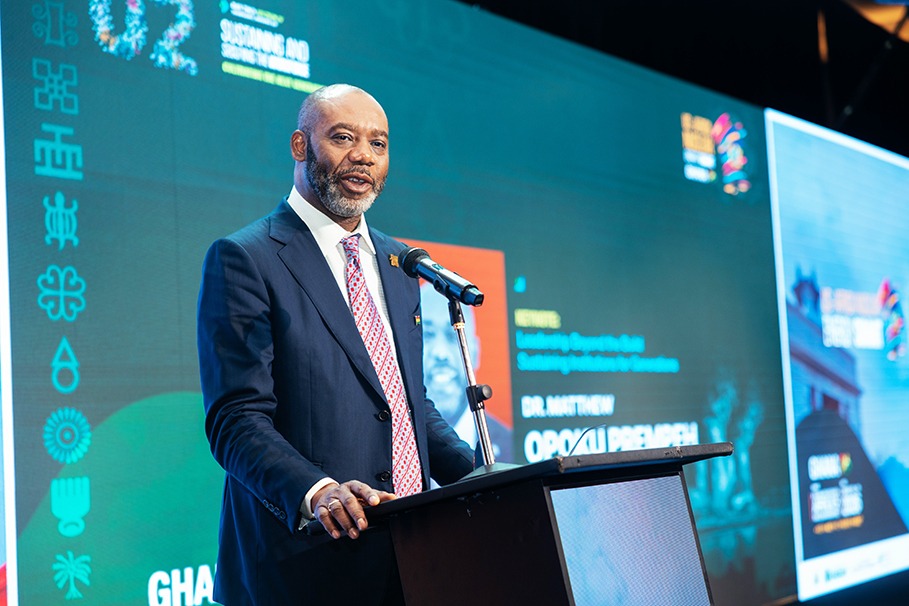
Dr. Matthew Opoku Prempeh, the former Ghanaian Minister for both Education and Energy, has challenged the Nuclear Energy industry to look past the immediate engineering feats of reactor construction.
He was delivering the keynote address at the 2026 US-Africa Nuclear Energy Summit, a high-profile Pan-African event held in Accra and organised by the United States. The summit was dedicated to the future of nuclear power on the continent.
The theme of the summit, which brought together global experts, including representatives from the Atlantic Council was: “Building and Sustaining Africa’s Nuclear Workforce,” and was meant to chart a course for energy independence.
Dr. Opoku Prempeh argued that while the “build” is essential, the true challenge lies in the long-term survival and excellence of the institutions that will manage these facilities for decades to come.
Dr. Prempeh, popularly known as NAPO, while presenting his keynote address, titled “Cultivating the Next Generation of Leaders; Leadership Beyond the Build – Sustaining Institutions for Generations”, yesterday asserted that “nuclear begins in the classroom”.
Leveraging his unique experience at the helm of Ghana’s educational and energy sectors, he emphasised that a successful nuclear programme is a direct product of a nation’s talent ecosystem and advocated for a foundational approach where the youth are prepared from an early age to meet the rigorous demands of this specialised field.
NAPO observed that across the continent, “nuclear ambition is real,” driven by a collective desire for “low-carbon energy” and the strategic utilisation of Africa’s abundant uranium sources.
He, however, cautioned that this ambition cannot be realized without a clear-eyed focus on human capital, emphasising that the transition to nuclear power is not merely a technical shift but a socio-economic evolution that requires a robust and homegrown workforce.
The session highlighted a stark warning: the “greatest system risk” currently facing the global nuclear industry is the “workforce gap”.
Dr. Prempeh noted that without a deliberate strategy for “sustaining and securing the workforce,”even the most advanced projects risk failure. He urged leaders to move beyond reactive hiring and instead focus on proactive, long-term talent retention and development.
He proposed a solution that involves “training people for the future to lead,” rather than just to operate. This distinction, Napo argued, is critical, and the industry must identify and nurture individuals who can navigate the complex regulatory and geopolitical landscapes of the future.
The former Energy Minister said that by establishing “clear progression routes,” African nations can inspire their brightest minds to pursue lifelong careers in the nuclear sector.
To achieve this, Dr. Prempeh called for the development of a “single pool of talents” that integrates traditional nuclear science with cutting-edge digital disciplines.
He specifically identified “cyber security, data analytics, and Artificial Intelligence (AI)” as essential skills for the modern nuclear professional whose multidisciplinary approach ensures that the workforce is equipped to handle the complexities of a 21st-century energy grid.
The keynote address also emphasised that “leadership goes beyond technical excellence”. While technical proficiency is a non-negotiable baseline, the next generation of leaders must also possess “digital leadership” qualities, which involve a sophisticated understanding of how technology and policy intersect, ensuring that nuclear institutions remain ethical, transparent, and efficient.
Dr. Prempeh emphasised that collaboration remains a vital piece of the puzzle, stating that “partnerships must accelerate” between African nations and international allies.
He called for “progressive technology transfer” and stressed the need for nations to “legislate” comprehensive frameworks that ensure safety and security.
These global ties, exemplified by the involvement of the U.S. Department of Energy and the Atlantic Council, are necessary to bridge the technical divide, Dr, Prempeh noted.
Dr. Prempeh’s concluding remarks focused on the importance of “localisation” as a means of ensuring sustainability.
He argued that for nuclear energy to truly benefit the continent, it must be supported by local expertise and advocacy by empowering the youth to move from “followers to change makers,” to enable Africa to build a nuclear legacy that is not only technically sound but also fundamentally its own.
By Mohammed T. Kataba
For more news, join The Chronicle Newspaper channel on WhatsApp: https://whatsapp.com/channel/0029VbBSs55E50UqNPvSOm2z