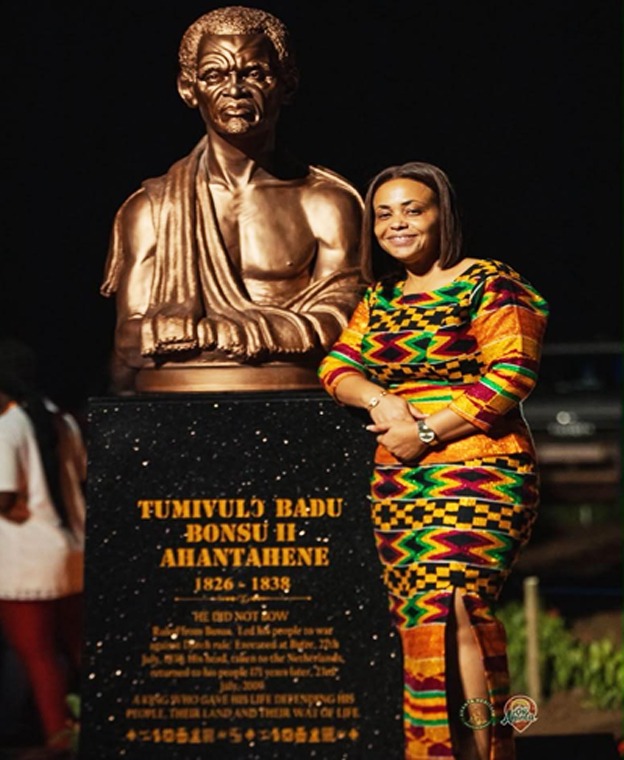
History came alive on the evening of Monday 27th July, 2026 as a statue of Otumfuo Nana Badu Bonsu II, the Ahantahene who was executed by Dutch colonial forces in 1838, was unveiled before a gathering of chiefs, government officials, diplomats and residents.
The unveiling formed the climax of Ahanta Heritage Month, a month-long celebration that culminated in a grand Chiefs’ Durbar and the official unveiling of the Nana Badu Bonsu II sculpture, held as a historic tribute to one of Ahanta’s most revered traditional leaders whose legacy remains central to the political and cultural history of the Ahanta people.
The month-long programme was organised by the Member of Parliament for the Ahanta West Constituency, Mavis Kuukua Bissue, who has been a vocal advocate for preserving the memory of the fallen king, including championing calls in Parliament for a dedicated museum to house his repatriated remains.
The imposing bust, mounted on a black granite pedestal inscribed with the words ‘He Did Not Bow,’ captures the king in regal cloth, his gaze fixed and unflinching; a fitting tribute to a monarch remembered for leading his people against Dutch rule rather than submit to it. The inscription notes his reign from 1826 to 1838, his execution at Butre, and the return of his head to his people 171 years later, on the 23rd of July.
Otumfuo Nana Badu Bonsu II’s story is one of the most haunting chapters in Ghana’s colonial history. He led the Ahanta people, who had migrated south and separated from the Fante people upon reaching the Pra River, and was executed in 1838 by the Dutch, who at the time controlled the Dutch Gold Coast. In 1837, he had rebelled against the Dutch administration and killed several of its officers, including the acting governor. The Dutch responded by mobilising an expeditionary force; the king was captured, tried and hanged.
Monday’s ceremony drew a cross-section of traditional, political and diplomatic dignitaries. Prominent among those present were the Tufohene of the Badu Bonsu Stool, Odwenfo Nana Edzieku IV; the Paramount Chief of Upper Dixcove, Nana Agyeman; and the Divisional Chief of Henakrom, Nana Ndzafram, each representing the layered structure of Ahanta traditional authority that has kept the memory of the fallen king alive across generations.
Government was represented by the Deputy Minister for Local Government, Chieftaincy and Religious Affairs, Rita Naa Odoley Sowah, alongside Nii Lantey Vanderpuye, both of whom joined residents in paying tribute to a monarch whose resistance against colonial subjugation has increasingly been held up as a symbol of Ghana’s broader struggle for self-determination.
Adding an international dimension to the evening was the presence of Suriname’s local ambassador to Ghana, H.E. Fidelia Graand-Galo and H.E. Juliette Bynoe-Sutherland, the Barbados’ High Commissioner to Ghana; a reminder of the wider diaspora threads that bind the story of Ahanta’s resistance to the shared history of the African descendants scattered by the colonial and slave-trading era.
Also in attendance was a delegation of women in vivid kente, among them a striking rendering of the national colours, standing proudly beside the newly unveiled bust, a generation once removed from the king’s own era, but visibly moved by the weight of the moment.
Organisers say the statue is intended to be far more than a static memorial. Ahanta Heritage Month itself was conceived as an enduring platform for preserving history, promoting cultural tourism, strengthening community identity and creating economic opportunities for residents,unlike traditional cultural festivals built solely around entertainment, it was designed around a development-oriented approach that weaves together economic empowerment, education, tourism, health and cultural preservation into a single comprehensive programme.
The month’s events had begun over a week earlier with a business summit aimed at entrepreneurs and investors, an inter-schools quiz competition testing students’ knowledge of Ahanta history, a free health screening exercise, and a street carnival featuring performances by some of Ghana’s leading musical acts all building toward Monday’s durbar and unveiling.
The statue’s siting along the busy Agona Nkwanta–Aboadze road was a deliberate choice, elders say, ensuring that both residents and travellers passing through the Ahanta West Municipality will forever be greeted by the image of the king who chose death over submission.
A Legacy Still Being Written
The unveiling comes at a significant moment for the Ahanta Traditional Area, only weeks after the enstoolment in Busua of a new Ahantahene, and amid ongoing national conversation, including calls raised on the floor of Parliament for a dedicated museum to permanently house the king’s repatriated remains and preserve his story for future generations.