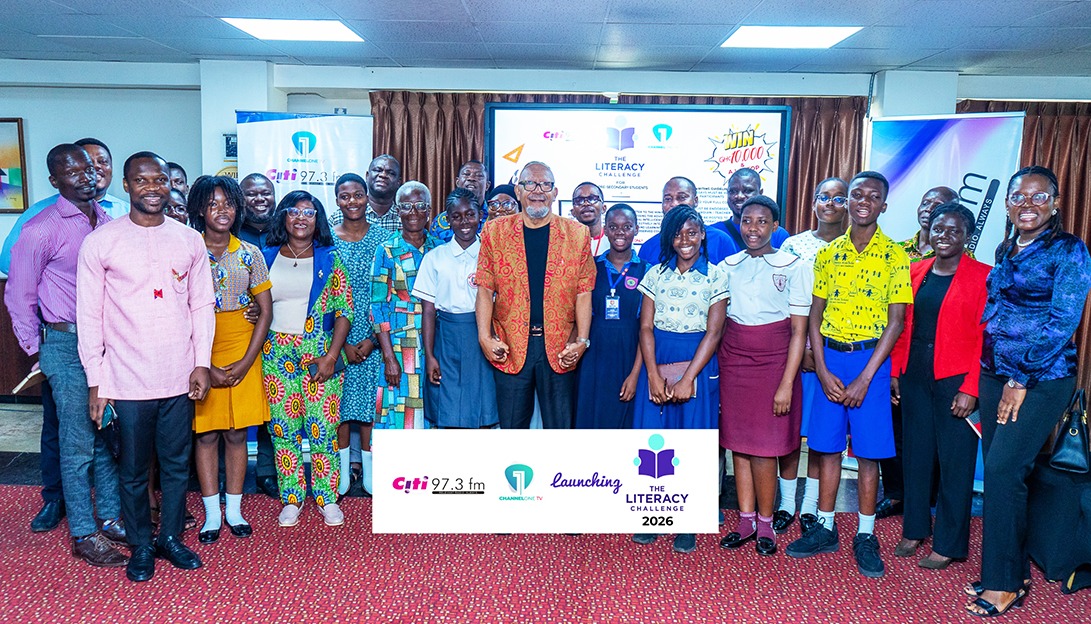
Channel One TV and Citi FM have officially launched the 2026 edition of the Literacy Challenge, unveiling a nationwide competition that will task young Ghanaians to examine the opportunities and risks of Artificial Intelligence (AI) in education while reinforcing literacy, critical thinking and creativity among students.
The organisers also announced an expanded national focus aimed at reaching children in underserved communities, a move that received strong backing from the Ghana Library Authority and the British Council.
Launching the programme, Acting Chief Executive Officer of the Ghana Library Authority, Alhassan Betintiche Ziblim, praised Citi FM and Channel One TV for sustaining the initiative for nearly two decades, describing it as a significant contribution to Ghana’s literacy agenda.
He said while promoting literacy and lifelong learning is the statutory responsibility of the Ghana Library Authority, the media organisations have consistently complemented government’s efforts through the Literacy Challenge.
“For us at the Ghana Library Authority, promoting literacy and lifelong learning among Ghanaians is our mandate. It is what we are assessed on. Yet Citi FM and Channel One TV have taken it upon themselves to champion this cause without government support, and that deserves commendation,” he said.
Mr. Ziblim particularly applauded the organisers for extending the competition beyond Ghana’s major cities, saying many educational interventions often fail to reach deprived communities.
“I do not believe Accra is Ghana. Ghana is bigger than Accra. Most initiatives are concentrated in Accra, Kumasi and Takoradi. But this programme is reaching communities beyond these cities, including places where I come from. That is a major achievement,” he stated.
According to him, students in rural communities often struggle with inadequate learning materials and limited access to quality teachers, making literacy interventions even more important.
To support the nationwide rollout, Mr. Ziblim announced that the Ghana Library Authority would make its library facilities across the country available to the organisers for regional activities.
“We want to make available our library spaces across the country to support the organisation of these programmes at the regional level so that together we can deepen literacy promotion and achieve even better outcomes,” he added.
Also speaking at the launch, Mr. Adjei Kwarteng, Project Support Officer at the British Council, reaffirmed the organisation’s commitment to initiatives that strengthen literacy and improve learning outcomes among young people.
He said literacy remains a key driver of educational advancement, social inclusion and national development, making partnerships such as the Literacy Challenge essential.
“The British Council recognises the critical role that collaborative and well-structured programmes such as the Literacy Challenge 2026 play in enhancing reading quality and improving learning outcomes among young people,” he said.
Mr. Kwarteng also welcomed the organisers’ decision to expand participation beyond Accra, noting that young people in the regions often demonstrate remarkable enthusiasm for educational opportunities.
“Most things happen in Accra, making it seem as though the other regions are not part of Ghana. But whenever you travel to those communities, the hunger for learning is incredible,” he said.
He recalled a recent programme in Tamale where participants had filled the venue an hour before the scheduled start, contrasting it with experiences in Accra where programmes often begin late due to low early attendance. “The British Council remains committed to supporting this initiative,” he assured.
Earlier, presenting the concept behind the 2026 Literacy Challenge, Apiorkor Seyiram Ashong-Abbey described the competition as the flagship Corporate Social Responsibility initiative of Citi FM and Channel One TV.
She said the programme seeks to promote literacy, numeracy, writing, creativity and critical thinking while nurturing young talents and encouraging excellence among Ghanaian children.
Although previous editions largely targeted Junior High School students, she explained that the competition now caters for all young people between the ages of 11 and 15 to encourage wider participation.
This year’s competition will be held in three stages. Participants will first submit an essay on an assigned topic, after which the top 100 contestants will sit for a written aptitude test in Accra. The best 48 contestants will then compete in the grand quiz stage in teams of three.
For the 2026 edition, contestants are expected to write a letter of not less than 600 words to the Minister for Education, acting as youth consultants. The essay should examine both the advantages and disadvantages of Artificial Intelligence in education and recommend how Ghana can integrate AI into basic schools while ensuring learners in rural and underserved communities are not left behind.
Entries must be submitted by July 20, 2026, either through P.O. Box GP 14123, Accra Central, or by hand delivery to the Channel One TV premises at Tesano.
Organisers say participating schools stand to benefit from national media exposure, improved writing and critical thinking skills, enhanced academic enrichment, increased student confidence and opportunities for national recognition, while the eventual winner will receive a cash prize, a trophy and the coveted title of Ghana’s most outstanding all-round student within the competition’s age category.
For more news, join The Chronicle Newspaper channel on WhatsApp: https://whatsapp.com/channel/0029VbBSs55E50UqNPvSOm2z