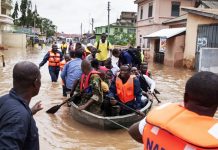
The Greater Accra Resilient and Integrated Development (GARID) programme has identified a filling station in Oyarifa sitting “directly on the water body”, describing the development as one of the human activities contributing to the recurrent flooding in parts of the Greater Accra Region.
The disclosure was made by the National Coordinator of GARID, Dr. Kwadwo Oheme Sarfo, during a national press briefing at the Jubilee House on the recent floods that affected seven regions, with Greater Accra, the Central and Volta regions recording the worst impact.
The revelation is expected to trigger questions over Ghana’s development approval regime, as filling stations are required to undergo environmental, spatial planning and other statutory approval processes before construction.
Presenting aerial footage captured during GARID’s assessment of waterways and wetlands, Dr. Sarfo pointed to the facility and said:
“The development that you see here is a filling station and it is sitting directly on the water body. Just a little channel has been allowed to pass under it to take the water. So when there’s going to be excess water, it will have to flow backwards and spill into the communities that are upstream.”
According to him, the filling station has constrained the natural flow of stormwater by leaving only a narrow passage beneath the structure for water to pass.
Dr. Sarfo explained that the obstruction forces excess runoff to reverse direction instead of flowing naturally downstream, increasing the likelihood of flooding in upstream communities during heavy rains.
He said the Oyarifa facility formed part of a broader pattern of developments that have encroached on waterways and wetlands across the capital.
Continuing his presentation, Dr. Sarfo stated:
“Here you can see that this is a retention area, a natural retention area, and people have built within it. Some of it you can see that they have, even though they’ve walled it, water is ponding inside the spaces that they have kept.”
He added that developers had adopted a common pattern of occupying wetlands.
“This property, there was a property there, a number of properties here, they are all… they fence it off, wait for dry season, then they build. They fence it off, wait for dry season, then they build. This is what’s going on in certain sections of Oyarifa.”
Dr. Sarfo stressed that the problem extends beyond the watercourse itself.
“So not just the water body, but the water body in combination with the wetlands that are associated with them.”
He warned that as natural wetlands and flood retention areas continue to disappear, floodwaters are left with little room to spread without affecting surrounding communities.
The GARID Coordinator maintained that the flooding witnessed in recent years is increasingly being driven by human activities that obstruct natural drainage systems.
“The whole society’s attitude and behaviour… is affecting everybody.”
The briefing formed part of government’s national update on the floods that recently affected seven regions, with Greater Accra, the Central Region and the Volta Region identified as the worst-hit areas.
For more news, join The Chronicle Newspaper channel on WhatsApp: https://whatsapp.com/channel/0029VbBSs55E50UqNPvSOm2z