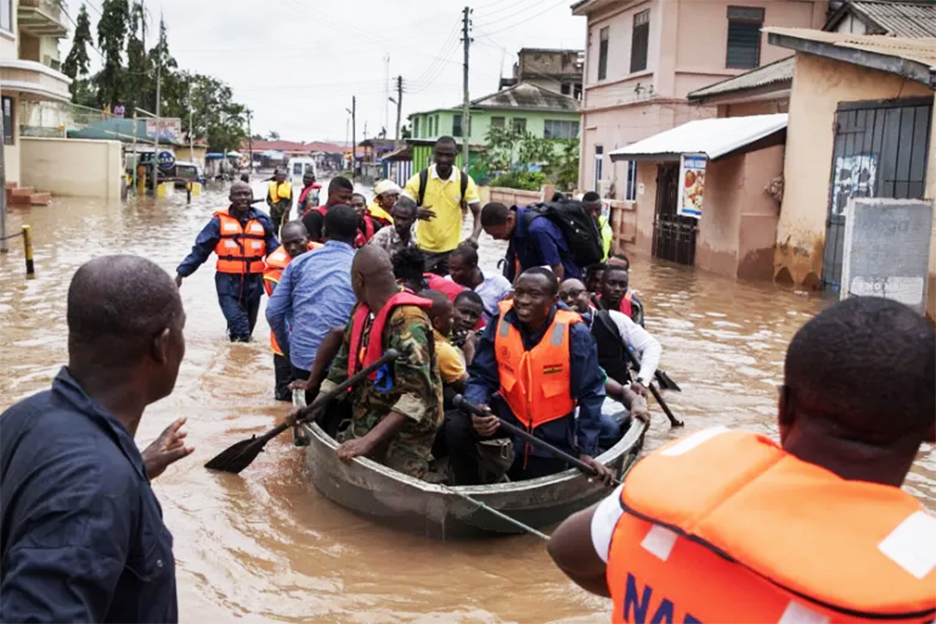
More than 10,000 structures have sprung up within the 25-metre statutory buffer zones of major watercourses across just 16 assemblies studied, a survey by the Greater Accra Resilient and Integrated Development (GARID) programme has found — a key driver, officials say, behind the flooding that has devastated seven regions of the country.
Speaking at a news conference at the Jubilee House on the national flood situation, GARID Coordinator Dr. Kwadwo Ohene Sarfo, said an assembly-by-assembly analysis of short stretches of drainage across the affected areas had counted 10,497 structures built within buffer zones the law requires to be kept free of development.
“We have lost around 16% of the land [in these buffer zones], and thereby leading to the situation as we face it,” Dr. Sarfo told reporters, presenting satellite imagery and drone footage spanning more than two decades to illustrate the scale of encroachment on wetlands, streams and storm drains.
Worst-hit regions
The floods have struck roughly seven regions nationwide, with Greater Accra, Central Region and Volta Region bearing the brunt of the damage, according to the briefing.
A river reduced to a tenth of its width
Dr. Sarfo cited the Corridor Stream, which feeds into the Chippago, as a stark illustration of the decline. At a fixed monitoring point, the watercourse measured 261 metres wide in 2002. By 2013 it had narrowed to 211 metres; by 2022, to just 19 metres; and by 2026, to 10.6 metres.
“In a space of less than 25 years, we have reduced almost to 100% the size of the flow — until when it rains and people are complaining that it’s flooding,” he said.
Wetlands lost to development
The presentation traced similar losses across multiple catchments. In the Nensu Weja Basin, roughly half the Tetegu Wetlands have been developed since 2010, while in the Lafa Basin’s Malam Market section, more than half the wetland has been taken up by development over the same period. Around the Pambrose salt pans, large sections have been filled with solid waste, capped with laterite and built upon. At the Tessa Dam on the East Legon Boundary Road, more than 50% of the catchment has been lost since 2008, and the Sacramento Basin has seen more than half its site lost to development since 2011. The Sakumono Ramsar site, meanwhile, once extended as far as Community 12 in the mid-1980s, but has since shrunk considerably as Communities 12 and 6, parts of 5 and 3, and Klagon were built over.
Dr. Sarfo said the pattern of encroachment typically begins with developers importing fill material during the dry season, then constructing buildings once the land is raised — often forcing watercourses to meander or bend at sharp angles around new buildings rather than follow their natural course.
Structures on the rise, assembly by assembly
GARID’s assembly-level counts showed sharp increases in structures within buffer zones between 2022 and 2026. Ablekuma West rose from 904 structures to 1,293, while Ga North climbed from 1,049 to 1,261. Okaikwei North increased from 596 to 729, and Ga South from 746 to 801.
Weija-Gbawe grew from 462 to 511 structures, and Ledzokuku from 544 to 638. La Dade Kotopon nearly rose from 207 to 295, while Ga West increased from 456 to 559. Ashaiman East saw a sharper jump, from 337 to 494, and Ga East rose more modestly, from 693 to 711. Ashaiman Central moved from 793 to 801 structures, Krowor from 171 to 214, and Korle Klottey from 178 to 186.
Dr. Sarfo noted that in one location, Abokobi Central, only six structures were recorded in the surveyed stretch, with no new development since — an exception he described as “an isolated case,” largely because most other areas are already fully built up, leaving little room for further construction.
Compounding the crisis: blocked access for dredging
Video evidence shown at the briefing depicted construction directly to the water’s edge in several catchments, which officials said now prevents assemblies from bringing in equipment to dredge silted channels — undermining flood mitigation efforts even where the institutional capacity exists.
Footage also showed trucks dumping solid waste into wetland areas as recently as early June, land that is subsequently capped with laterite and sold off, according to the presentation.
Dr. Sarfo said the erosion of topsoil on the Akwapim range, where many of the region’s water bodies originate, has intensified siltation downstream, further raising flood risk in low-lying parts of the city.
For more news, join The Chronicle Newspaper channel on WhatsApp: https://whatsapp.com/channel/0029VbBSs55E50UqNPvSOm2z