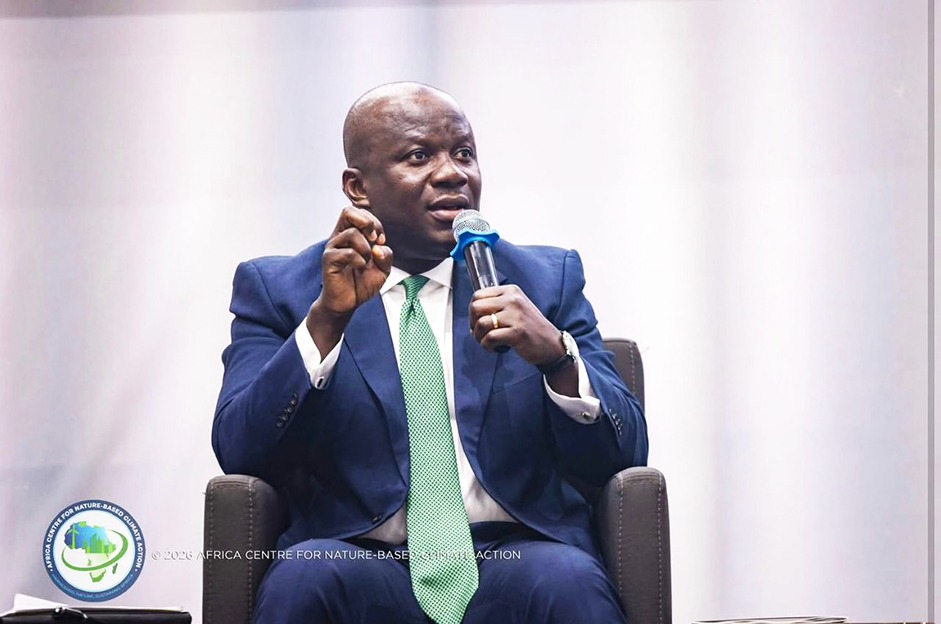
Former Minister for Lands and Natural Resources and Global Lead of the Africa Centre for Nature-Based Climate Action (AC4NCA), Samuel Abdulai Jinapor, has called on African countries to adopt innovative financing mechanisms to unlock the continent’s vast nature-based solutions potential, insisting that governments can no longer depend solely on traditional climate finance.
Speaking during a high-level panel discussion at the Vice-Chancellor’s Lecture held as part of the 2026 Day of Scientific Renaissance of Africa (DSRA) celebrations at the University of Ghana, Mr Jinapor said Africa possesses enormous natural capital, but harnessing it would require bold financing models and stronger partnerships across sectors.
The public lecture, organised by the Africa Centre for Nature-Based Climate Action (AC4NCA) in partnership with the University of Ghana, was held under the theme, “Africa at a Crossroads: Can Nature-Based Solutions Deliver Climate Resilience, Jobs, Equity and Justice?”
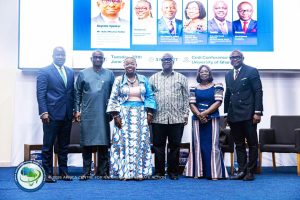
The event formed part of activities marking the 2026 Day of Scientific Renaissance of Africa (DSRA), an African Union-recognised observance dedicated to promoting science, technology, research and innovation as catalysts for Africa’s sustainable development and socio-economic transformation.
Addressing the panel on Nature-Based Climate Action, Mr Jinapor stressed that Africa must diversify its climate financing sources if it is to realise the full benefits of nature-based solutions.
“To unlock the full potential of Nature-Based Solutions, we need to explore innovative and diversified financing mechanisms, including carbon markets, blended finance, private sector investment, green bonds and other sustainable financing instruments that can mobilise the scale of resources required.”
He argued that conventional sources of climate finance alone would not provide the level of investment needed to scale up nature-based interventions across the continent.
Mr Jinapor further noted that governments could not shoulder the responsibility alone, saying effective implementation would require stronger collaboration among governments, academia, the private sector, civil society organisations, development partners and local communities.
“By working together, we can transform promising pilot initiatives into large-scale programmes that protect biodiversity, strengthen climate resilience, create green jobs and improve livelihoods.”
According to him, Africa’s abundant natural resources present enormous opportunities for sustainable development, but success will depend on building the right partnerships, policies and financing frameworks capable of unlocking that potential.
The panel discussion followed a keynote address by the Regional Director for West and Central Africa of the International Union for Conservation of Nature (IUCN), Mr Balla Moussa Sidibé, who urged African leaders to place nature at the centre of the continent’s development agenda.
Delivering the lecture on “Africa at a Crossroads: Can Nature-Based Solutions Deliver Climate Resilience, Jobs, Equity and Justice?”, Mr Sidibé said climate change should no longer be viewed merely as an environmental challenge, but as a development crisis affecting food security, livelihoods, economic growth and human well-being.
He observed that recurring droughts, floods and coastal erosion across Africa were being worsened by ecosystem degradation and poor land-use practices, citing Ghana’s recent floods as an example of how weakened wetlands, degraded watersheds and unplanned development amplify climate risks.
Mr Sidibé described the Congo Basin as one of humanity’s greatest life-support systems, saying its forests, biodiversity and carbon storage capacity demonstrate that protecting ecosystems should be seen as an investment in prosperity, resilience and long-term economic stability rather than an obstacle to development.
He further noted that nature-based solutions present significant opportunities for green jobs, entrepreneurship and inclusive economic growth through ecosystem restoration, sustainable agriculture, ecotourism, fisheries, renewable energy and the bioeconomy.
According to him, Africa’s future depends on recognising nature as critical infrastructure and natural capital capable of driving climate resilience, social equity and sustainable development.
Chairing the programme, the Vice-Chancellor of the University of Ghana, Prof. Nana Aba Appiah Amfo, highlighted the indispensable role of research in transforming societies, stating that universities must be judged not only by the graduates they produce but also by the knowledge they create and the solutions they provide to society.
“History frequently remembers universities for something else: the knowledge they create and the solutions they offer society. It is through research that universities move beyond explaining the world to transforming it,” she stated.
For more news, join The Chronicle Newspaper channel on WhatsApp: https://whatsapp.com/channel/0029VbBSs55E50UqNPvSOm2z