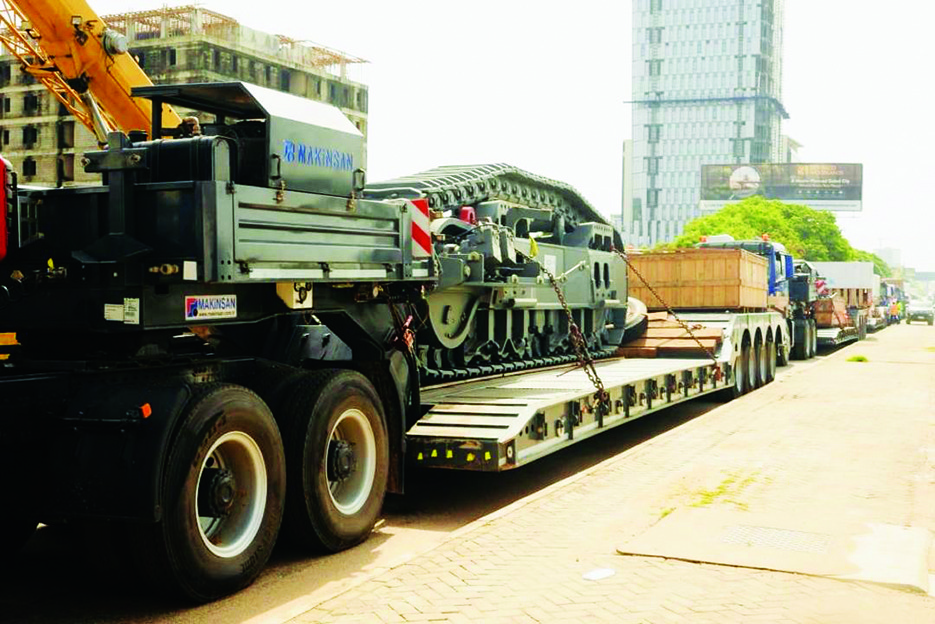
The ongoing transformation of Damang Gold Mine by indigenous operator, Damang Gold Mine Limited, is being touted as a strong justification for Ghana’s growing push towards local ownership of strategic mineral assets, following a massive US$250 million investment in modern mining equipment, aimed at expanding production and improving efficiency.
The development marks a notable shift in Ghana’s mining landscape, where large-scale operations have historically been dominated by foreign multinational companies.
Damang Gold Mine Limited’s investment signals a growing capacity among indigenous firms to compete at the highest level of capital intensive mining operations, a space previously considered the preserve of global mining giants.
The project also underscores the expansion of Dzata Holdings Limited into the extractive sector, reinforcing its position as a major player in Ghana’s industrial and resource development space.
For Ghana’s mining industry, the scale of the investment reflects increasing confidence in local ownership structures and a gradual shift toward Ghanaian-led participation in strategic mineral assets.
The move into full-scale mining operations is backed by decades of experience in mining services through Engineers and Planners Ltd, a leading indigenous contractor with over 30 years of experience in mining support services, civil engineering and equipment operations.
This technical background is expected to provide a strong operational foundation for the transition from contracting services into full mining ownership and production management.
The integration of deep contracting experience with ownership of a producing mine offers a unique advantage in cost control, equipment utilisation and operational discipline.
Industry analysts say the US$250 million investment carries broader implications for Ghana’s mining industry, particularly in terms of competitiveness, localisation and value retention.
First, it signals that indigenous firms are increasingly capable of mobilising significant capital for large-scale industrial investments without relying solely on foreign partners.
Second, it demonstrates a shift toward vertical integration, where Ghanaian companies are moving from service provision into direct resource extraction and production ownership.
Third, the investment may increase pressure on existing operators, both local and foreign, to modernise equipment fleets and adopt more efficient production systems in order to remain competitive.
The introduction of high-capacity excavators and haul trucks also positions the Damang operation to potentially scale up production volumes in line with global demand for gold and other minerals.
The arrival of the first fleet of 52 heavy-duty machines at Damang marks more than just an equipment upgrade; it represents a strategic repositioning of Ghanaian ownership in one of the country’s most important economic sectors.
With an investment of US$250 million, a modernised fleet and a clear expansion strategy, Damang Gold Mine Limited is positioning itself at the forefront of a new era in indigenous mining.
As additional equipment arrives in the coming months and full operations ramp up, the project is expected to serve as a critical test of Ghanaian capacity to manage, scale and sustain world-class mining operations.
Damang Gold Mine Limited, a subsidiary of Dzata Holdings Limited, has commenced a large-scale procurement exercise involving state-of-the-art mining equipment as part of a major expansion drive aimed at boosting production capacity and operational efficiency.
The company, owned by mining entrepreneur Ibrahim Mahama, has committed a US$250 million investment into the acquisition of heavy-duty mining machinery, marking one of the most significant capital injections by a wholly Ghanaian-owned operator in the country’s large-scale mining sector in recent years.
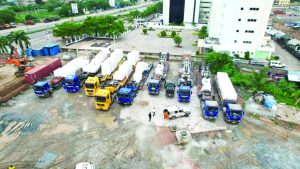
The first tranche of equipment, consisting of 52 heavy-duty machines, is currently being transported to the Damang operational site in the Western Region, signalling the beginning of a phased transformation of the mine’s production infrastructure.
The new fleet comprises a carefully selected mix of high-performance mining equipment designed to support intensive open-pit operations and improve material movement across the mine site.
The equipment includes seven Liebherr excavators, 15 Caterpillar, 395 excavators and 30 triple 777 dump trucks, all of which are widely regarded in the global mining industry for their durability, load capacity and efficiency in large-scale extraction environments.
Industry analysts note that this combination of excavators and haulage trucks is typically deployed in high-output mines where continuous ore extraction, waste removal and rapid material transport are essential to sustaining production targets.
The excavators will be responsible for overburden stripping, ore extraction, bench mining and stockpile management, while the triple 777 dump trucks will handle large-volume haulage of both ore and waste material between the pit, stockpiles and processing facilities.
According to the company, the remaining equipment in the procurement package will be delivered in subsequent tranches over the coming months.
This phased delivery approach is expected to ensure operational continuity while the mine gradually integrates the new machinery into its existing production systems.
The strategy also allows for structured workforce training, equipment calibration and operational alignment to maximise efficiency and minimise downtime during the transition period.
Once fully deployed, the expanded fleet is expected to significantly increase the mine’s overall production throughput and reduce reliance on older or outsourced equipment.
The US$250 million investment is projected to deliver a substantial increase in mining output at Damang, with management focusing on improving cycle times, reducing operational bottlenecks and enhancing ore recovery rates.
The introduction of modern Liebherr excavators and Caterpillar 395 units is expected to improve digging power, fuel efficiency and precision in ore extraction, particularly in deeper and more complex ore bodies.
Meanwhile, the deployment of 30 triple 777 dump trucks is expected to strengthen haulage capacity across the mine, reducing waiting times between loading and transport cycles and ensuring smoother material flow from pit to plant.
Mining engineers note that haulage efficiency is one of the most critical determinants of productivity in open-pit mining, and the addition of high-capacity trucks can dramatically improve overall output when properly integrated into pit operations.
Beyond production gains, the expansion is also expected to generate significant employment opportunities, both directly and indirectly.
The installation and operation of the new equipment will require additional skilled operators, maintenance technicians, mechanical engineers, safety officers and logistics personnel.
Local supply chains supporting fuel, tyres, spare parts and equipment servicing are also expected to benefit from increased demand as the mine scales up operations.
In mining communities within the Western Region, the investment is anticipated to stimulate local economic activity through subcontracting opportunities, transportation services and ancillary business growth.