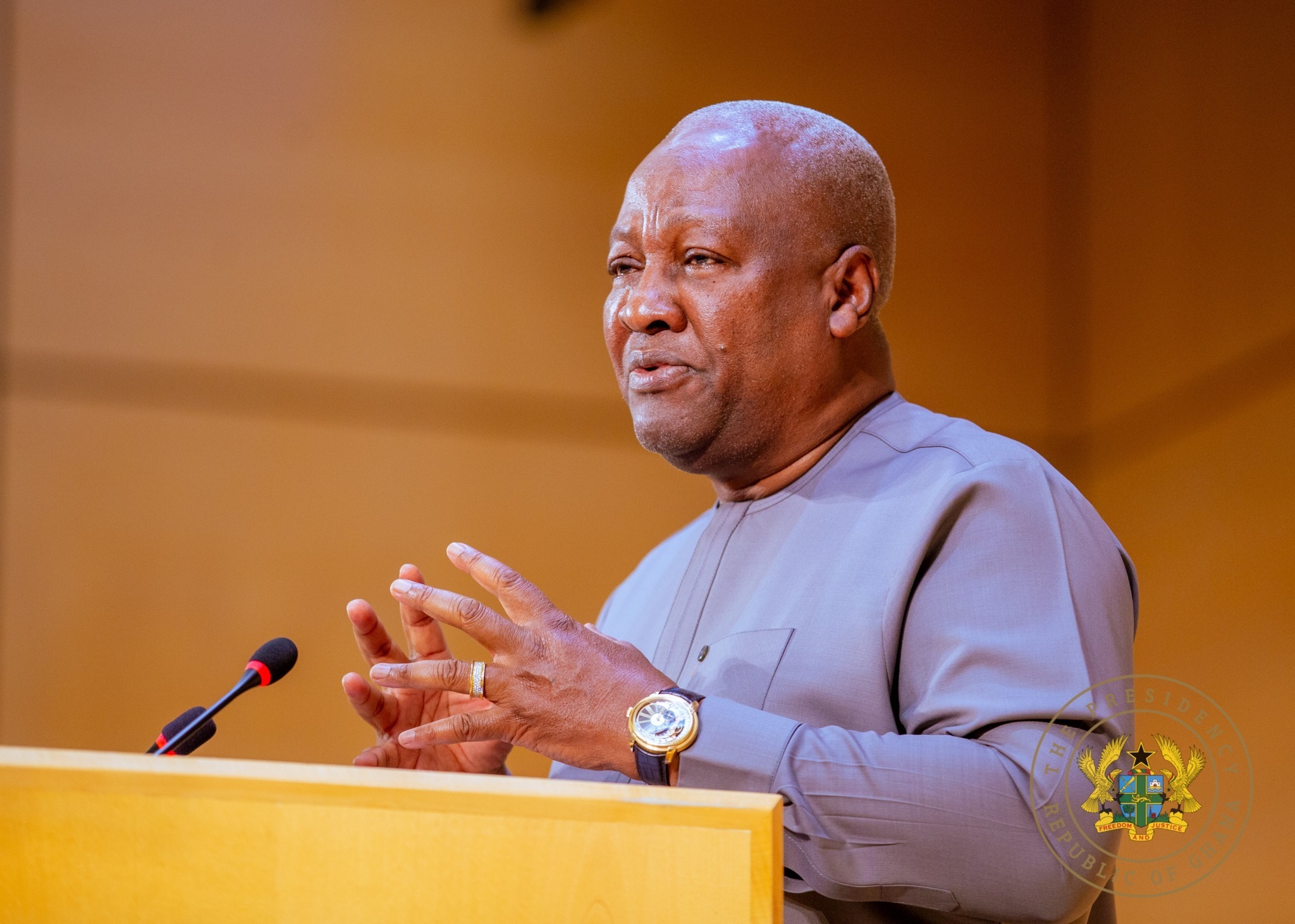
President John Dramani Mahama has announced in faraway Geneva, Switzerland that the removal of the cap on the National Health Insurance Fund has freed an additional GH¢3 billion, equivalent to about $300 million, for healthcare investment in Ghana.
In 2017, the previous government passed the Earmarked Funds Capping and Realignment Act, 2017 (Act 947) to free up public resources and give the government greater fiscal policy flexibility.
This capping policy limited the percentage of tax revenue that is automatically allocated to statutory and earmarked funds, such as National Health Insurance Scheme (NHIS), GETfund among others.
But the then candidate, John Mahama, during the 2024 electioneering campaign promised to set these statutory funds ‘free’, which he did immediately he assumed power in 2025.
President Mahama, who was addressing delegates at the opening ceremony of the 79th World Health Assembly in the Swiss capital, said having freed the funds from the control of the Act passed in 2017 his administration was now focusing on how to eliminate fraud in system.
According to him, his government was leveraging digital technologies, including artificial intelligence, to detect fraudulent claims and improve efficiency within the health insurance system.
He further highlighted the establishment of the Ghana Medical Trust Fund, popularly known as “Mahama Cares,” which is designed to support people suffering from non-communicable diseases such as cancer, cardiovascular diseases, liver conditions and kidney failure.
“Specialised high-cost care should not be a privilege for just a few, but a right for all,” he said.
The President also disclosed that Ghana was on track to transition away from support from Gavi, the Vaccine Alliance by 2030 as part of efforts to strengthen domestic vaccine financing and local manufacturing capacity.
Turning his attention to the world stage, the president called for a fundamental restructuring of the global health financing system, declaring that Africa must move away from dependence on foreign aid and build sovereign, self-sustaining healthcare systems capable of responding to the continent’s growing health challenges.
President Mahama said recent cuts in international humanitarian assistance and overseas development aid had exposed the fragility of Africa’s health systems and underscored the urgent need for reform.
“The old system of donor dependency is past its sell-by date,” President Mahama declared. Adding “these cuts in humanitarian assistance and ODA, as painful as they are, serve as the final clear signal that the old paradigms of dependency must give way to a new era of health sovereignty.”
His remarks come amid growing concerns over declining global health funding following the withdrawal or reduction of support from several major Western economies, including the United States.
According to the President, Ghana alone lost approximately $78 million in health financing after the closure of U.S. aid programmes, affecting malaria interventions, maternal and child healthcare, nutrition programmes, and HIV/AIDS treatment services.
He noted that the abrupt withdrawal of global support has already had devastating effects in some African countries, citing South Africa, where the reduction in PEPFAR funding reportedly led to the closure of clinics and disruptions in HIV treatment services for over a million people.
“By 2030, nine million preventable deaths could occur due to these shifts. It is estimated that the direct consequences of this aid suspension could push about 5.7 million Africans into poverty by the end of 2026,” he said.
Despite the gloomy outlook, Mahama stressed that African countries were not at the Assembly to lament their circumstances, but to chart a new path for the future of healthcare delivery.
The Ghanaian leader used the platform to advocate strongly for the “Accra Reset Initiative,” a movement aimed at promoting African health sovereignty and reforming the global health architecture.
He explained that the initiative was born out of frustrations with a fragmented international health system that often leaves developing countries dependent on donors while limiting their ability to independently finance and manage their healthcare systems.
“I come from a continent that has too often been the subject of global health policy rather than its author,” Mahama stated.
He also criticised what he described as the excessive fragmentation within global health institutions, arguing that many developing countries spend more time satisfying donor reporting requirements than building effective healthcare systems.
“Ministers of Health in the Global South often spend more time writing donor reports than designing and fixing primary healthcare. This is a system that has confused the multiplication of institutions with the multiplication of impact.”
President Mahama further warned against attempts to water down ongoing discussions on reforming the global health architecture.
Referring to proposals before the Assembly, he expressed concern that some reform efforts appeared designed to protect existing institutional structures rather than pursue genuine transformation.
“If we launch a process of reform that is prohibited from recommending actual reform, we are merely performing a ritual. We cannot prioritize institutional comfort over human survival,” he noted.
The President highlighted several healthcare reforms currently being implemented in Ghana as evidence of the country’s commitment to building a more resilient and self-reliant health system.
He said Ghana’s National Health Insurance Scheme currently covers approximately 66 per cent of the population, while a newly introduced free primary healthcare programme is aimed at extending essential healthcare services to underserved rural communities.
He stressed that Africa’s overdependence on imported vaccines and medicines remains a major threat to the continent’s health security.
“A continent that manufactures less than one per cent of its vaccines while carrying 25 per cent of the global disease burden is not sovereign,” Mahama said. He concluded by urging world leaders and international health institutions to embrace bold reforms that prioritise practical investments in healthcare systems rather than rhetoric.
For more news, join The Chronicle Newspaper channel on WhatsApp: https://whatsapp.com/channel/0029VbBSs55E50UqNPvSOm2z