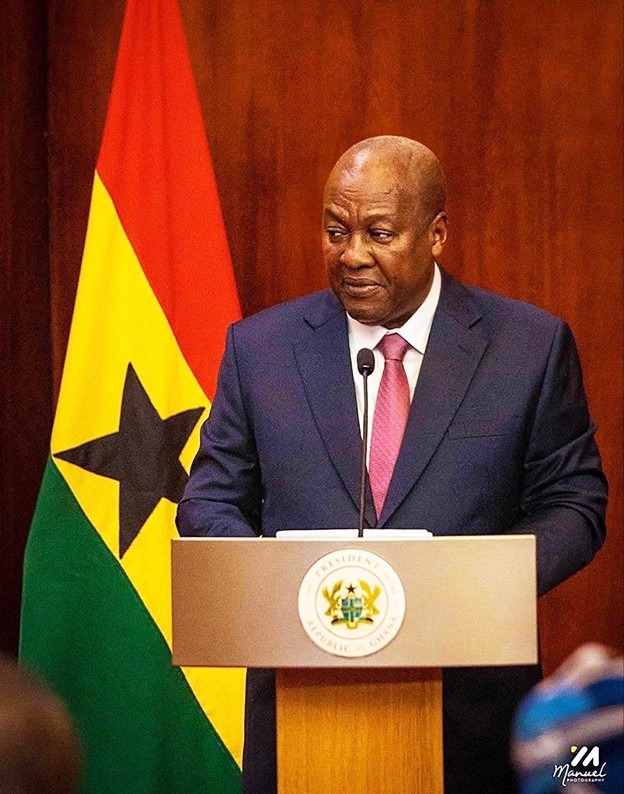
President John Dramani Mahama has declared that Ghana will pursue a human-centred approach to artificial intelligence (AI) development, positioning technology as a tool to enhance — not replace — human capability.
Launching the country’s National Artificial Intelligence Strategy (2025–2035) at a high-level forum in Accra, the President framed the policy as a decisive shift from passive consumption of global technologies to active participation in designing and governing them.
“A simple principle will guide our approach: AI must enhance human capabilities and not diminish human dignity,” he stated.
The strategy, unveiled in the presence of government officials, industry leaders and members of the diplomatic corps, outlines Ghana’s ambition to become a leading AI hub in West Africa, leveraging innovation to drive economic growth, improve public service delivery and strengthen institutional efficiency.
President Mahama emphasised that the global narrative around AI has evolved from fear and uncertainty to opportunity and responsibility. According to him, while earlier debates focused on job losses and technological disruption, countries are now embracing “AI for good,” using policy frameworks to steer innovation toward national development goals.
He cited practical applications already transforming sectors worldwide — including healthcare diagnostics, education, agriculture forecasting, security systems and public administration — arguing that AI is no longer a futuristic concept but an immediate development tool.
“For Ghana, the question is no longer whether AI will shape our future,” he said. “The question is whether we will shape its use in ways that reflect our national priorities, values and aspirations.”
Addressing concerns about job displacement, the President acknowledged anxieties among workers but assured that government policy would prioritise inclusion and workforce adaptation.
“We do not intend to surrender our people to technological disruptions,” he said. “We intend to prepare them to lead in it.”
To that end, he announced plans to invest in large-scale upskilling and reskilling programmes across both the public and private sectors, ensuring that workers are equipped to operate effectively in an AI-driven economy.
The President also underscored the need for leadership preparedness, revealing that ministers and senior government officials had already undergone a National AI Boot Camp to build capacity at the highest levels of governance.
He added that key performance indicators (KPIs) have been introduced across ministries, departments and agencies to ensure measurable adoption and integration of AI technologies.
“Transformation must not remain rhetorical,” he stressed. “It must be measurable, accountable and result in change.”
In a lighter moment during his address, President Mahama referenced emerging AI tools capable of speaking multiple Ghanaian languages and performing creative tasks, noting both their potential and the need to carefully balance innovation with human creativity.
The 10-year strategy is expected to guide Ghana’s AI governance, infrastructure development and ethical standards, aligning technological advancement with national development priorities while safeguarding social equity.
With this launch, Ghana joins a growing number of countries formalising AI policies — a move widely seen as essential to maintaining competitiveness in an increasingly digital global economy.
For more news, join The Chronicle Newspaper channel on WhatsApp: https://whatsapp.com/channel/0029VbBSs55E50UqNPvSOm2z