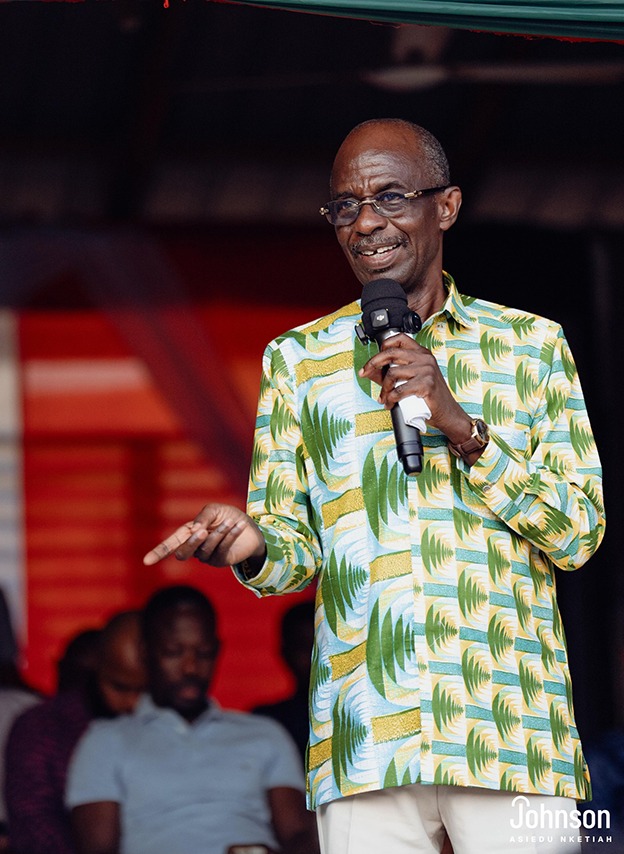
A nationwide survey of constituency executives within the National Democratic Congress (NDC) has revealed a tightly contested and inconclusive flagbearer race, ahead of the party’s 2028 presidential primary.

The study, conducted by Africa Policy Lens, between April 17 and 19, 2026 shows a near deadlock between the two leading contenders – Party Chairman Johnson Asiedu Nketia and Chief of Staff Julius Debrah – with neither candidate able to establish a decisive lead.
Split at the Top
According to the report, Asiedu Nketiah commands 31.9% support among respondents, narrowly ahead of Julius Debrah, who secured 30.1%.
The slim margin underscores what analysts describe as a “structurally balanced” race, with both candidates enjoying solid but limited support bases.
When respondents were asked who they would vote for if elections were held at the time of the survey, the pattern remained unchanged, with Asiedu Nketia polling 32.7% against Julius Debrah’s 30.9%.
The consistency suggests that preferences among party executives are largely firm, with little indication of significant shift in the short term.
The findings point to an entrenched stalemate at the top, with neither candidate commanding the majority required to dominate the race.
Other Contenders Remain Relevant
While the contest appears to be a two-horse race, the survey highlights the continued strategic relevance of other contenders.
Notably, Finance Minister Cassiel Ato Forson, who was identified by 27.1% of respondents as a “closest competitor,” trailing slightly behind Asiedu Nketia’s 29.1% in that category.
Former Minority Leader Haruna Iddrisu recorded lower perceptions of competitiveness, hovering around 15–16%.
This suggests that while direct support for these candidates may be comparatively lower, their influence could prove decisive, particularly in a tightly contested race where second-choice preferences may matter.
Delegates Prioritise Competence over Policy
The report indicates that leadership qualities, rather than policy proposals, are shaping voter preferences within the party.
A majority of respondents cited experience and track record (66.1%) as the most important factor influencing their choice.
This was followed by personal integrity and honesty (56.8%), ability to unite the party (46.8%) and grassroots appeal (46.5%).
Policy proposals ranked significantly lower at 27.9% suggesting that the contest is less about ideological direction and more about credibility, trust and internal cohesion.
Survey Scope and Limitations
The survey covered all 276 constituencies nationwide and drew 2,408 valid responses through a structured SMS-based questionnaire, administered over a three-day period.
Participation was voluntary, a factor the report acknowledges could introduce self-selection bias. Additionally, reliance on mobile-based responses may have excluded individuals without access to digital tools.
However, the study’s broad geographic spread and relatively large sample size provide what researchers describe as a credible snapshot of prevailing sentiment among constituency-level party actors.
Demographic Insights
The respondent pool was dominated by a highly educated, mid-career demographic. Over half (50.5%) were aged between 35 and 44, while nearly 90% had tertiary education.
Regionally, responses were strongest from Greater Accra, the Northern Region, Central, Ashanti, and Eastern regions, areas considered politically strategic within the party’s electoral calculus.
The report concludes that the NDC flagbearer race remains open, despite the early lead established by Asiedu Nketia and Julius Debrah.
“The most defining feature of the current landscape is that neither of the two leading candidates has secured a decisive advantage,” the study noted.
Analysts say the eventual outcome will hinge on candidates’ ability to expand beyond their core support bases and appeal to broader party interests, particularly around unity and credibility.
For now, the race remains delicately poised, competitive, balanced and far from settled.