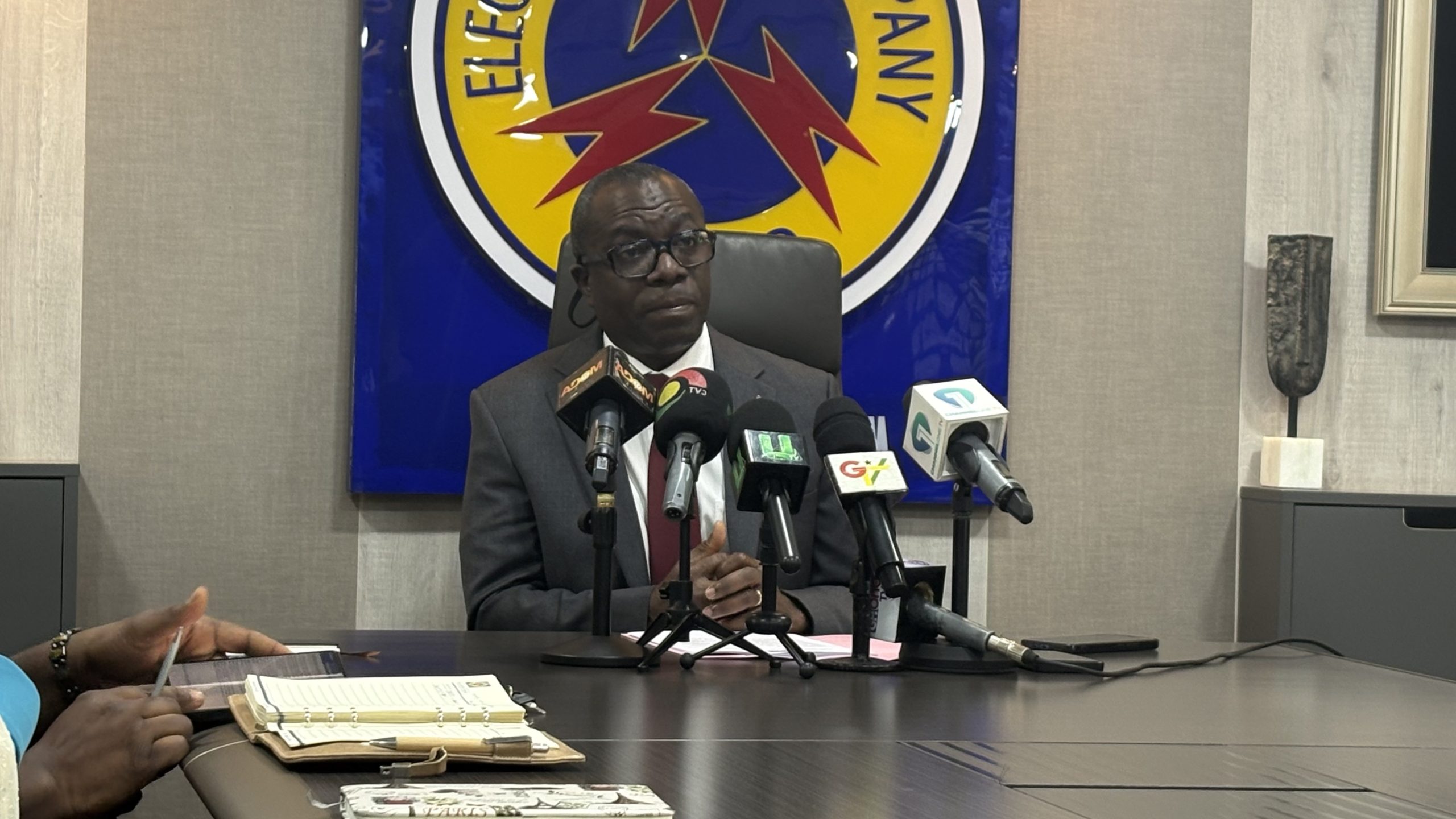
The government is set to introduce an intervention dubbed: “Operation Keep the Lights On” (OKLO), as part of efforts to stabilise electricity supply and address persistent reliability challenges within the distribution network.
This was disclosed yesterday at a press conference in Accra, by the Acting Managing Director of the Electricity Company of Ghana (ECG), Ing. Kwame Kpekpena, who outlined the operational challenges affecting power delivery and the measures being implemented to address them.
According to him, although power supply across most parts of the country has remained relatively stable, some communities continue to experience intermittent outages and low voltage.
He acknowledged the inconvenience these challenges pose to households, businesses, healthcare facilities and educational institutions, noting that ECG does not take these concerns lightly.
Ing. Kpekpena explained that while significant attention has been given over the years to improving generation and expanding transmission infrastructure, the distribution network, which delivers power directly to consumers, has not received adequate investment.
“The electricity does not end its journey at power plants or along high-voltage lines. Its true value is realised only when it is reliably delivered to homes, businesses, schools and hospitals,” he stated.
He attributed the current situation to years of underinvestment and poor planning in the distribution sector, resulting in ageing infrastructure, overloaded feeders, inadequate maintenance, and limited adoption of modern technologies.
These challenges, he said, have led to inefficiencies, frequent outages, technical loses and unreliable power supply.
As part of efforts to address the situation, ECG has developed a comprehensive roadmap, including a phased investment programme valued at GHS 3.46 billion, aimed at restoring reliability across the network.
A key component of the immediate interventions under this programme is “Operation Keep the Lights On,” which focuses on urgent network improvements.
Under the initiative, ECG will undertake the replacement of 1,600 rotten poles in the low-voltage network and install 2,500 treated poles to reinforce the system.
The programme also includes the injection of 2,500 distribution transformers to relieve overloaded networks, as well as the replacement of damaged transformers and associated equipment.
In addition, ECG plans to distribute 28,000 fuses and 240 distribution panels to restore and protect low-voltage networks, alongside the provision of cable termination and joint kits to address underground cable faults
The Acting Managing Director indicated that these measures are designed to stabilise supply in the short term while broader infrastructure upgrades are undertaken.
He highlighted several key challenges affecting the distribution network, including the overloading of transformers and substations due to rapid urbanisation and population growth.
He revealed that ECG recorded the loss of 834 distribution transformers in 2023, which increased to 1,064 in 2024 with only about 300 replaced by 2025.
The remaining damaged transformers forced customers to be transferred to adjacent units, further worsening network overload and reliability.
He also pointed to the presence of deteriorated wooden poles across both low and high voltage networks, describing them as a major safety and reliability risk.
Vegetation encroachment and the impact of illegal mining activities, particularly in the Western and Western North regions, were also cited as factors hindering maintenance, fault restoration, and new construction.
On funding, Ing. Kpekpena noted that many critical infrastructure projects, including substation construction and network reinforcement, had stalled due to financial constraints.
However, he indicated that following Cabinet approval for ECG to retain 20 percent of its collections, including a ring-fenced 3 percent for capital investment, and the injection of over GHS 1.2 billion into the sector, contractors have been re-engaged, with construction expected to resume from May 2026.
He further noted that in some regions, including Volta, Oti, and Ashanti, voltage challenges are linked to limitations within the national transmission grid, requiring coordinated interventions involving the Ghana Grid Company (GRIDCo).
As part of broader efforts, ECG has outlined additional short- to medium-term and long-term investments, including the construction of new feeders, upgrading of existing infrastructure, and deployment of modern technologies such as drones for network inspection.
The Acting Managing Director also provided updates on area-specific interventions, including major reinforcement projects in Kumasi, transmission upgrades in the Volta and Oti regions and targeted improvements in communities such as Enchi, Mpohor, Kasoa, and parts of Accra East.
He noted that ECG has developed a detailed activity schedule covering April to September, 2026 to guide the implementation of these interventions, supported by monitoring and reporting mechanisms to ensure accountability.
Ing. Kpekpena apologised to customers who have experienced prolonged outages, assuring that addressing reliability challenges remains ECG’s top operational priority.
He added that steps are being taken to improve communication, response times, and customer engagement.
“The challenges we face are real, complex, and in some cases, the accumulated consequence of years of underinvestment… but we have a plan, we have a schedule, and we are committing all our resources to execute it,” he stated.
He reaffirmed ECG’s commitment to keeping the public informed and welcomed the role of the media in holding the company accountable.
For more news, join The Chronicle Newspaper channel on WhatsApp: https://whatsapp.com/channel/0029VbBSs55E50UqNPvSOm2z