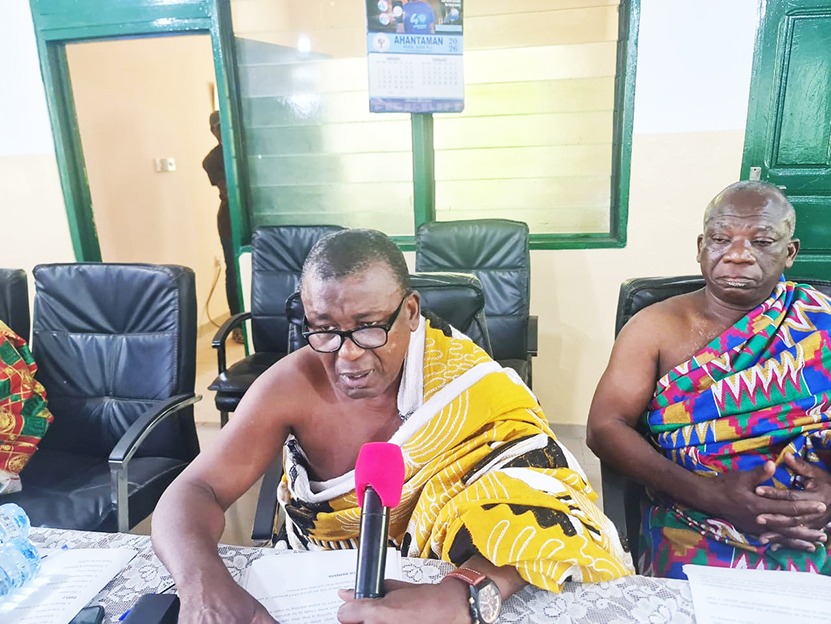
The Vice President of the Western Region House of Chiefs (WRHC), Nana Kwesi Agyemang IX, has called on government to expedite action on the proposed restriction on the export of raw rubber, warning that delays are crippling local processing factories.
Speaking to journalists, Nana Agyemang urged government to urgently lay a Legislative Instrument (LI) before Parliament to give legal backing to the restriction on raw rubber exports.
According to him, the absence of concrete legislative action is undermining government’s own policy direction announced in the 2026 Budget.
“Government announced in the 2026 Budget that it would restrict the export of raw rubber this year. Two three months into 2026, however, there is no trace of a Legislative Instrument to enforce the restriction. We are calling on government to speed up the process to demonstrate seriousness,” he stated.
The WRHC at its sitting last Year November unanimously called for total ban of the raw rubber exports. The president of the House, Nana Kobina Nketiah read the resolution by the House. He noted that several processing factories depend on consistent supplies of raw rubber to operate efficiently, create jobs and contribute to national revenue through value addition.
However, the growing trend of exporting raw rubber, he said, is depriving these factories of the materials needed to sustain operations.
“Our local processors are being denied the raw rubber they require. If this continues, it will affect jobs, production levels and ultimately government revenue,” he cautioned.
Nana Agyemang stressed that the swift passage of the LI would not only protect local industries but also ensure that Ghana maximises the economic benefits of its rubber sector through processing and export of finished products rather than raw materials.
He described the delay in laying the LI before Parliament as worrying and urged authorities to treat the matter as urgent in the interest of the rubber industry and the broader economy.
The traditional leader reiterated his support for government’s stated intention to restrict raw rubber exports, but emphasised that policy declarations must be backed by immediate legislative action to have the desired impact.
Speaking at the Annual General Meeting of ACLANGO, a congregation of Nzema chiefs whose lands Ghana Rubber Estate is operating, Nana Kwesi Agyemang called on government to impose a ban on the export of raw rubber to safeguard local processing factories and maximise economic benefits for Ghana.
According to Nana Agyemang who is also the chairman of ACLANGO, the increasing export of unprocessed rubber was depriving local processing companies of critical raw materials, threatening jobs and weakening the country’s efforts to build a strong value-addition industry.
“There are about seven rubber processing factories currently in operation, and these factories need more raw rubber to function effectively. Unfortunately, some individuals are exporting raw rubber instead of supplying local factories. We are, therefore, calling on the government to place a complete ban on raw rubber export so that we can process more locally and generate more revenue,” he said.
He praised GREL for its continued investment in host communities, noting that the company had significantly improved livelihoods through the provision of social infrastructure. “GREL continues to provide our communities with good drinking water, schools, community centers and other essential facilities. We are deeply grateful for their support and pray that this partnership will continue for many years,” he said.
The traditional leader also commended the company for responding to farmers’ concerns by establishing additional weighing centers to ease the burden on rubber producers. However, he appealed for more centers to be created to improve access and reduce delays.
“The more weighing centers we have, the better it will be for our farmers, as it will reduce their suffering and improve efficiency,” he stressed.
Nana Agyemang further raised alarm over the growing threat of illegal mining, popularly known as galamsey, which he said, was destroying rubber plantations and endangering farmers’ livelihoods.
He called on government to intensify efforts to combat the menace and warned that chiefs found to be involved in illegal mining would not receive the Association’s support if arrested.
“The activities of galamsey are seriously affecting rubber plantations. We urge government to act decisively. Any chief involved should desist immediately. The Association will not come to the aid of anyone who engages in such illegal acts,” he cautioned.
He also expressed appreciation to GREL management and government for their continued cooperation with traditional authorities and rubber farmers, describing the partnership as essential to the growth and sustainability of the rubber industry.
Nana Agyemang urged more farmers and stakeholders to join efforts to strengthen the sector, emphasizing that unity and collaboration remained key to securing a prosperous future for rubber-growing communities.
For more news, join The Chronicle Newspaper channel on WhatsApp: https://whatsapp.com/channel/0029VbBSs55E50UqNPvSOm2z