
The Minority Leader in Parliament, Alexander Kwamena Afenyo-Markin, has accused the ruling National Democratic Congress (NDC) of political deception over its handling of the controversial anti-LGBTQ+ bill, claiming the party exploited the issue to secure electoral victory, but has since abandoned its commitment to pass the legislation.
Addressing a press conference in Accra to mark one year of Minority scrutiny of Parliament, Mr Afenyo-Markin said the government’s sudden shift from its earlier hard-line position exposed what he described as hypocrisy and bad faith.
“The NDC used the anti-LGBTQ+ bill to win power and is now running away from it,” he said, accusing the government of deliberately denying Ghanaians a law it had once insisted was urgent and non-negotiable.
According to the Minority Leader, while in opposition, the NDC publicly demanded the passage of the anti-LGBTQ+ bill, arguing that it was necessary to protect Ghana’s cultural and religious values.
He said the party aggressively engaged the media and mobilised public sentiment around the issue, only to retreat after assuming office.
“One year down the line, we hear the President say the government is conducting wider consultations to see how the law can be better formulated. That is not the same law they said must be passed without delay,” Mr Afenyo-Markin noted.
He further alleged that after Parliament had followed all due processes and approval had been granted, the Majority Leader used procedural tactics to claim there was no valid approval by the Speaker, effectively stalling the bill.
“As we speak, the government has refused, neglected and deliberately denied the people of Ghana the very anti-LGBTQ+ law they promised,” he said.
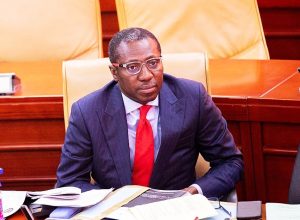
Mr Afenyo-Markin also accused the government of attempting to introduce sexual rights concepts into school curricula, describing the move as inconsistent with its stated position on protecting Ghanaian values.
“When official government documents are printed, separated and signed by a sector minister, you cannot later describe them as an anomaly. It was only through the vigilance of the Minority that this was exposed,” he said.
Beyond the LGBTQ+ debate, the Minority Leader criticised the government’s economic record, dismissing claims of prudent management and attributing recent macroeconomic improvements to external factors rather than policy competence.
He argued that Ghana’s current stability was largely the result of the International Monetary Fund (IMF) programme, debt restructuring agreements and favourable global commodity prices. According to him, fiscal consolidation had been achieved through expenditure cuts that had weakened critical social services.
He cited debt relief arrangements involving official creditors, including China, France, the United States and the United Kingdom, which he said had temporarily improved Ghana’s outlook but failed to address deeper structural weaknesses.
On the Gold-for-Reserves policy, Mr Afenyo-Markin said the Minority was not opposed to the concept, noting that it originated under a previous administration.
However, he criticised the government’s decision to make the Gold Board both regulator and operator, warning that it could encourage illegal mining activities.
He referenced an IMF report indicating losses of about US$240 million as of September 2025, questioning the role of the Bank of Ghana in underwriting transactions that exposed public funds to exchange-rate risks.
“How can public money be used to buy gold, incur losses, and then be described as the cost of policy?” he asked, calling for immediate corrective action by the Central Bank.
Touching on foreign policy, the Minority Leader warned that Ghana could no longer rely on traditional assumptions about global cooperation, arguing that economic leverage and protectionism were increasingly shaping international relations.
“For a smaller economy like Ghana, this is a direct challenge,” he said, calling for economic sovereignty, diversified partnerships and a foreign policy rooted in constitutional values.
He also criticised what he described as selective justice, alleging that former officials of the New Patriotic Party were being pursued aggressively while figures associated with the ruling party faced little scrutiny.
“When the law is applied according to political colour rather than evidence, it ceases to be the rule of law,” he said.
Mr Afenyo-Markin concluded by reaffirming the Minority’s role as Parliament’s watchdog, pledging to continue holding the government accountable.
“The future of this country is at stake. We will insist that this government acts by the principles it preached before coming into office,” he said.
For more news, join The Chronicle Newspaper channel on WhatsApp: https://whatsapp.com/channel/0029VbBSs55E50UqNPvSOm2z